Showing posts with label string test. Show all posts

Thursday, 15 December 2016

Oldie: 1970s Head Master Aluminium

After decades of hearing from his old man on how well the old aluminium stick played, a young chap finally dusted off his dad's old racket and asked if I could restring it.

"With full poly", he asked.

I always have a thing for oldies, such as:
My 30+ Years Old Slazenger Woody
Another 30+ Years Old Racket By Head
Oldie: Yonex R-10
Yonex Couguss II
Exploding Woody - 1980s Slazenger Vilas

So I accepted after the usual disclaimers and upfront payment.

I'll let the pics do the talking...


I had a session with the chap. The racket was very flexible and comfy. Despite it's strung and gripped total weight of about 380 grams, it was not that difficult to whip this around. 

Even serves were good! I managed an out-wide ace!

Strangely, with a head size of probably 60+ sq inches, coupled with a dense 18x18 string pattern, the string gaps were still large enough to generate more than enough spin to match today's spin effect sticks! I attribute that to the soft flex and heavy swingweight. (link)

The young chap did not fancy this racket, so he traded it with me for something else he liked. 

Glad to add another nice find to my collection!


Thursday, 31 March 2016

String "Timing"

Being a former high string tension user myself, I now advise others to string as low as they can still control the ball with.

By high-tension in today's viewpoint, I mean 60 lbs and above with full poly or most poly hybrids.

Dropping tension has more advantages than disadvantages. While not everyone would be able to adapt, most should find no big problems, with only slight changes in their swings. 

With full permission from this chap I have been speaking with, I reproduced below what I thought was an interesting myth regarding tension and accuracy. Let's call him "K".

For as long as I can remember, K has been stringing his 16x19 stringbed with full 16g poly at 68 lbs. K is a strong guy. He hits hard and snaps thinner poly strings frequently.

Like many hard hitters, K prefers his stringbed as dead and as low-powered as possible. He believed in minimizing all power variables and allowing himself to be the sole power generator. Thus maximizing control and accuracy.

We couldn't find any paper with us, hence we drew on the back of an envelope...

Below is a graph depicting string "Pocketing Depth" vs "Time". Time "0" is when ball impacts stringbed.

"A" is a soft string, like natural gut or multifilament.
"B" is a stiff string, typically poly.
Both "A1" and "B1" show the respective string's rebound after it has lost tension. 


So, when freshly strung, the softer string "A" offers more pocketing than the stiffer "B". As a result, the dwell time, or how long the ball stays on the string, is longer for "A" and shorter for "B" too. This is true even after "B" loses tension to become "B1".

In K's opinion, the shorter the dwell time, the better. 

If you refer to the bottom half of the above drawing, it shows a right-hander hitting a ball with a racket. The contact point is "X", and "Y" is the point where the ball leaves the stringbed. So the time between "X" and "Y" is the dwell time.

K's argument was, since the ideal ball impact location is way in front of our body, a long dwell time would mean the ball leaving the strings too late. By then, the racket face would have rotated inwards. The shot would go left instead of straight.

That was the only complaint K had.

So I did some simplified calculations with him to prove my point:

Average dwell time generally accepted: 5 milliseconds
K's fastest swing speed: 78 miles per hour
5 ms = 5/1000 second = 0.005 second
78 mph = 124.8 km/h = 124800 m/h = 2080 m/min = 34.67 m/s

So, during the duration of the 5 ms dwell time, based on K's swing speed, his racket would have travelled a distance of:

34.67 metres per second  X  0.005 seconds
= 0.17335 metres or 17.335 cm or 6.82 inches

My point is, all K needed to do, was to chase the ball forward with the racket, or even upwards for topspin, after impact.

6.8 inches is slightly less than the diameter of three tennis balls. Perhaps that's why coaches keep barking:

"Hit through the ball"

"Visualize hitting through 3 or 4 tennis balls"

Whether it is a string tension problem, long dwell time problem or swing timing problem, I left it for K to mull over.


Thursday, 21 January 2016

Divorced Mains and Crosses

Despite suffering a serious bout of tennis elbow from dead poly, M still could not give up the spin. So he wanted gut/poly to see if the comfort would increase.

To isolate variables, we tried different setups on similar matched racket. Among them, there were two gut/poly hybrids that caught my attention.

Strangely, one played dead from the start while the other played perfectly.

The dead one felt too tight, like it was over-tensioned. We could not load the strings. There was no pocketing, no dwell time. The ball just "touched and flew off". 

M felt he did not have enough time to spin nor shape the shot. This was done only in the the low 50s lbs. I figured it may need some time to break-in.

The good one performed perfectly from the first hit. As expected from gut/poly, it was comfortable, powerful, fast, spinny and had great control. However, it did not last long. Maybe 2 sessions?

Since gut was not cheap, M continued playing with both.

After several sessions with others, we met up and played again. When hitting with both setups, the pocketing had grown so deep it felt like a fishing net!

But yet, after it reached it's maximum stretch, we could feel the strings deflecting the ball back out. The dwell time was long and extended. Both were still playable but rebound angle was high.

Then it dawned on us, that it could be because one string of the hybrid had completely lost tension. Most likely the poly. The other string was actually doing most of the work during ball impact!

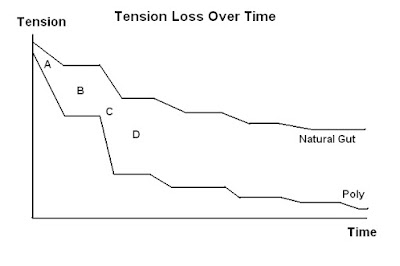
Probably something like this chart below?


At point "A", both strings start to lose tension right off the stringing machine. Poly's loss is higher than natural gut.

"B", "D" and the other horizontal lines indicate rest periods where the racket was left unused in a room.

The second big tension drop occurs during "C", which was the first session of play after stringing.

Regardless who strings the rackets, both "A" and "C" would always register the biggest tension loss. Subsequent drops would be slow and gradual.

So, it seems that the poly in M's setup could not hold tension. And the tension gap between the gut and poly had grown too huge. So huge, that their actions during ball impact became divorced, with one string doing almost all the work and the other idling.

And how did I know this feeling? 

I once strung up only the mains on an old test racket and hit some balls with it...


Thursday, 17 December 2015

Budget Natural Gut

If natural gut could be made more affordable, then there would be much less arm injuries.

Maybe, more than half of the current string brands could also close down due to poor demand.

Other than price, there is nothing to hold anyone back from trying or using natural gut. That string alone is capable of elevating anyone's game. Natural gut excels in power, control, spin and comfort like no other.

That's why the lure of cheap gut is irresistible... (Thanks to Cullin Kin for sharing his review here)

As with most new strings, I like to weigh them and check the exact gauge. It's 14 grams for half a set of this budget natural gut. That's very heavy.


Although touted to be 16 gauge, it measured closer to 1.50mm. That's about 14L or 15 gauge! Thick!


The string felt much stiffer and coarser than all other natural guts I had tried. Whatever coating it had appeared very little and somewhat inconsistent. There were many "weak spots" where the gut had no coatings at all.


Coil memory was minimal. It just expanded apart when the cable tie was cut.


From the packing, the string was downright oily! Probably had as much oil as my breakfast bacon. Did they deep fry the natural gut before packing it?!?


Took a few pieces of tissue just to wipe off most of the oil. If not cleaned properly, it would wreck havoc on the string clamps and gripper later on during stringing.

Despite that, more oil seeped out from the string during tensioning. So it became - thread, wipe, tension, wipe, wipe...


Compared to any other natural guts, this had very little elongation during tensioning. It felt stiff, like a poly.

Most of the whitish spots in the close-up pic below were weak spots with almost zero coating. Just plain natural gut fibres twisted together. It held up well after tensioning though.


Strung as a gut/poly hybrid in a 16x19 frame at 52/48 lbs, it played terribly.

The stringbed responded ONLY to all out 100% full swings. Shots hit softer felt dead, stiff and boardy. Nothing like natural gut at all. It resembled dead full poly more than a fresh bed of gut/poly.

Giving it a benefit of doubt, my friend clobbered balls against the wall to see if the string would "break-in". But it remained dead, even after several hours of play over a few sessions.

So we moved on to try another pack that measured thinner although all were labelled as 16 gauge.

Gauge was inconsistent throughout that same piece of 6.5 metres half-set. Some parts measured 1.25mm, other area about 1.40mm.


Fortunately, this second pack was overall thinner than the first pack we tried. However, 16 gauge would mean about 1.30mm, or 1.32mm at most. This 1.40mm diameter would still put it squarely into the 15 gauge category. So gauge wise, it remained unacceptably inconsistent to me.

Using about 3 feet from the end, I pulled tensioned at 52 lbs, marked and measured the elongation and let it stay under tension for about 10 minutes. The creep, frequency and string diameter all behaved close to other natural guts I have used.

To ensure consistency with the first pack, this was strung in another identical frame, with the same poly cross, at the same tension and with the same tie-offs. Literally ceteris paribus.

Even during stringing, I could tell this would play much better. The string no longer resisted stretching like a poly. It was much softer and pliable.


However, the inconsistent gauge seemed to affect elongation slightly. Within the 8 centre mains, which are very close in length (due to the Yonex isometric head shape), the same amount of slack provided for near the string gripper DID NOT allow the tension arm to be as near parallel as it should.

Translated, this meant there would be "hot spots" on the stringbed that may be exceptionally lively and powerful. And there would be "dead spots" where the gut would yield less and have less power. All within just the centre 8 main strings.

The chap whom I strung this for, M, seemed to enjoy this setup very much. While the performance could not be rated similar to better guts, the price/performance ratio was good enough for him to consider converting to this setup. It all depends how long the playability would last.

Exactly what I meant when I mentioned the lure of cheap gut earlier.


Monday, 30 November 2015

Bad Batch of Strings?

It's the school holidays and I was busy with a lot of stringing and customizations. One after another. Almost non stop. 

With the Black Friday sales and Christmas mood, many were testing new string setups. Almost all wanted more spin.

Strangely, there was one poly string that kept snapping during tensioning. After the initial string snap, every single grommet hole was scrutinized thoroughly. All was in order.

The string gripper and clamps were stripped apart, cleaned and checked before re-assembling. 

The poly string was also examined for kinks, nicks or other damages. None were found.

But when I applied tension on the mains, it just snapped. Not very tight, just 50 lbs on a 1.23 mm shaped poly.


Sustained a small cut on my left arm from the string lashing. Guess this is all part of stringing. Another reason why I just cannot like poly...

Should be a bad batch since I cut it out from the reel. At least it was not as bad as my previous lashing (link).


Wednesday, 23 September 2015

A Very Close Shave...

A competitive player asked if I could help him fine tune his strings setup.

Both his coach and himself claimed he was hitting well. They attributed the control issues he faced to the strings.

However, he liked his current 1.10mm thin poly strings. Better bite, more feel and more spin, he said. Well, common sense dictates - thicker string, more control right?

But instead, they wanted to increase the string tension on the 16x19 frame. By 10 pounds! To 72 lbs! I felt dizzy just listening to him mentioned THAT number!

As usual, my way of dealing with this pesky behaviour was to quote an insanely ridiculous price (link), hoping to turn him away diplomatically.

But he accepted! And paid upfront! Oh my goodness!!!

Before stringing, I put on a long sleeve shirt to protect my arms. While tensioning, I kept my face away from the racket as far as possible. But it was still not enough...

While pulling the outer mains, the string snapped! The flying clamps flew!

And the string that was under tension, whipped around and lashed me across my neck, chest and left hand. If NASA recorded some earthquake-like shock waves from Asia, it was my scream! 

OUCH...!!!

My first knuckle on my left hand and ring finger turned numb. 


It felt like my skin has split open. Took off my shirt to check, and saw my neck received a lashing as well.


Super lucky it missed my face!

Next time anyone wants high tension with thin strings, it would be US$2,000,000.00. Per racket! Upfront! In cash!


Wednesday, 19 August 2015

Signum Pro Poly Plasma (SPPP) ...again...

Since I was given quite a few packets of SPPP, I thought I'll just continue testing this string to see how to make it work. 

This time, I strung it straight-up at 40 lbs based on feedback from my previous attempt. (link) If you look carefully at the pic below, it was done two piece with four knots this time.


Even at this low tension, the extreme low-power remained. I passed this racket around my partners. None liked it. Not even those who were previously fascinated by SPPP's legendary tension holding. Neither those who gave me the string.

Comments mirror those from the previous attempt:
- too low power (note my racket's stock SW is 331)
- low spin
- stiff, uncomfortable strings
- need to bash the ball
- very difficult to serve

I persisted using this up to 8 full hours of play to see if there would be any change. Still equally dead, lifeless and very low spin regardless of type of balls used. My shoulder and elbow ached.

So I decided to try it one last time in my very open 10x19 string pattern. (link) This string pattern needed really strong strings!


Such an open pattern would really stress the strings and help me load the ball with my measly swing! Even kevlar mains (link) lasted only 2+ hours in this racket!

Well... it did perform much better! The power could easily match any string setup in an AeroPro Drive. 

Ball rebound and launch angle was only slightly higher than normal. This clearly indicated SPPP's incredible stiffness and tension holding. It did not yield much.

Once I adapted to the power and ball rebound angle, I started whipping the racket to test spin. 

It was very, very good! 

Even with its incredible power levels, almost trampoline-like, all out forward drives sent probably only 5-10% of the shots out. Most curled down in time, neatly between the service and baseline in my partner's court, then jumped about 45 degrees upwards and forward, reaching my partner's head height before descending.

By then, they were hitting the ball somewhere between the baseline and the back fence. The topspin kicked my shots about 2+ metres before my partner could hit it.

Even after 10 minutes of hitting, my partner could not get the ball timing right due to the excessive spin. It was very difficult to read and anticipate where the ball would land and how far it would jump.

Hey! Even my backhand was working super well! I could hit winners, crosscourt or down the line, when I was a little late for the ball. The power helped!

No noticeable drop in tension nor control was sensed after about 20 minutes of heavy, intense groundstrokes. So I tried serves.

Both flat and spin were good. I had little problems aiming for corners. For once in my life, I could hit topspin serves like what I saw on TV! Offensive, powerful, fast-paced and high-kicking topspin serves! The combination of power and spin in the stringbed was perfect!

My conclusion?

If you think you are a very hard hitter, this string would suit you fine. Else, reserve it for rackets with very open string patterns. Or you may find your ego very quickly and harshly tamed.


Thursday, 6 August 2015

Signum Pro Poly Plasma (SPPP)

Someone whom I string for became curious about this string. He gave me a few sets and asked for my opinion in return.

It was strange that he asked me, a known non-lover of poly (link), to help him assess the strings.


Online reviews have been mixed. Some claim SPPP plays soft and comfortable, while others felt it played stiff and dead. Many suggested tensioning it really low, like low-mid 40s lbs since the tension holding was very good.


After examining the string and taking some measurements, I decided to do up a full bed using proportional stringing (link) averaging about 48 lbs. I need all the power and comfort I can get...


Initial Impressions

- This is a stiff poly with very good tension holding indeed.
- The texture was not as slick as newer polys but neither is it rough nor textured. Just round.
- Most other polys would "slip" through my fingers as I weaved, but this string did not. So I figured the "ball bite" friction should be good for this string.
- Overnight, tension by frequency dropped only about 15 hz, which was impressive since most polys I tried loses about 40+ hz overnight unplayed.

Warm Up Rallies
- Only a very slight softening was felt after half an hour.
- Power was low and pocketing was minimal.
- An abnormally large number of shots hit the tape on the net. To me, this was another indication of its low power and correspondingly, a very low angle of rebound. Most of my shots normally clear the net two to three feet above.
- Control was decent but I struggled with spin. As a result, when I tried to step up the pace, the ball flew long.

Game Play
- Serves were very easy to place due to the tight stringbed. While I could hit down the "T" or out wide quite often, the pace was significantly slower than with other poly strings I used. 
- From my side, the serve did not feel offensive enough. I preferred a little more power, so I reduced the spin and hit flatter serves. Then it looked better.
- Return of serves revealed something very interesting to me. When contacted right at the sweetspot, ball impacts felt exceptionally nice, soft, comfy and powerful. But the ball flew long. Not up, but low and long. Even with follow-throughs above my shoulder.
- I noticed the same problem when returning very hard flat shots from my partner. "Trampoline" came to my mind. But only dead centre on the sweetspot. Other areas felt flat and stiff.
- This "trampoline" effect could be due to string loading, string timing and racket timing. Hard incoming shots, like serves, added a lot of "punch" to the stringbed, even with my compact swings. 

- This loaded both the strings and the very flexy racket. However, there was a huge rebound timing difference between the strings and the racket, resulting in this "loss of control" feeling. Since I cannot adjust the racket flex, I need to fine tune the tension to minimize this timing gap (link).
- With almost any poly, volleys and touch shots were dead. No exception with SPPP. Totally devoid of feel and feedback even with full proportional stringing. So dead I kept volleying easy shots into the net or out long!
- Long-drawn points were disadvantageous to me since I realized the string and racket flex timings were totally out. Neither could I rely on topspin as I either could not load the strings, or I ended up hitting too clean on the sweetspot. Again, the result was either into the net or out long.
- I found it was very difficult to play with this setup. But keep in mind, I have always preferred syn gut.

Overall
- To me, the greatest strength of this string was also it's worst flaw: tension holding.
- I doubt it was the ingredients. Highly suspect this string was heavily prestretched in the factory, hence its impeccable tension stability, both overnight after stringing and after the initial session of play.
- If it was indeed prestretched, it should have been indicated on the packaging. Then I would have strung this completely differently. Discovering, or suspecting this after stringing it up was very disappointing.
- That said, all was not lost. To those very hard-hitters looking for tension stable polys, or to tame very powerful stiff rackets, this string would be an exceptionally good fit. Just a straight-up full bed somewhere in the mid-40s to mid-50s lbs would suffice.
- If I were to try this string again, I would probably go for 40 lbs or less. That's how meek my swing is!


Monday, 13 July 2015

ProStaff 6.0 85 with Full Poly

This racket elicits strong emotions from everyone. Those who have used it, keeps reminiscing about how well it felt and played. Those who have not tried it, could never resist the urge for a few swings.

The most dramatic incident I encountered while playing with a ProStaff, was a verbal lashing from an elderly man. 

Within minutes of taking this racket on court, he started scolding me for using that stick because I was not Pete Sampras. Then proceeded to grab/pry the stick from my hands, wanting to teach me how to wield it properly.

I held firmly, stood still and calmly asked:
"Then are you Pete Sampras? I don't think so. You would not know how to use this racket too. Please leave."

Despite having played for only about 20 minutes, he packed up and left the courts. 

I must have been doing great injustice to the ProStaff...


Having done full syn gut (link) and gut/poly (link), the next step would be to try how full poly would play in this 80/20 graphite/kevlar composite racket. 

I was curious how much spin could I extract from this old faithful? And how much more difficult to use would poly make this racket?

Nothing could compare with gut/poly. Against full syn gut, surprisingly, full poly was only marginally more demanding. Sweetspot size felt the same. Power was very close. Control was slightly better.

I thought it would have been a no contest against syn gut and was prepared for a lot of hard work. But it wasn't. Although I had mis-hits and framed shots, those that caught the stringbed were enjoyable - baseline rallies, high forehands/backhands, swinging volleys, drop shots, serves and return of serves.

Makes me wonder if the softness and playability of the latest poly strings has surpassed syn gut?

The choice to use the thinnest gauge (1.10mm) poly was good. It added a lot of spin which covered some of my other deficiencies. So I focused on hitting deep and spinny and got away winning the first set, although the energy expended on the heavy frame felt like I have already played several.

Still, if anyone wants to continue to use this antique piece, gut/poly is the best only way to keep it fit for use in today's fast-paced game. Even then, I would not suggest anyone use it for serious matches. Only for training and friendlies.


Tuesday, 2 June 2015

Racket-holics Anonymous

"We admitted we were powerless over alcohol new tennis rackets - that our lives had become unmanageable." 
(adapted from "The Twelve Steps of Alcoholics Anonymous")

Not only am I a struggling racket-holic, my addictions include:

- strings-holic,
- tension-holic,
- hybrid-holic.

With greater affluence, many are actively trying new frames and strings. To some, this gives as much pleasure as playing the game itself. 


What puzzled me was the furious pace at which these players change equipment and setups. On local online forums, it is commonplace to see ads like:


"Latest model racket for sale, used for only one session, condition 9.9/10 totally unscratched, plastic wrapper still on handle, selling cos unsuitable for my play"


Despite seriously meddling with my "new" ProKennex Black Ace 98 for almost two years, I am still discovering new things about the racket!


Here's just a portion of what has been attempted in the Black Ace 98 from June 2013 to June 2014. My racket discovery process, so to speak:


Low Tension with Syn Gut @ 35/34 Boxed


Black Ace 98 Overhauled


Low Tension with Syn Gut @ 28 lbs


Skipping Crosses for 16x10


Grass Trimmer Line


0.90mm Fishing Line/Syn Gut Hybrid

Fishing Line/Poly Hybrid

Fishing Line/Poly/Multifilament Tri-brid

1.0mm Fishing Line/Syn Gut Hybrid

Another Fishing Line/Poly Hybrid

Monitoring Racket Distortion Levels After Stringing

0.6mm Dyneema Fishing Line/Syn Gut Hybrid


Kevlar/Syn Gut Hybrid

Re-stringing Mains Only

A few whom I help to re-string has sent in different acquisitions each time. Offhand, some would have changed rackets about seven to eight times in less than a year.

How did these chaps come to their realizations so fast?

Whenever I handle a new stick, the first thing I look out for are the weights - swing weight, total weight and weight distribution.


These weights determine our timings, power, spin and control. They carry huge implications on every aspect of our games, primarily, serve, return of serve, ground strokes and net play. And each aspect takes a lot of time to be tested thoroughly.


Some frames are better for serve and volley, while others excel in spin. Some frames are extremely string or tension sensitive, while others perform the same strung with syn gut or poly.


After the preferred frame has been selected, the next major component would be strings and tension. Perhaps a little lead tape somewhere too.

Ultimately, all these testings mean money need to be spent. Purchasing the racket merely started the process. 


If you are not prepared - physically, financially, mentally and emotionally, to go through the adjustment period, changing only one variable each time, and getting an astute partner to spot the differences in your play, then it's just a senseless waste of time and money.

And the cycle keeps repeating...

Personally, whenever I test a new racket, I always start with a familiar strings setup at middle of the recommended tension. Over the next few sessions, I would explore as wide a variety of strokes as possible. 


Only after I've dialed in about 70-80% of the weight and power adjustments, would I then start playing with strings. It takes at least a few weeks to decide whether it's a keeper, or to revert back to old faithful, or to search for another.

Before you spend your hard-earned money to purchase a new stick, budget a little more for lead tape, court bookings and balls to test it out. Plus a few stringjobs.


Sunday, 3 May 2015

Tying Together Used Strings for Re-use?

Inspired by Ricardo from this post, I thought I should give it a try too.

The most recently snapped string I had was kevlar (link), and since kevlar have absolutely no life nor stretch, I thought it would be a good test to see if the knots would hold up.

Ricardo recommended the triple fisherman's knot but I could not wrap the stiff kevlar around. So I tied them together using two parnell knots on each string, totalling four parnell knots.


The knot joint was placed at the throat during stringing.


Despite tensioning the used kevlar at 75 lbs, I managed to complete the all the 10 mains strings smoothly without incident.

However, it was mid-way through the syn gut crosses that the kevlar snapped cleanly from the knotted area. The increased tension from the weaving must have stressed the kevlar.


To be fair, I did not use the recommended fishing knot. Secondly, the snapped kevlar was already fraying at some spots, so it was obviously weakened.

I think I would try this again next time with some other strings. Maybe natural gut?


Tuesday, 21 April 2015

Pre-Stretched Syn Gut/Poly Hybrid

The pre-stretched poly played much better than expected. (link) In total, it lasted about 12 hours before a main snapped. It was truly good till the last hit. Not something I would expect from full poly.

Since I had about half-set of that poly leftover, I used it in the crosses with syn gut mains. Both pre-stretched, of course.


Tension holding and the initial tension drop was similar to the fullbed of poly. After the overnight and initial hits drop, it stabilized.

With syn gut mains, the feel and power was much nicer. I felt I could "load" the strings better for more of my usual shots without trying to crank it up.

Although softer than full poly, control remained more than enough. There was no "mis-behaved" shots that I could attribute directly to the strings. The fault was mine.

The "fast strings" feel was more apparent in this setup. There was more power, more pace. Even serves attempted just after 20 minutes of light use felt good. The stringbed was powerful and responsive enough for me.

With a different partner testing this out with me, I could not tell for sure if spin was better than the pre-stretched full poly. However, it was enough for me, when my partner called the ball in several times, just when I thought it was going long. From that, I deduced the topspin had to be more than my usual, since I interpreted it should have gone long.

My greatest satisfaction from this setup comes from the impeccable stringbed consistency. Over two hours of play, the difference in feel between the first few hits and the last shots was so minute compared to strings without pre-stretch. All along, this was something I could only enjoy with natural gut. Now no longer.

Tension loss, measured through frequency in hertz:
Overnight after strung --> dropped 7.8 hz
After 1 hour play --> dropped 3.1 hz
After 2 hours play --> dropped 0.2 hz

How's that for tension maintenance?


Wednesday, 15 April 2015

Pre-Stretched Poly

Conventional advice is to tension poly carefully with the slowest pull setting in the machine. That preserves the limited amount of elasticity in the string. (link)

The elasticity of nylon/mutifilaments allow them to stretch about 10-12%, natural gut about 7% and most polys only around 3-4%.

What I could not reconcile with, is that these poly strings, with the worst tension maintenance, is always prescribed for the hardest hitters who break strings frequently. See the dichotomy?

While the string breaking may be taken care of, what about the tension holding? It still becomes unplayable. So, poly users are recommended to restring regularly. 

But how is breaking nylon/multi after a few hours different from cutting out spent poly in the same amount of time?

After two months, a full reel of poly, and deriving only about 4 hours of play per racket, both my big hitter friend and myself got tired of this incessant need to restring.

Against conventional wisdom, and encouraged by positive feedbacks of pioneers online, we pre-stretched the poly string before stringing.

To add a layer of protection from the super-boardy elbow-busting string bed we were anticipating, we hybrid the perimeter with softer synthetic gut, also pre-stretched. And used my arm-friendlier Pro Kennex instead of his stiffer rackets.


Playtest:
- Simple bounce tests after stringing indicated the string bed was about as soft as a brick wall. No pocketing at all.
- The frequency was monitored immediately off the stringing machine and at different intervals.
- After an overnight rest unplayed, the first observation was impressive. String bed frequency dropped by only 9 Hz compared to the usual 40 Hz. This loss was similar to a freshly strung gut/poly hybrid left overnight. Unprecedented for any poly or syn gut.
- On court, the entire first hour played stiff and powerless but NOT boardy at all. The usual break-in after about 20 minutes of rally did not happen. It maintained almost exactly the same tight controlled feel as the initial hits, only softer. 
- Spin was impressive. Very much better than without pre-stretch. Could be the tightness encouraging us to swing away freely. We had fun hitting some new extreme angles previously impossible, and watching the ball curled in.
- We switched to serve practice. Being the weaker hitter, I served first. It was disastrous. There was not enough power to drive the ball even on flat serves. Comparing the slow-motion video frames with my usual strings, I lost about 25-40% ball speed. Clearly reminded myself why I did not like could not use poly. (link)
- However, in the hands of my hard-hitting partner, it was like a dream come true. Alternating with his other freshly strung unprestretched stick, I could see there was absolutely no doubt nor hesitation with the pre-stretched strings. He just let it go full blast. From video reviews, serve percentage, serve speed, placements were all better.
- That took about an hour and we measured the frequency again. It dropped only another 11 Hz, compared to the usual about 30+ Hz.
- Somewhere after 90 minutes of use, I took over the racket for rallies again. By then, the pocketing and sweet spot opened up significantly. There was more proportionate power. Harder hits had deeper pocketing and softer hits less pocketing. Strangely, it reminded me very much of synthetic gut!
- For once, we could even volley decently, with good feel, using this poly string!
- In my partner's words, another distinct difference was that this poly became a "fast string", like natural gut, instead of its usual "slow and sloppy."
- At the two hour mark, it dropped only another 0.8 Hz.
- Immediately, this chap handed me both his rackets to be re-strung. I think we're onto something significant...