Over a cuppa with my fishing line "sponsor" (link), we discussed how to further improve fishing line's playing characteristics.
Since both that thin fishing line and poly have high tension loss, we had to pre-stretch and string both at very high tensions.
That led to racket warp and poor string durability. And poly STILL lost heaps of tension.
We liked the slick poly for the fish mains to slide and snapback. So we couldn't eliminate it. Then we thought, how about reducing a few poly crosses and filling them with something else?
That's how this quad-brid came about! Yep, four different strings with eight knots!
A thick fishing line, leftover from some previous stringing experiments was used. After some planning on where to tie the knots and estimating the tension adjustments, the stringing started.
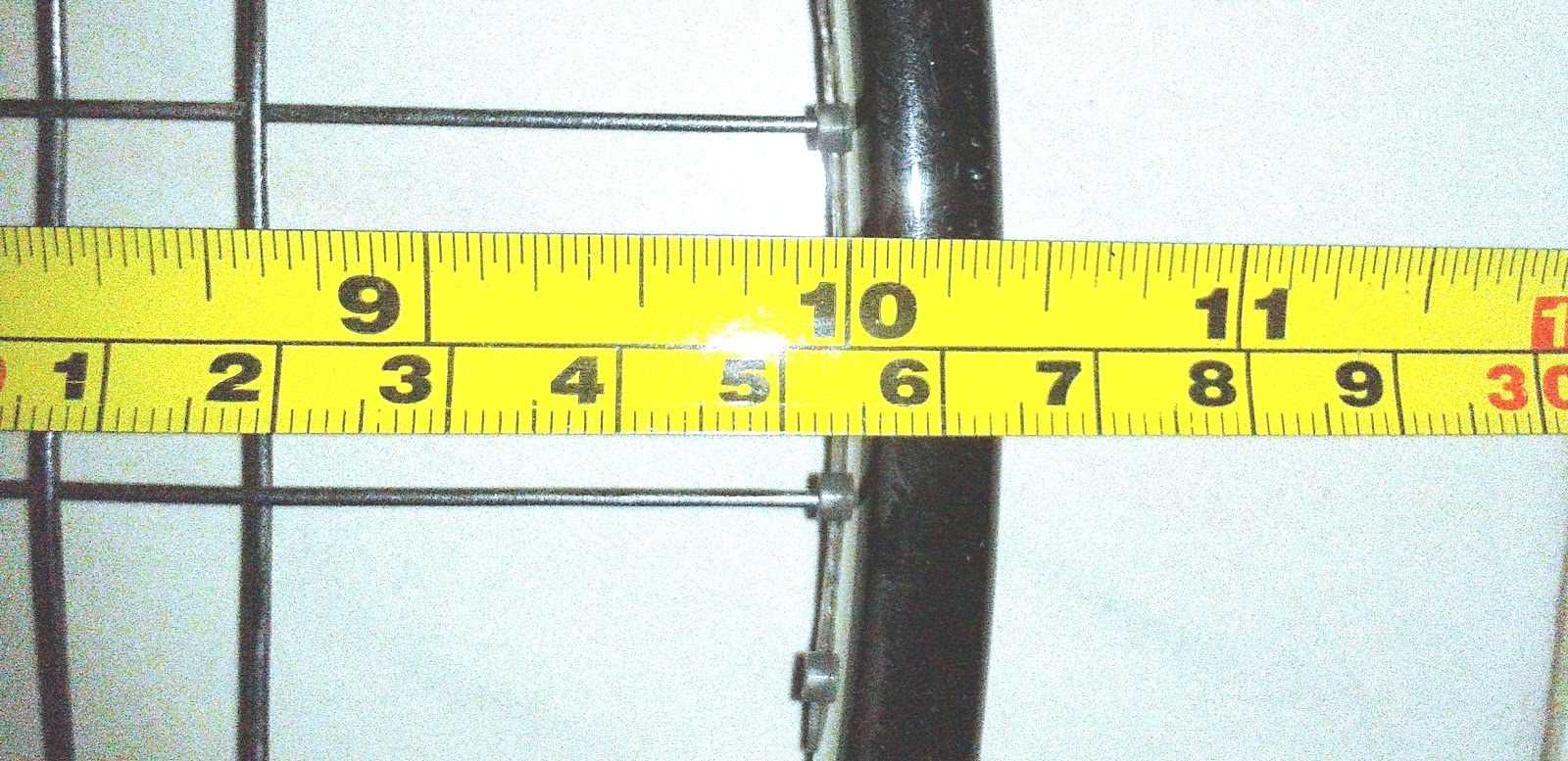
The frame narrowed by only 1mm to 26.2cm this time, so the tensioning was quite evenly balanced out.
Playtest:
- After hitting for 15 minutes or so for the strings to break-in, I started wondering if tension holding was too good.
- It felt more like a board than a set of strings. But this was a good problem to have since we wanted to lower tension to increase durability!
- The only two things I did not like about the "boardy feel" was the extremely low power and reduced spin. Control and ball feel remained very good.
- As usual, a centre main string was snapped by a flat serve.
Showing posts with label skipping crosses. Show all posts
Thursday, 22 May 2014
Monday, 21 April 2014
Skipping Every Third Cross (16x12)
While the second attempt of the Lendl pattern (link) offered a lot more comfort, power and control over the first, it was still not enough to placate this syn gut lover.
My set of old and lazy bones needed just a little more comfort, a little more pocketing and a LOT more power. Extra spin would be nice too!
However hard I try, my footwork was no longer fast enough. That meant insufficient time for those old school long loopy swings that I have been accustomed to.
Many previous attempts skipping crosses compromised control in return for comfort, power and spin. (link1)(link2)(link3)
Now, by skipping every third instead of alternate cross, maybe I could tone down some power and add back control? In addition, I was also hoping for a little more pocketing to deal with the harsh feel when the stiff poly stringbed stops giving.
Not sure how to interpret the ITF tennis rules regarding this string pattern (link):
"The hitting surface, defined as the main area of the stringing pattern bordered by the points of entry of the strings into the head or points of contact of the strings with the head, whichever is the smaller, shall be flat and consist of a pattern of crossed strings, which shall be alternately interlaced or bonded where they cross. The stringing pattern must be generally uniform and, in particular, not less dense in the centre than in any other area. The racket shall be designed and strung such that the playing characteristics are identical on both faces."
Probably best left to the professional umpires and judges while I have fun trodding down unconventional paths!
Another variation could be skipping every fourth cross instead... I'll let the playtest dictate where this goes...
Playtest:
- The stringbed softened significantly and became as comfortable as any soft syn gut or multi.
- Directional control were good for medium hits, but when I cranked up the power, the control dipped terribly. The crosses were just not enough to support the heavy impact.
- By control dipping, what I meant was the ball depressing very deep into the stringbed and an exceptionally high rebound angle. So heavy topspin shots became topspin lobs which was fun to see, especially towards the end when it dived down steeply.
- Strangely, other aspects of control remained intact, even for serves.
- Spin was good as the mains could really slide and snap-back.
- Volleys were good too and effortless to execute. Just get the racket in the way of the ball and voila! Perfect dropshot!
- Since the rules dictate that the stringing pattern cannot be less dense in the centre, I think it will be good for anyone intending to try this, to string an extra one or two crosses in the centre of the stringbed. That might stiffen up the sweetspot a little to bring ball trajectory nearing to earth.
- Another option could be to string the same but using poly in the crosses instead of syn gut.
- Not much string movement after play, but some ball fur stuck on the strings.
My set of old and lazy bones needed just a little more comfort, a little more pocketing and a LOT more power. Extra spin would be nice too!
However hard I try, my footwork was no longer fast enough. That meant insufficient time for those old school long loopy swings that I have been accustomed to.
Many previous attempts skipping crosses compromised control in return for comfort, power and spin. (link1)(link2)(link3)
Now, by skipping every third instead of alternate cross, maybe I could tone down some power and add back control? In addition, I was also hoping for a little more pocketing to deal with the harsh feel when the stiff poly stringbed stops giving.
Not sure how to interpret the ITF tennis rules regarding this string pattern (link):
"The hitting surface, defined as the main area of the stringing pattern bordered by the points of entry of the strings into the head or points of contact of the strings with the head, whichever is the smaller, shall be flat and consist of a pattern of crossed strings, which shall be alternately interlaced or bonded where they cross. The stringing pattern must be generally uniform and, in particular, not less dense in the centre than in any other area. The racket shall be designed and strung such that the playing characteristics are identical on both faces."
Probably best left to the professional umpires and judges while I have fun trodding down unconventional paths!
Another variation could be skipping every fourth cross instead... I'll let the playtest dictate where this goes...
Playtest:
- The stringbed softened significantly and became as comfortable as any soft syn gut or multi.
- Directional control were good for medium hits, but when I cranked up the power, the control dipped terribly. The crosses were just not enough to support the heavy impact.
- By control dipping, what I meant was the ball depressing very deep into the stringbed and an exceptionally high rebound angle. So heavy topspin shots became topspin lobs which was fun to see, especially towards the end when it dived down steeply.
- Strangely, other aspects of control remained intact, even for serves.
- Spin was good as the mains could really slide and snap-back.
- Volleys were good too and effortless to execute. Just get the racket in the way of the ball and voila! Perfect dropshot!
- Since the rules dictate that the stringing pattern cannot be less dense in the centre, I think it will be good for anyone intending to try this, to string an extra one or two crosses in the centre of the stringbed. That might stiffen up the sweetspot a little to bring ball trajectory nearing to earth.
- Another option could be to string the same but using poly in the crosses instead of syn gut.
- Not much string movement after play, but some ball fur stuck on the strings.
Monday, 4 November 2013
Fancy: 1.20mm Fishing Line / Syn Gut (16x17)
Many thought I was either stingy or crazy to use fishing line. Online reports of those who tried it were mainly negative.
The grade of fishing line I use is very premium. It is made in Japan and available in Japan only. I have not been able to find it anywhere else so far. I'm told it's not nylon. Since I don't understand Japanese, I suspect it could be some flurocarbon-polyethylene hybrid. Maybe with some polyamide added as well.
Among my friends who tried it, about 80% of them loved this string within mere minutes and wanted it done on their rackets. It's only when I told them of the ridiculously high tensions that their jaws dropped and backed off. One chapshamelessly jokingly asked if I could string it on my racket then loan it to him for a month!
Playtest:
- The feel is very similar to the previous hybrid with poly (link). So I know the characteristics of this fishing line in the mains was very dominant.
- This played comfortably, powerful, spinny and very controllable despite skipping two outer cross strings for a 16x17 pattern.
- A friend with recurring tennis elbow pain tried this and liked it immediately too. I think it speaks volumes about the comfort.
- String movement is minimal, maybe just a tad more than with the poly cross. Just look at that ball fur on the strings!
- There was some very light notching on the fishing mains after about 90 minutes of play.
The grade of fishing line I use is very premium. It is made in Japan and available in Japan only. I have not been able to find it anywhere else so far. I'm told it's not nylon. Since I don't understand Japanese, I suspect it could be some flurocarbon-polyethylene hybrid. Maybe with some polyamide added as well.
Among my friends who tried it, about 80% of them loved this string within mere minutes and wanted it done on their rackets. It's only when I told them of the ridiculously high tensions that their jaws dropped and backed off. One chap
Playtest:
- The feel is very similar to the previous hybrid with poly (link). So I know the characteristics of this fishing line in the mains was very dominant.
- A friend with recurring tennis elbow pain tried this and liked it immediately too. I think it speaks volumes about the comfort.
- String movement is minimal, maybe just a tad more than with the poly cross. Just look at that ball fur on the strings!
- There was some very light notching on the fishing mains after about 90 minutes of play.
Tuesday, 15 October 2013
Retrying Grass Trimmer Line (16x10)
After advising someone to try grass trimmer line in his exotic 12x16 patterned racket (link), I got very curious myself and started thinking...
I recalled the grass trimmer line hybrid (link) played a little dead for soft hits. But all-out full swings felt extremely nice. Almost like natural gut.
Then I also recalled deeply enjoying the 16x10 stringing pattern in the Black Ace 98 (link). The only downside was poor durability, lasting only about 3 hours before snapping.
If I marry the two together, how would it play? The grass trimmer line needed hard hits or a "strong loading" to play well. That's how I arrived at a 16x10 fullbed of grass trimmer line.
As usual, string tensions were way above the recommended range so I will not be posting details here.
Threading the mains first...
The way to get this thick 1.7mm gauge through the grommets is to trim the thickness down, push it through the grommet, then pull with a pair of pliers.
The racket is a Dunlop Aerogel 200 (18x20) if anyone is curious.
Edit:
This stringjob took a little more than 90 minutes. Threading the thick string through the small and very tight grommets took up the most amount of time.
Towards the last few crosses, I grew tired and lax and pulled the string a little too hard and too fast. Just realised that a few mains were notched near the bottom crosses...
Can you imagine how rough the texture is now?
Playtest:
- Strangely, a fullbed of this played much better than a hybrid.
- Compared to the hybrid, ball feel, spin and control were better.
- Instead of needing hard hits for the stringbed to come to live, even modest shots felt good. The skipped crosses did its job well to soften the stringbed. Now, it feels like a normal thick gauge tennis string.
- Due to the very harsh string texture, the crosses did not move at all. Only the mains slided back and forth. When I pulled the cross aside, there was very deep notching on the mains.
- Spin was very good from the mains slide and rough texture. Particular spin serves. A couple of my topspin serves kicked over my partner's height. I'm pleased.
- Control was very good despite the very open pattern. No problems with aiming except when the strings were not straightened out, then some mis-directions occurred.
- Very playable and enjoyable for me, especially the spin!
25Oct2013 update:
- I only rallied with this racket for about 15 minutes in the morning.
- Tension loss was evident compared to the previous session. Not as bad as to render control useless but enough to make me think about stringing this tighter, or filling in all the missing crosses if I use this again.
- At night, I heard a main string snap in the bag. With this string at 1.7mm thickness, notching must have been the culprit...
I recalled the grass trimmer line hybrid (link) played a little dead for soft hits. But all-out full swings felt extremely nice. Almost like natural gut.
Then I also recalled deeply enjoying the 16x10 stringing pattern in the Black Ace 98 (link). The only downside was poor durability, lasting only about 3 hours before snapping.
If I marry the two together, how would it play? The grass trimmer line needed hard hits or a "strong loading" to play well. That's how I arrived at a 16x10 fullbed of grass trimmer line.
As usual, string tensions were way above the recommended range so I will not be posting details here.
Threading the mains first...
The way to get this thick 1.7mm gauge through the grommets is to trim the thickness down, push it through the grommet, then pull with a pair of pliers.
The racket is a Dunlop Aerogel 200 (18x20) if anyone is curious.
Edit:
This stringjob took a little more than 90 minutes. Threading the thick string through the small and very tight grommets took up the most amount of time.
Towards the last few crosses, I grew tired and lax and pulled the string a little too hard and too fast. Just realised that a few mains were notched near the bottom crosses...
Can you imagine how rough the texture is now?
Playtest:
- Strangely, a fullbed of this played much better than a hybrid.
- Compared to the hybrid, ball feel, spin and control were better.
- Instead of needing hard hits for the stringbed to come to live, even modest shots felt good. The skipped crosses did its job well to soften the stringbed. Now, it feels like a normal thick gauge tennis string.
- Due to the very harsh string texture, the crosses did not move at all. Only the mains slided back and forth. When I pulled the cross aside, there was very deep notching on the mains.
- Spin was very good from the mains slide and rough texture. Particular spin serves. A couple of my topspin serves kicked over my partner's height. I'm pleased.
- Control was very good despite the very open pattern. No problems with aiming except when the strings were not straightened out, then some mis-directions occurred.
- Very playable and enjoyable for me, especially the spin!
25Oct2013 update:
- I only rallied with this racket for about 15 minutes in the morning.
- Tension loss was evident compared to the previous session. Not as bad as to render control useless but enough to make me think about stringing this tighter, or filling in all the missing crosses if I use this again.
- At night, I heard a main string snap in the bag. With this string at 1.7mm thickness, notching must have been the culprit...
Saturday, 24 August 2013
Fancy: Wilson Hammer5.8 + Poly/Syn Gut
A picture speaks a thousand words.
Can you spot what has been done to the cross strings?
This racket has a 16x19 string pattern. Two crosses were skipped so it has been strung as 16x17 with poly in mains and syn gut in crosses.
Playtest:
- With this crosses setup, I managed to retain almost the same amount of spin while improving comfort and control as compared to the previous 16x10 stringbed. (link)
- When desired, a simple wipe of the wrist can add a lot of extra spin to make the shot more offensive.
- The traditional stiff boardy feel of the poly mains have been softened substantially so it plays very comfortable.
- Control improved tremendously since an extra 7 cross strings were strung. In exchange, there is a slight drop in power with a lower rebound angle, but it was easily overcome with a slightly longer swing.
- Another plus I liked was the great improvement in flat serves which the previous 16x10 only scored an average.
- Comfort and control were the top attributes consistently mentioned by those who have tested this setup.
Can you spot what has been done to the cross strings?
This racket has a 16x19 string pattern. Two crosses were skipped so it has been strung as 16x17 with poly in mains and syn gut in crosses.
Playtest:
- With this crosses setup, I managed to retain almost the same amount of spin while improving comfort and control as compared to the previous 16x10 stringbed. (link)
- When desired, a simple wipe of the wrist can add a lot of extra spin to make the shot more offensive.
- The traditional stiff boardy feel of the poly mains have been softened substantially so it plays very comfortable.
- Control improved tremendously since an extra 7 cross strings were strung. In exchange, there is a slight drop in power with a lower rebound angle, but it was easily overcome with a slightly longer swing.
- Another plus I liked was the great improvement in flat serves which the previous 16x10 only scored an average.
- Comfort and control were the top attributes consistently mentioned by those who have tested this setup.
Friday, 9 August 2013
Residual Elasticity (Part 2): Hammer5.8 (16x10 Proportional)
(Link to Part 1 is here)
Among all the strings I've tried, poly has the highest deformation factor. That's why tension loss for poly is always so high. Especially immediately after stringing!
To further test my theory on stringing based on residual elasticity, I will be stringing with used poly this time.
The used poly string will come from my Wilson Hammer 5.8 (link). It was strung a few months ago and should have seen at least 10 hours of play, maybe more.
My plan is to string 2-piece with poly in mains. The previous stringing pattern would give me plenty of extra string to play with. A new set of synthetic gut will be used for crosses. That would help me isolate any problems, if any, with the stringbed later.
Before re-use, the used poly was tested for its elasticity, resilience and deformation properties. The test results would determine the tension and stringing method to use.
To prevent unnecessary stress or damage to the used poly, I am using only both ends for testing since they will be trimmed after stringing. Each segment of string would be tested a maximum of three times with the lightest tension first and heaviest last.
After I have arrived at my preferred tension, I will test the centre of the used poly string once to confirm consistency of results. This is because the centre of the stringbed suffers more ball impacts than the side strings.
Here's a pic of how a segment of string was marked, measured, clamped and tested. Two black dots (circled in red) marks the test length before, during and after tension was applied.
Here's two results (from the same string segment) which I felt were insightful:
Test1
Starting length: 20.1cm
Length @ 45lbs: 20.8cm (after 1min)
Length @ 45lbs: 20.9cm (after 30min)
Ending length: 20.3cm
Elasticity @ 45lbs: (20.9 - 20.3)/20.3 = 2.95%
Test2
Starting length: 20.3cm
Length @ 50lbs: 20.9cm (after 1min)
Length @ 50lbs: 21.0cm (after 5min)
Elasticity @ 50lbs: (21.1 - 20.3)/20.3 = 3.94%
If you refer back to my chart on "Poly Stretch Test" posted in March 2013 (link), you can see that this poly starts stretching from about 45 lbs. The above test findings again confirms that.
One very important observation is the absence of additional string deformation at 50lbs after the 45lbs test was completed. Despite being re-used, this poly string stays resilient!
Thus, 50lbs was selected as the starting tension and proportional stringing was used, just like the PK Black Ace 98 (link). That's how much I like that setup!
Stringing pics below...
From the last pic, it is clear how the slick round poly mains "snap back" automatically whereas the synthetic gut strings lay crooked.
Playtest:
- It played very very close to the PK BA98 (link).
- From the first hit, it is very comfortable. There is absolutely zero trace that the poly was re-used! From my previous recollection of how the poly played when new, it felt exactly the same to me. Exactly.
- Directional control is good. But there is this same feeling of the ball "penetrating the cross strings gap" whenever I crank it up. It is not a serious mis-direction and happens only occasionally. Maybe it will go away in the second session like previously?
- Spin shines! Between this and the BA98 full syn gut, the spin levels appear very similar.
- Power level for this is slightly lower than the BA98 full syn gut. So it is very good for people who like to swing all out. The low-power and heavy spin would easily keep the ball in the court.
- I'll test it again in the next session and update later.
12Aug2013 update:
- Surprisingly, the ball "penetrating the cross strings gap" problem disappeared.
- Spin levels improved over the first session. Both serves and groundstrokes kicked up hard and fast. Slices skidded off the ground wickedly and forced my partner to scrap the racket against the floor just to return that shot.
- The used poly performed as well as, if not better, than a fresh set of similar poly string. I am thoroughly satisfied that it is possible to re-use strings as long as it is strung based on residual elasticity.
- The new synthetic gut cross string lost quite a bit of tension during play today. It started getting softer and softer. As crazy as it sounds, I prefer re-using used strings as tension holding is so much more stable.
- Similar to the PK BA98 (link), light notching can be seen only on the mains poly string. The crosses have absolutely zero notching so far. I find this strange as poly is so much stiffer than syn gut. It seems like tightly-strung syn gut could be stiffer than poly!
Among all the strings I've tried, poly has the highest deformation factor. That's why tension loss for poly is always so high. Especially immediately after stringing!
To further test my theory on stringing based on residual elasticity, I will be stringing with used poly this time.
The used poly string will come from my Wilson Hammer 5.8 (link). It was strung a few months ago and should have seen at least 10 hours of play, maybe more.
My plan is to string 2-piece with poly in mains. The previous stringing pattern would give me plenty of extra string to play with. A new set of synthetic gut will be used for crosses. That would help me isolate any problems, if any, with the stringbed later.
Before re-use, the used poly was tested for its elasticity, resilience and deformation properties. The test results would determine the tension and stringing method to use.
To prevent unnecessary stress or damage to the used poly, I am using only both ends for testing since they will be trimmed after stringing. Each segment of string would be tested a maximum of three times with the lightest tension first and heaviest last.
After I have arrived at my preferred tension, I will test the centre of the used poly string once to confirm consistency of results. This is because the centre of the stringbed suffers more ball impacts than the side strings.
Here's a pic of how a segment of string was marked, measured, clamped and tested. Two black dots (circled in red) marks the test length before, during and after tension was applied.
Here's two results (from the same string segment) which I felt were insightful:
Test1
Starting length: 20.1cm
Length @ 45lbs: 20.8cm (after 1min)
Length @ 45lbs: 20.9cm (after 30min)
Ending length: 20.3cm
Elasticity @ 45lbs: (20.9 - 20.3)/20.3 = 2.95%
Test2
Starting length: 20.3cm
Length @ 50lbs: 20.9cm (after 1min)
Length @ 50lbs: 21.0cm (after 5min)
Length @ 50lbs: 21.1cm (after 30min)
Ending length: 20.3cmElasticity @ 50lbs: (21.1 - 20.3)/20.3 = 3.94%
If you refer back to my chart on "Poly Stretch Test" posted in March 2013 (link), you can see that this poly starts stretching from about 45 lbs. The above test findings again confirms that.
One very important observation is the absence of additional string deformation at 50lbs after the 45lbs test was completed. Despite being re-used, this poly string stays resilient!
Thus, 50lbs was selected as the starting tension and proportional stringing was used, just like the PK Black Ace 98 (link). That's how much I like that setup!
Stringing pics below...
From the last pic, it is clear how the slick round poly mains "snap back" automatically whereas the synthetic gut strings lay crooked.
Playtest:
- It played very very close to the PK BA98 (link).
- From the first hit, it is very comfortable. There is absolutely zero trace that the poly was re-used! From my previous recollection of how the poly played when new, it felt exactly the same to me. Exactly.
- Directional control is good. But there is this same feeling of the ball "penetrating the cross strings gap" whenever I crank it up. It is not a serious mis-direction and happens only occasionally. Maybe it will go away in the second session like previously?
- Spin shines! Between this and the BA98 full syn gut, the spin levels appear very similar.
- Power level for this is slightly lower than the BA98 full syn gut. So it is very good for people who like to swing all out. The low-power and heavy spin would easily keep the ball in the court.
- I'll test it again in the next session and update later.
12Aug2013 update:
- Surprisingly, the ball "penetrating the cross strings gap" problem disappeared.
- Spin levels improved over the first session. Both serves and groundstrokes kicked up hard and fast. Slices skidded off the ground wickedly and forced my partner to scrap the racket against the floor just to return that shot.
- The used poly performed as well as, if not better, than a fresh set of similar poly string. I am thoroughly satisfied that it is possible to re-use strings as long as it is strung based on residual elasticity.
- The new synthetic gut cross string lost quite a bit of tension during play today. It started getting softer and softer. As crazy as it sounds, I prefer re-using used strings as tension holding is so much more stable.
- Similar to the PK BA98 (link), light notching can be seen only on the mains poly string. The crosses have absolutely zero notching so far. I find this strange as poly is so much stiffer than syn gut. It seems like tightly-strung syn gut could be stiffer than poly!
Tuesday, 30 July 2013
ProKennex Black Ace 98 + Syn Gut (16x10 Proportional)
I have unfinished business with this frame...
Initially, I bought this to experience how a comfortable frame ought to play and feel (link). After all, Pro Kennex is the epitome of comfortable frames.
Now, I am exceedingly curious how to "optimise" stringing for this very low-powered 18x20 racket, and add some control and spin as well. Power, control, spin and comfort are always squabbling.
I've tried many combinations (some are not posted in this blog):
- low tension (28lbs)(link)
- low tension box method (35lbs)(link)
- normal tension (55lbs)
- proportional stringing (reference tension 60lbs)
- proportional stringing (reference tension 50lbs)
But I could not get the right mix of the above four factors. Not to my satisfaction.
So I listed down some "problems" I had with this racket. When summarised, my dis-satisfactions were primarily:
1. too low-powered due to very flexible hoop/throat,
2. low-mid spin from dense string pattern,
3. possible directional inaccuracies due to flex.
To solve 1 & 2, conventional methods would be to drop tension. However, for this racket, I found that the hoop flexes a lot at low tensions but played stable at high tensions. I need to string tight to "hold" the hoop together. So that option is out.
From previous playtests, I know the sweetspot and my regular contact area on the stringbed is within the centre 8 mains and between crosses 5 to12 from the top. (See pic below)
This got me thinking, what if I "mess around" with the other strings that I use less of?
So, that's how I arrived at this 16x10 proportional stringing pattern.
The length and width before stringing are 34.7cm and 26.4cm (link).
Length and width after stringing are 34.5cm and 26.4cm. Distortion is amazingly low given the very soft and flexy hoop!
Playtest:
- I only managed to rally with this racket for about 15 minutes.
- The stringbed felt extremely comfortable and yet tight. There was a slight loss of control only for shots I believe was contacted in the gap between cross strings.
- I had anticipated this problem as I've tried skipping crosses before. So while stringing the crosses, I pulled and released tension several times to pre-stretch the string so it would hold tension better. I think it helped.
- Spin looks very good from my side but my partner claims it was ordinary. So that's debatable.
- Power was good. Not excessive nor trampoline like. It made volleys and swinging volleys easy, comfortable and accurate.
- Directional control was not bad. Out of about 10 shots I tried to aim down the line and crosscourt, I nailed about 7. Two misses coincided with a weird feel from the stringbed. It could be the ball "penetrating" the wide gap between the crosses. But the miss was not huge, maybe by about 2 feet?
- I tried light spin serves and was still able to place them quite accurately.
- The main takeaway from this session is how to mitigate the problem of the ball "penetrating" the wide gap. If this can be solved, I see a big potential for this setup. I'll let the strings settle-in and try them again next session.
05Aug2013 update:
- I always enjoy the second session of use for newly strung rackets. Somehow, the strings always perform the best on its second use.
- Tension felt as good as it did in the first outing. Tight and controlled would be how to describe it. Yet it was very very comfortable!
- I was early on court so I had about 10 minutes of practice serves. Both flats and spins were very good. Flats could be directed confidently and accurately. Spins were really spinny! Side spins easily curled 3 to 4 feet sideways as it entered the service box. Topspin serves kicked up almost 6 ft near the baseline.
- During warm-up volleys, the stringbed did not give any hint of skipped crosses at all. I thought I was playing with a normally strung racket with all strings filled. Control was surprisingly fully intact!
- I played a set and was leading 5-1 when it started raining and play stopped. Every aspect (serves, overheads, volleys, return-of-serve and groundstrokes) performed almost as well as my ultimate control stick which was strung with kevlar (link).
- My partner finally admitted this played more spinny than usual.
- The mains were tensioned proportionately starting from 50lbs. To equalize pressure in the crosses, increase overall control and also "stretch-out" the elasticity to improve tension holding, some of the cross strings were tensioned close to 80lbs! (Isn't it surprising that the frame distortion is so low?)
- During play, the mains move a lot and with very loud crackling sounds! Ball fur pic below...
- The only downside so far is severe notching. Total play is only about one hour so far... see pic below...
- This setup is very comfortable, controllable, spinny and fun! I like it!
07Aug2013 update:
- It rained overnight but stopped about 2 hours before my game. I wanted to push this stringbed to its limits to test if the earlier notching would break the strings today.
- I usually use pressureless trainer balls in wet conditions because they bounce a little higher. US Opens or Slazengers don't play well when wet.
- Even with the heavy, hard and wet balls, the stringbed felt incredibly comfortable! I cannot think of any more challenging test for stringbed comfort than this!
- For baseline rallies, I had expected the stringbed to lose some control but it didn't. Control was exactly the same as when it was dry.
- The ground was a little too wet to play a game safely so I decided to test control with flat serves. I hit about 30 flat serves at 80% power. 10 each down the T, middle of service box and the sidelines. 22 serves made it where it was aimed. Service is not my forte and I'm very impressed by the accuracy of the stringbed and racket. I have no doubts on this stringbed's control and accuracy anymore.
- Spin was still very good. Perhaps the wet balls fluffed up more than when it's dry, so there's more "grab", but there is substantially more ball fur on the stringbed today. Quite a few balls my partner thought was going out curled in and kicked up. Yes! Those wet heavy balls kicked up!!!
- The "ball penetrating the crosses gap" problem did not re-surface at all. Not even once!
- Notching got deeper. That was expected. But the string did not break however hard I bashed the ball. That was surprising!
- I think this setup can stay. I really like it!
10Aug2013 update:
- Just as I was wondering how much longer can this strings last, it snapped!
- I had used it for less than 5 minutes today.
- All together, this stringbed lasted me only about 3 hours of use.
Initially, I bought this to experience how a comfortable frame ought to play and feel (link). After all, Pro Kennex is the epitome of comfortable frames.
Now, I am exceedingly curious how to "optimise" stringing for this very low-powered 18x20 racket, and add some control and spin as well. Power, control, spin and comfort are always squabbling.
I've tried many combinations (some are not posted in this blog):
- low tension (28lbs)(link)
- low tension box method (35lbs)(link)
- normal tension (55lbs)
- proportional stringing (reference tension 60lbs)
- proportional stringing (reference tension 50lbs)
But I could not get the right mix of the above four factors. Not to my satisfaction.
So I listed down some "problems" I had with this racket. When summarised, my dis-satisfactions were primarily:
1. too low-powered due to very flexible hoop/throat,
2. low-mid spin from dense string pattern,
3. possible directional inaccuracies due to flex.
To solve 1 & 2, conventional methods would be to drop tension. However, for this racket, I found that the hoop flexes a lot at low tensions but played stable at high tensions. I need to string tight to "hold" the hoop together. So that option is out.
From previous playtests, I know the sweetspot and my regular contact area on the stringbed is within the centre 8 mains and between crosses 5 to12 from the top. (See pic below)
This got me thinking, what if I "mess around" with the other strings that I use less of?
So, that's how I arrived at this 16x10 proportional stringing pattern.
The length and width before stringing are 34.7cm and 26.4cm (link).
Length and width after stringing are 34.5cm and 26.4cm. Distortion is amazingly low given the very soft and flexy hoop!
Playtest:
- I only managed to rally with this racket for about 15 minutes.
- The stringbed felt extremely comfortable and yet tight. There was a slight loss of control only for shots I believe was contacted in the gap between cross strings.
- I had anticipated this problem as I've tried skipping crosses before. So while stringing the crosses, I pulled and released tension several times to pre-stretch the string so it would hold tension better. I think it helped.
- Spin looks very good from my side but my partner claims it was ordinary. So that's debatable.
- Power was good. Not excessive nor trampoline like. It made volleys and swinging volleys easy, comfortable and accurate.
- Directional control was not bad. Out of about 10 shots I tried to aim down the line and crosscourt, I nailed about 7. Two misses coincided with a weird feel from the stringbed. It could be the ball "penetrating" the wide gap between the crosses. But the miss was not huge, maybe by about 2 feet?
- I tried light spin serves and was still able to place them quite accurately.
- The main takeaway from this session is how to mitigate the problem of the ball "penetrating" the wide gap. If this can be solved, I see a big potential for this setup. I'll let the strings settle-in and try them again next session.
05Aug2013 update:
- I always enjoy the second session of use for newly strung rackets. Somehow, the strings always perform the best on its second use.
- Tension felt as good as it did in the first outing. Tight and controlled would be how to describe it. Yet it was very very comfortable!
- I was early on court so I had about 10 minutes of practice serves. Both flats and spins were very good. Flats could be directed confidently and accurately. Spins were really spinny! Side spins easily curled 3 to 4 feet sideways as it entered the service box. Topspin serves kicked up almost 6 ft near the baseline.
- During warm-up volleys, the stringbed did not give any hint of skipped crosses at all. I thought I was playing with a normally strung racket with all strings filled. Control was surprisingly fully intact!
- I played a set and was leading 5-1 when it started raining and play stopped. Every aspect (serves, overheads, volleys, return-of-serve and groundstrokes) performed almost as well as my ultimate control stick which was strung with kevlar (link).
- My partner finally admitted this played more spinny than usual.
- The mains were tensioned proportionately starting from 50lbs. To equalize pressure in the crosses, increase overall control and also "stretch-out" the elasticity to improve tension holding, some of the cross strings were tensioned close to 80lbs! (Isn't it surprising that the frame distortion is so low?)
- During play, the mains move a lot and with very loud crackling sounds! Ball fur pic below...
- The only downside so far is severe notching. Total play is only about one hour so far... see pic below...
- This setup is very comfortable, controllable, spinny and fun! I like it!
07Aug2013 update:
- It rained overnight but stopped about 2 hours before my game. I wanted to push this stringbed to its limits to test if the earlier notching would break the strings today.
- I usually use pressureless trainer balls in wet conditions because they bounce a little higher. US Opens or Slazengers don't play well when wet.
- Even with the heavy, hard and wet balls, the stringbed felt incredibly comfortable! I cannot think of any more challenging test for stringbed comfort than this!
- For baseline rallies, I had expected the stringbed to lose some control but it didn't. Control was exactly the same as when it was dry.
- The ground was a little too wet to play a game safely so I decided to test control with flat serves. I hit about 30 flat serves at 80% power. 10 each down the T, middle of service box and the sidelines. 22 serves made it where it was aimed. Service is not my forte and I'm very impressed by the accuracy of the stringbed and racket. I have no doubts on this stringbed's control and accuracy anymore.
- Spin was still very good. Perhaps the wet balls fluffed up more than when it's dry, so there's more "grab", but there is substantially more ball fur on the stringbed today. Quite a few balls my partner thought was going out curled in and kicked up. Yes! Those wet heavy balls kicked up!!!
- The "ball penetrating the crosses gap" problem did not re-surface at all. Not even once!
- Notching got deeper. That was expected. But the string did not break however hard I bashed the ball. That was surprising!
- I think this setup can stay. I really like it!
10Aug2013 update:
- Just as I was wondering how much longer can this strings last, it snapped!
- I had used it for less than 5 minutes today.
- All together, this stringbed lasted me only about 3 hours of use.
Wednesday, 20 February 2013
Wilson Hammer 5.8 + Poly/Syn Gut @ 32/30 lbs (16x17)
Combined, both my playing partner and myself hit with the ELT full poly for less than 15min. It felt too harsh to continue. Or, it could just be that we loved our arms too much...
After some thought, I decided to convert this job to a ELT hybrid and see how different it would play.
Online, there's plenty of debate on re-using strings or converting strung rackets. Most issues revolve around how unpredictable the strings would play. Some fear racket damage. Perhaps I have been lucky so far?
After mounting the racket, I cut the crosses. If you observe the gap between the cut strings, it's clear how little snap there is when cut. Poly is a very stiff string.
Removing the cut crosses.
After inspecting the mains for any damage, it's back to regular stringing.
Somehow, the top and bottom cross seemed a little too near the frame to me. My previous rackets all played very well with both crosses skipped, so I skipped them this time too!
Playtest:
- I only hit with it for about 5 min, then passed it to M, who snapped the cross string with a backhand topspin!
- For that few shots, spin was better than with full poly. It was quite comfortable too.
- In fact, I could not tell any difference between this ELT stringjob and another done in the 40-50s. It played exactly the same to me!
- Spin clearly loses out to full syn gut at ELT
- Control is the only thing better than ELT syn gut
After some thought, I decided to convert this job to a ELT hybrid and see how different it would play.
Online, there's plenty of debate on re-using strings or converting strung rackets. Most issues revolve around how unpredictable the strings would play. Some fear racket damage. Perhaps I have been lucky so far?
After mounting the racket, I cut the crosses. If you observe the gap between the cut strings, it's clear how little snap there is when cut. Poly is a very stiff string.
Removing the cut crosses.
After inspecting the mains for any damage, it's back to regular stringing.
Somehow, the top and bottom cross seemed a little too near the frame to me. My previous rackets all played very well with both crosses skipped, so I skipped them this time too!
Playtest:
- I only hit with it for about 5 min, then passed it to M, who snapped the cross string with a backhand topspin!
- For that few shots, spin was better than with full poly. It was quite comfortable too.
- In fact, I could not tell any difference between this ELT stringjob and another done in the 40-50s. It played exactly the same to me!
- Spin clearly loses out to full syn gut at ELT
- Control is the only thing better than ELT syn gut
Strings:
Pro Supex Big Ace Revo 1.25mm mains @ 32 lbs
Pro Supex Synthetic Gut Titan 1.25mm cross @ 30 lbs
Thursday, 27 December 2012
RW5800 + Poly / Syn Gut @ 48 / 65-46-65 (16x14)
Since the previous setup did not play well (link), I cut out and re-installed only the cross strings. In addition to skipping some cross strings to simulate proportional stringing, I also varied the tension.
This time, the first 3 installed cross strings were pulled at 65 lbs. Then the next 8 at 46 lbs and the last 3 at 65 lbs again.
To ascertain whether the difference in tension would eventually even out in the cross strings, I marked a straight line down from tip to throat on the cross strings in red BEFORE the clamps are removed. Any significant cross strings tension movements should make the line crooked.
Below's a clearer close-up of the red line on the cross strings. You can clearly see the tension loss on the last cross string at the bottom due to the tie-off. The rest remains intact and well within the middle main strings. Even after I bounced a tennis ball around for about ten minutes, the red line did not move.
To recap, I was trying to:
- obtain a lot more spin
- maintain or increase comfort of the stringbed
- maintain a predictable stringbed with good control
Playtest:
- the tension holding was completely beyond my expectations, the red line did not move at all
- sweet spot hits were very soft and comfortable with excellent control and spin
- off sweetspots hits near the top felt harsh as the tension did not even out as expected
- i think this method of stringing crosses is worth exploring further
- below pic is after playing (I straightened out the main strings)
4th Jan 2013 update:
- below pic is after 4+ hours of play and 8 days after stringing --> red line is still straight!!!
This time, the first 3 installed cross strings were pulled at 65 lbs. Then the next 8 at 46 lbs and the last 3 at 65 lbs again.
To ascertain whether the difference in tension would eventually even out in the cross strings, I marked a straight line down from tip to throat on the cross strings in red BEFORE the clamps are removed. Any significant cross strings tension movements should make the line crooked.
To recap, I was trying to:
- obtain a lot more spin
- maintain or increase comfort of the stringbed
- maintain a predictable stringbed with good control
Playtest:
- the tension holding was completely beyond my expectations, the red line did not move at all
- sweet spot hits were very soft and comfortable with excellent control and spin
- off sweetspots hits near the top felt harsh as the tension did not even out as expected
- i think this method of stringing crosses is worth exploring further
- below pic is after playing (I straightened out the main strings)
4th Jan 2013 update:
- below pic is after 4+ hours of play and 8 days after stringing --> red line is still straight!!!
Strings:
Pro Supex Black Fusion 1.19mm mains @ 48 lbs (from JET method)
Pro Supex Synthetic Gut Spiral Flex 1.30mm cross @ 65-46-65 lbs
Wednesday, 26 December 2012
RW5800 + Poly / Syn Gut @ 48/46 (then 16by9 @ 48/65)
The best way I know how to soften a full poly job is to cut out the cross string and use a softer synthetic gut. The previous full poly was too harsh and uncomfortable. (link)
I mounted the racket on my stringing machine before I cut out the poly crosses.
More spin is good. So here I am, skipping some cross strings near the top and bottom of the frame to allow the mains to move more freely. Hopefully, the synthetic gut will hold tension and provide better stability than when I skipped strings using poly. (link1)(link2) (Surprisingly, Big Ace is so soft that I find it unstable to be used when skipping strings.)
The conversion completed. To simulate the effects of proportional stringing (link), I varied tension of the cross strings slightly at different points although it is one piece of cross string I used. I believe this stringing pattern is still legal according to the ITF rules.
Playtest:
- no chance.... cross strings snapped before any playing!
Playtest:
- skipping strings with a synthetic gut cross is more stable than with poly cross
- spin is absolutely insane with topspin shots curling down hard and kicking fast and high
- power level is very good
- volleys and serves feel too soft on the stringbed
- would have preferred the earlier setup which snapped before testing
- there is some adjustment to get used to the different rebound angle off the string after contact
- i like this setup for spin but control needs to be improved
I mounted the racket on my stringing machine before I cut out the poly crosses.
More spin is good. So here I am, skipping some cross strings near the top and bottom of the frame to allow the mains to move more freely. Hopefully, the synthetic gut will hold tension and provide better stability than when I skipped strings using poly. (link1)(link2) (Surprisingly, Big Ace is so soft that I find it unstable to be used when skipping strings.)
The conversion completed. To simulate the effects of proportional stringing (link), I varied tension of the cross strings slightly at different points although it is one piece of cross string I used. I believe this stringing pattern is still legal according to the ITF rules.
Playtest:
- no chance.... cross strings snapped before any playing!
So, here's the re-restring. I decided to do an open stringing of 16 by 9. It's something I've wanted to try with synthetic gut. And given today's tight schedule, I thought I might save some time installing only 9 cross strings.
- skipping strings with a synthetic gut cross is more stable than with poly cross
- spin is absolutely insane with topspin shots curling down hard and kicking fast and high
- power level is very good
- volleys and serves feel too soft on the stringbed
- would have preferred the earlier setup which snapped before testing
- there is some adjustment to get used to the different rebound angle off the string after contact
- i like this setup for spin but control needs to be improved
Strings:
Pro Supex Black Fusion 1.19mm mains @ 48 lbs (from JET method)
Pro Supex Synthetic Gut Spiral Flex 1.30mm cross @ 65 lbs
Subscribe to:
Posts (Atom)