Showing posts with label modifications. Show all posts

Monday, 4 October 2021

Cutting Down Racket Length


With Covid-19 still raging, especially the Delta variant, many are staying home voluntarily despite full vaccinations. 

Work-from-home remains the default in Singapore. 

Probably because of this, a lot of my old friends picked up tennis. A former colleague, now in his 70s and retired, pursued tennis rigorously. Taking lessons twice a week and playing another two more days with his wife. 

We caught up and played. He used an oversized head-heavy racket recommended by his coach. 

And I noticed the strain on his face as he struggled with his timing on every forehand shot. He thought that was normal and how tennis ought to be played. His coach commended his strokes. 

When I took his racket back for measurements and restring, I was shocked! 

His second hand racket had been modified previously. At 28 inches long, it weighed 297 grams with a balance of 36.5cm and a swingweight of 381 kg/cm2! 

Despite removing all the lead tape I could find, it remained too head-heavy. I suggested to cut down by half-inch for a start and he agreed. 

Some weight was added in the handle end to rebalance. The old kevlar/synthetic gut was cut and restrung with full poly at about 40 lbs using proportional stringing. 

He loved it from the first hit! 

"So easy!" he exclaimed! 

Longer is not always better. The specs has to be within his strength ability. He immediately sent in his wife's racket to be re-worked too. 


Friday, 15 March 2019

Wilson Clash Customization

The latest Wilson Clash seemed interesting. 

Marketing generated so much hype that even during pre-launch in late 2018, I received many questions from players about its potential to up their game.

It did not take long before both versions were sent in to me for stringing and modifications.

I had a few hits with some that were sent to me strung. Surprisingly, many were strung with poly/multi or full multi. Few were with full poly. 

Dampener or not, the feel was very muted yet included a lot of buzz and trembling. This felt exactly like "hoop wobble" (link). Immediately, this hinted a potentially very soft hoop. Extra care needed when stringing. 


When lacing up the centre main, what struck me was how big the modern grommet holes were. Every hole was large enough to be a tie-off hole. That made threading strings very easy.


My earlier suspicions were confirmed when tensioning the mains. Previous soft hoops I worked on warped more when outer mains like 6, 7 or 8 were tensioned. The Clash started warping significantly from inner mains like 3, 4 and 5. That is a very significant change and carries huge implications.


Crosses start very high and have smaller gaps near 12 o'clock. These gaps almost double near the last few bottom crosses. Another hint of potential erratic stringbed response especially nearer the top quarter or top third which most professional players like to contact the ball at.

When weaving the crosses, the gaps kept reminding me of the earlier Burn series. It was so wide it created control issues for many. And those that could somehow control the ball snapped strings too quickly. Would this happen with the Clash open gaps? (I was later updated by several their strings notched extra fast in the Clash compared to their own 16x19 stringbeds)


As I examined the throat area, I noticed a notched recessed area inside the throat. (Somewhere beside the "o" and "n" of the red "Wilson" wordings) This must be where the racket is flexing on impact. Interesting. Few rackets I can think of, other than wood, flex at such a low and faraway point away from impact point.

Not long after, another Clash came in. Brand new unstrung. For very heavy customizations for a touring professional.


Armed with the feedback from the earlier few Clashes, I took up the challenge. 

It was a challenge because the Clash was marketed as a very powerful frame. Many complained of timing issues and erratic hot spots on the stringbed. And it had very open strings coupled with a very soft flex of about 55. All these pointed to control issues.

To add power or weight meant doubling up on these control problems.

Nevertheless, I did the calculations and it all added up nicely. So I proceeded.

First step, strip the grommets.


Now that you see how much lead tape I am adding, can you understand why I said it was a challenge to add control and keep the ball in? For a professional full time tennis player!

(I scribbled on the lead tape too!)


Grommet installation was very very easy. Took me about 4 seconds. Fastest I have ever reinstalled top grommets after adding lead tape.


For this ease of reinstallation, I have to thank Wilson for this modern grommet design. The centre pieces always cause the biggest obstructions. So they cleverly separated the centre 10 grommets from the bumper guard. And the drilling featured extra large holes for easy grommet installation. Well done Wilson!! And thank you!!


Typical of a new unstrung before racket, the grommets need to be seated properly to ensure a playable string job. Look at the red circles area below, compare the properly seated grommet with the "unseated" one.

Do not assume this happens automatically when you pull tension. I have several strung frames sent in to me with the grommets still "unseated".
 

Until now I do not understand why so many are enamored and mesmerized by silicone in the butt. Everyone I customize for asked for it!


Final checks before handing the frame over to the player. So far the hoop size QC seems very consistent. All Clash and Clash Tour I worked on measured 326mm length and 251mm width for the inside hoop from base of grommet to base of grommet. Zero hoop distortion achieved.


PS: No details of racket weights, specs nor string tensions would be revealed as these players are still actively competing. So please do not ask. 


Saturday, 10 March 2018

Blacked Out Frames

A sponsored player was struggling with arm pain. He asked if I could replicate his preferred specs in an arm friendly frame instead, then black it out.

His requirements were unique. It was not based on the usual mass, balance nor swingweight. I had to do some "reverse calculations" to determine how to proceed.

Since it was a first for me, I suggested trying the paint and mod on my personal frames to ascertain if I could pull it off. Then let him conduct a playtest before starting work on his actual sticks. 


Took the opportunity to spray paint my trusty rusty wedge as well...


He agreed to the costs. And was happy with the comfort, playability, feel and control after testing it.

But by then, we only had about half a day left before his flight. And he wanted me to modify, match, paint and string SIX rackets. I only agreed to try my best.

There was not enough time to do a proper paint job - stripping out old paint, prime, two coats before a final top coat. Add to that, drying time between coats and final layer.

The black out was to meet his sponsorship obligations. Not for aesthetic purposes. I told him I would spray-paint right over the grommets. And with minimal sanding. He gave the thumbs up.

Within seven hours, I managed to complete four. And when I strung them, the paint was not even completely dry!

The most time consuming part was the pre/post paint measurements, calculations and adjustments. Depending on how much paint was removed or added, the weight impact was very significant to its end state playability.

If anyone wishes to try a similar DIY, do not under-estimate the weight implications of the paintjob. 

Conversely, if you have a thorough understanding of the implications and effects of mass at different areas of the racket, you could make use of this sanding/painting to re-distribute weight to your desired end state, which would otherwise be unachievable.

Even with minimal sanding, which took me probably 15 minutes per racket, initially using 400 grit followed by 800 grit sandpaper, I removed an average of 10 grams per racket!

Final weight adjustments could only be done after the paint completely cured. In the earlier experiment on my own frames, I noticed that the solvent based paint lost weight gradually as it cured. I had to add that back to restore proper specs.

As I did not have time for the paint to cure fully, I added an extra 3 grams per racket to make up for the evaporating solvent. If my calculations were correct, it would end up 1 gram below his target specs when fully cured. 

I gave him enough lead tape to cover any potential shortfall, should he need any.

Needless to say, my stringing machine mounts, hands, arms and shirt were all paint-stained during stringing.

Even though this was a paid project, I have no wish to repeat this mad rush. More time would have been helpful. And I would be more selective on the type of modifications.

But I must admit any rackets look nicer all black. They seem to play better too...


Efficiency - Example #2

(This example #2 is a follow-up from a previous post here)

More than a few times, I came across tour or serious  competitive players with very difficult to use rackets.

When asked, they would sheepishly tell of how small the sweetspot is, how heavy and difficult to maneuver and how tough it was to generate power or spin.

I could not understand why.

Suppose if a chef uses an old blunt knife to prepare food, then cooks over a candle flame instead of a stove, and serves soup on disposable paper plates without cutlery, what would your impression of the chef be?

Even if they were the greatest player on earth, was there any need to make things difficult? Would they earn more points if they use old rackets? Or triple points and prize money for using a woody?

Not surprisingly, many of these same folks, whom I asked about their challenging equipment, all admitted struggling in matches.

All quoted impeccable feel or sentimental reasons for sticking with their "old faithful".

Player B

Mid 30s. 1.7+ metres tall. Weighs about 70 kg. Moves well but commented he was not as fast as before. Reads opponents fast and accurately.

Flattish or sidespin forehand. Flat or slice backhand. Flat to mid-spin serves. All serves and strokes executed with very good placements to opponents' weaknesses. Volleys often and well to end points fast.

Initially played with the ProStaff 85, then to a 90 sq inch Yonex and to a 100 sq inch for about one year. Been struggling with touch and feel and confidence of the 100 sq inch, so would rotate back to the 90 occasionally.

After initial hits, I was impressed by his extremely consistent contact point on the stringbed. There were very few shots I could see that missed the sweetspot. Even those did not miss by much.

When I examined his used stringbed, the deepest notches were concentrated in the centre 8 mains and crosses. He mentioned that usually one of the centre strings would snap after some use.

I had him rotate between his 90 and the 100 while he showed me his serves. The difference was huge. The ease and relaxation, the smoothness of the swing, pronation and release, tempo and most importantly, the consistency and placement accuracy was superior with the 90.

When I measured both his 90 and 100, the weights were all very close. Some matching had been done.

My thoughts

Topspin is an extremely inefficient stroke (link) and difficult to execute well. Since he hits flat, and does not swipe the racket upwards steeply to generate topspin, he rarely frames the ball or catches it off-center.

With the very consistent notches, he proved his ability to hit the centre regularly. In this rare case, I suggested he ditch the 100 and switch back to the 90 with two minor weight tweaks - redistribution and reduction.

While this might seem a simple conclusion, there were important reasons behind this decision.

First, the isometric shape of the 90 sq inch Yonex played with an almost similar sweetspot size of the 100. Only thing was, according to him, the 100 sweetspot felt distinctly less "sweet".

Second, even though both the 90 and 100 were on similar specs, I felt the weight was more "productive" in the smaller 90. 

With a smaller hoop size, the advantage was the weight in the hoop was closer to the sweetspot. That contributed to better feel. And less weight was needed to stabilize the smaller hoop, making it more efficient and allowing weight to be redistributed to achieve other objectives, while maintaining a lower total weight than the 100.

Third, the sweetspot in the 90 Yonex was located  significantly higher on the racket face than the 100. That was exactly the spot I saw him deliver some of his best placed serves.

Fourth, I felt he had no need for a larger head size as he does not use topspin. During the hitting sessions, I did not observe any instance where he brushed the ball upwards. It was all flat or slices.

Since hitting flat or slices was much more efficient in imparting energy to the ball, this reinforced my view that he did not need any extra "free power" from a larger head size. For without topspin, the ball would float out, which I saw some with the 100.

The changes

The 90 still performed extremely well for his serves, as he had full control of his own ball toss, tempo and timing. But since I have never seen his play last time, I could only base my recommendation on his own remark that his movement was not as fast as before. 

That recommendation was to reduce the weight of the 90 just a tad, to speed it up, to make up for "lost time" from the slightly slower footwork he claimed.

In this instance, his greatest efficiency was achieved by downsizing back to a 90 sq inch which performed best to his natural strength, ability and style of play. 

It might not work for another player, but in my opinion, the weight adjusted 90 was a much better fit for him than the 100. 

In my opinion, for the 100 to play similar in feel, control, stability and power with the 90 would require the 100 be substantially heavier than the 90. That would not be efficient, nor advisable given his remark about feeling slow.

When I asked him a few months after, he was still using the 90 exclusively, happily.


Thursday, 8 March 2018

Efficiency - Example #1

Since the last post (link), I received some questions regarding the "efficiency" I mentioned.

I will share one real-life example which I thought exemplifies efficiency. No names would be revealed. And to protect the anonymity of the actual player, some details might be altered.

Player A

Male. 20+ years old. Very fit and fast footwork. Has ranking points, but he felt he was "stuck" at a certain level and could not move up the rankings despite changing coaches.

He was a heavy-topspin baseliner. Big slice/topspin serves. Very little volleys. From his match videos, I saw most of his shots were contacted about a metre or more outside the baseline.

From our discussions, he believed that racket head speed (RHS) was the most important attribute and had selected his racket and strings to maximise RHS.

RHS is vital for spin. For his case, I agreed that high RHS was important for his game style. 

However, to achieve his desired RHS, he chose a very light racket. About 330 grams strung. Swingweight at low 310s. Using a golf swing speed radar, I clocked his swing speed at 70+ mph average for both wings. Pretty good.

Then I videoed him in a co-operative rally with both players hitting directly to each other's forehands. Then backhands.

Even with his 100 sq inch racket, he was contacting the ball all over the stringbed. Out of 100 forehands and 100 backhands, his sweetspot or COP contact was less than 25%.

For a co-operative rally, this was disastrous!

What I felt he omitted in his racket selection, was that he was extremely strong, fit and moved fast. 

He was not convinced. 

So, after the two hours hitting session, I asked him to run 2.4km at 80% of his fastest pace. He clocked in at 7.25 minutes.

Physically, he was almost 1.8 metres tall, had long limbs, and weighed just below 80 kg. In my opinion, that was very good proportion.

To me, he was not optimising his physical strength, speed and stamina.

His racket was too light. I saw his very well developed footwork and early racket prep. Many of the half volleys he executed aggressively, when his opponent sent the ball just outside the baseline, had near perfect timing.

In my view, his was a case of "over-acceleration". That led to too early release of the wrist hinge and racket face closing too fast. That resulted in poor directional accuracy and inconsistent contact, both on the stringbed and contact point relative to his body position. That held him back from playing 100%.

Both his coach and himself thought these were a result of his grip, timing and lost string tension (ie wear and tear) but I disagreed.

At the next session, I got him to test a modified version of his racket with the same strings and tension. I did not restring his used strings.

Immediately, his timing fell in place. He could "go for it", step in and chase the ball aggressively without fearing the ball veer left or right. 

His shot placement accuracy, depth control and trajectory control all improved. He could place return of serves confidently.

In a video I shot from the side of the baseline, his contact point relative to his body position also improved. Sweet spot hit percentages on the stringbed for co-operative rallies went up to 70% for 100 shots.

This led to other improvements such as a much heavier ball and more offensive forward and high-kicking topspin. 

His coach struggled much more rallying with him this session versus the previous. The coach contacted and returned more shots above his shoulder level vs mid-torso level previously due to the increased kick from the topspin. (And I heard expletives during the rally!!!)

Despite this, the player felt he was struggling with the racket weight. It took him more effort to swing and he was unsure if he could sustain three sets or more with it. 

Before I could answer, his coach retorted: "This is it! This is what we wanted. The kind of shots we have been trying to achieve".

His efficient racket was actually 20+ grams more than what he had believed in. 

Part of the weight was used to beef up the recoil and slow down his racket slightly so he had time to fully release his power into the shots. 

As I expected much more consistent contacts, I believed he would experience less racket twists, so I reduced his excessive twistweight and adjusted his spin-to-power ratio to "compensate" for the increased weight.

It took him about three weeks to acclimatise to the new weight. And when he switched back to one of his lighter sticks for comparison, he felt he could not perform anymore - power, accuracy, spin, control and stability all dipped.

And the acid test? He managed to beat a player he previously struggled with for a very long time!
     

Monday, 3 April 2017

Some Random Modifications

Questions I'm most commonly asked regarding modifications:

Before modifications
- I am not a pro player, does it make a difference?
- Would the racket become too heavy and unwieldy for me?
- Would it really make any difference to my game?

After modifications
- The racket played so well now, why didn't you suggest this earlier?
- Can you replicate the same mod on my other sticks?
- Why didn't you tell me earlier it was not a stroke/technique issue but racket problem?
- What did you do to my racket to make it play so well?

Here's a few I did recently...

Player #1
- 30+ years old lady using Wilson K Factor K Surge
- needed greater racket stability to hit through shots
- silicone in the handle for dampening and balance


Player #2

- regular racket scraper
- worn top grommets and badly worn-off graphite at hoop
- new grommets replaced
- lead inserted to restore swingweight to former specs


Player #3

- competitive player with Blade 98
- wanted to beef up power and add dampening
- likes to use heavy spin hence polarized racket weights


Player #4

- recreational and occasional player using Head TiS6
- needed some extra mass for stability (added 50 grams!)
- added dampening to protect old tennis elbow & wrist pain


I like the fan-shaped string pattern in the Head TiS6. Natural "built-in" proportional stringing.


Applying lead tape and silicone is not difficult. The real work is in assessing the player accurately, then determining/calculating the correct specs, while ensuring the ratios are maintained for that players' tempo, strength and style of play.


Monday, 27 March 2017

Replicating a Pro Stock - Wilson ProStaff 90

A tennis coach cum former tour player asked if I could replicate a pro stock racket he had bought some time ago.

To me, pro stock is just a customized frame based on a particular user's requirements. 
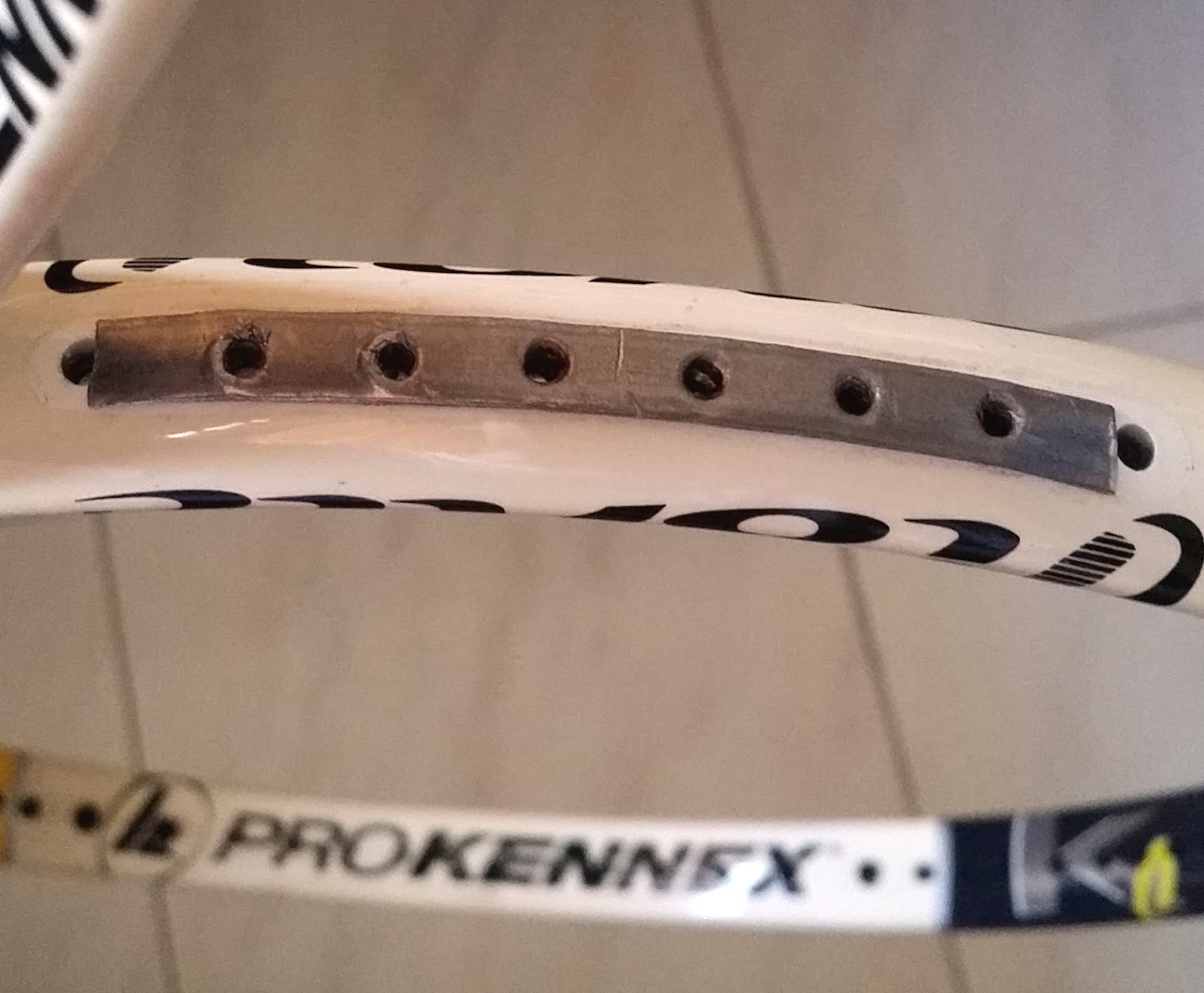

That said, of course the manufacturer's pro room would be able to do much more, such as the grip, flex profile, string pattern, graphite layup, etc


This coach just wanted something close to what he had. 
I have never met him, so there was no way to verify if his racket was indeed pro stock. 

After I received the funds, I procured the racket and start tweaking it to his specs.

He asked me to post some pics of the modifications process in this blog. No details though. So here they are...


Tuesday, 6 December 2016

Replicating an ATP Top Ten Professional Racket Specs

Through an introduction from someone I have worked with, I met a chap who claimed to be a ntrp 4.5-5.0 player and needed some help.

Everytime I hear about someone's self-rated ntrp rating, it was always inflated. So I took it with a pinch of salt.

We met for coffee.

He requested for anonymity so I cannot post too much details. I'll call him "RX".

In a nutshell, RX was a college player who dabbled in several futures tournaments. He trained and played through pain, and is now paying the price with recurring tennis elbow. 

Surprisingly, he has never heard of ProKennex rackets. And the racket manufacturer's claim that it helps with tennis elbow! 

If you missed the test report by the professor from Massachusetts Institute of Technology, it was quite impressive! (link)

The question RX kept asking was whether this comfort-oriented racket could perform for a high level player. Other than Andreas Seppi, he could not google anyone else using a ProKennex on tour. 

RX was not the first, nor the only high-level player asking me that question. So I had expected it.

Ultimately, there was only one way to find out. RX gave me his racket specs and asked if I would be willing to modify one of my ProKennex to his exact specs. Then let him test. He offered to bear all materials cost plus labour.

I accepted. 

What intrigued me was that his specs was similar to a current ATP top ten male player. I have always wondered how would such a stick wield. How could I turn away this chance to kill two birds with one stone? And I still get to keep my racket after!!!

If you are a hardcore follower of tour pro's racket specs, you will know there are only three variables that determine every other aspect of the racket.

RX allowed me to share only one digit from each of the three variables. See if you can make any sense out of it:
x6x
x5x
x2x

Here's some pics of the process...


Added three layers of lead tape under the bumper in above pic.


Added three layers of lead tape inside throat grommets.


Can still see the thick layers of lead tape after replacing the throat grommet.


This was the peek inside the butt before some silicone and lead was inserted. If you are attempting this, please remove the rusty staples first.

These were just a part of the changes made. There were others that I agreed to keep confidential.

When all was completed, I went to RX's apartment for a playtest with his hitting partner. I observed.

As RX was here on holiday and recuperating from his tennis elbow, he was a little rusty. His timing was off for some difficult shots. But during co-operative hitting, I was amazed at his consistency, depth, direction and spin. It looked so effortless!

It rained last night so I could see the ball marks where his shots landed. For that co-operative hitting, I could fit 90% of his shots within a 4 ft by 4 ft square! And they were not pushing, blocking nor dinking the ball!

Search youtube for tour pro practice videos. That's how it looked like. Very humbling for a hacker like me. With their kind of pace and spin, I would not have lasted more than 3-4 shots in their usual 15-20 shots rallies.

And the sound of their ball impacts were loud and crisp. The ball crushing came with loud distinct pops.


Then they played a match while I sat miserably staring at my phone.

Almost two hours and very little pain or discomfort. I could see RX was back to swinging the racket freely. He was no longer held back by pain, nor fear of pain. 

When I had my chance later, the racket was quite maneuverable. Heavy but not completely unwieldy. Not as difficult to use as I had imagined it to be. I liked the plowthrough and stability!

Thanks RX, I enjoyed working with you and have learnt much too!


Monday, 7 November 2016

Which Racket Characteristic Comes First?


All who have played with me know I use ProKennex rackets. 

Many made the "mistake" of trying them, and ended up getting hooked to the impeccable comfort. Even those with no arm injuries.

Before you place an order for ProKennex, note that all my rackets are heavily modified. And it's not just lead tape or silicone added. If you have missed them, here's some of the mods I've tried:

http://unorthodoxstringing.blogspot.sg/2015/02/custom-drilling-10x19-spin-pattern.html

http://unorthodoxstringing.blogspot.sg/2013/04/overhaul-wilson-hammer-58-syn-gut-3228.html

http://unorthodoxstringing.blogspot.sg/2013/06/overhaul-pro-kennex-black-ace-98.html

http://unorthodoxstringing.blogspot.sg/2014/07/extending-racket-by-inch.html

http://unorthodoxstringing.blogspot.sg/2014/01/tri-brid-stringing-vs-varied-tension.html

With the spin and power craze, marketing has been focusing on what consumers want, just to generate sales.

But has anyone considered what is the most important factor in a tennis racket? Is it spin? Or power? Or control?

For me, and a lot of people who thought otherwise, it is comfort. 

Think of the folks who play the most amount of tennis - professionals. Do you notice most prefer a flex in the high-50s to mid-60s? And many have silicone to both add weight and dampening.

Once comfort is established, we can enhance other variables. If we want more spin, use full poly with proportional stringing (link). For power and spin, gut/poly. For control and spin and durability, kevlar/poly or kevlar/zyex.

Almost all aspects, like power, spin or control can be added. But if comfort is absent, then all the other variables become limited. 

Think about it, how much spin or power do you want to add if every impact was already jarringly painful?

Please keep this in mind before your next racket purchase.

Play safe!


PS: Please do not take this as my endorsement for ProKennex rackets. There are many other comfortable playing sticks from other brands.