Almost everyone wants more spin!
If I were to estimate, among all those whom I have worked with, about 80% wanted more spin.
About 15% asked for comfort as top priority since they had some sort of pain in their arms.
Only a few (<5%) asked for more power or more control.
What these spin-obsessed folks did not realise, was how paramount power was to generating spin.
Let me make this statement boldly:
To achieve more spin, you have to obtain more power first!
The very nature of hitting topspin is inefficient. Compared to a flat shot, topspin robs power.
And in many low to intermediate players' quest for more spin, they end up swiping the racket almost 60-70 degrees upwards. That further reduces the amount of forward drive they put into the ball.
Sometimes they get a lot of spin, but it is a sitter. It does not kick forward.
A simple visit to the physics classroom to understand the resultant force under "Vectors" easily explains why. (link)
If you search youtube videos of Federer or Nadal, or any other pro player, you will see their follow through is only about 30 degrees upwards. That's all they need to achieve their 3000+ rpm on their forehands.
If you observe carefully, their shots usually land near the service line and then kicks all the way to the baseline. Average net clearance was only about 60cm or so.
So how should amateurs and wannabes like us hit topspin?
Simply:
- keep the net clearance low (max 60 cm)
- smack the ball hard with a shallow 30 degrees follow through
Of course many other factors play a part, including:
- string type,
- string tension,
- racket flex,
- racket hoop size,
- racket string pattern,
- type of balls,
- court surface,
- swing timing,
- footwork, etc
From my observations and experiments, power is the most critical and most neglected factor.
Specifically, swingweight.
When matched with the player's strength and abilities, this single variable has the most direct and strongest correlation with how much offensive kicking topspin he can generate.
All other spin factors have a poor correlation.
Showing posts with label spin. Show all posts
Showing posts with label spin. Show all posts
Friday, 20 May 2016

Thursday, 10 September 2015
Can a 18x20 String Pattern Be Open?
Before the popularity of spin patterns (eg 16x15), there were only two dominant string patterns - 16x19 or 18x20. The former was known as an "open pattern" and the latter a "closed/dense pattern".
But can those definitions of open or closed be universally applied to all 16x19s and 18x20s?
Even with the same racket headsize, I found it was not so straightforward.
Take a look at the 18x20 ProKennex Black Ace 98 versus the 16x19 Dunlop M-Fil300 below. Both are 98 square inches.

If you examine the string gaps carefully, it would be difficult to ascertain which racket's string gaps are larger, isn't it? The difference is so minute!

The total width of the 18 main strings in the BA98 is about 19.1 cm. For the Mfil300, the 16 mains are about 18.1 cm apart. So on average, each racket's main string are about 1.06 cm and 1.13 cm apart, respectively. With a tiny difference of only 0.07 cm, or 0.7 mm!!!
What about the cross strings' gap then?


All the crosses in the BA98 span over 25.5 cm versus 24.0 cm for the Mfil300. This translates to an average cross string gap of about 1.275 cm and 1.263cm respectively.
To me, both rackets have equally open strings!
It is very important to dispel the generalizations between open and closed string patterns because this has huge implications on tension and string selection, which in turn determines spin, power, string durability, comfort and control.
But can those definitions of open or closed be universally applied to all 16x19s and 18x20s?
Even with the same racket headsize, I found it was not so straightforward.
Take a look at the 18x20 ProKennex Black Ace 98 versus the 16x19 Dunlop M-Fil300 below. Both are 98 square inches.
If you examine the string gaps carefully, it would be difficult to ascertain which racket's string gaps are larger, isn't it? The difference is so minute!
The total width of the 18 main strings in the BA98 is about 19.1 cm. For the Mfil300, the 16 mains are about 18.1 cm apart. So on average, each racket's main string are about 1.06 cm and 1.13 cm apart, respectively. With a tiny difference of only 0.07 cm, or 0.7 mm!!!
What about the cross strings' gap then?
All the crosses in the BA98 span over 25.5 cm versus 24.0 cm for the Mfil300. This translates to an average cross string gap of about 1.275 cm and 1.263cm respectively.
To me, both rackets have equally open strings!
It is very important to dispel the generalizations between open and closed string patterns because this has huge implications on tension and string selection, which in turn determines spin, power, string durability, comfort and control.
Wednesday, 19 August 2015
Signum Pro Poly Plasma (SPPP) ...again...
Since I was given quite a few packets of SPPP, I thought I'll just continue testing this string to see how to make it work.
This time, I strung it straight-up at 40 lbs based on feedback from my previous attempt. (link) If you look carefully at the pic below, it was done two piece with four knots this time.

Even at this low tension, the extreme low-power remained. I passed this racket around my partners. None liked it. Not even those who were previously fascinated by SPPP's legendary tension holding. Neither those who gave me the string.
Comments mirror those from the previous attempt:
- too low power (note my racket's stock SW is 331)
- low spin
- stiff, uncomfortable strings
- need to bash the ball
- very difficult to serve
I persisted using this up to 8 full hours of play to see if there would be any change. Still equally dead, lifeless and very low spin regardless of type of balls used. My shoulder and elbow ached.
So I decided to try it one last time in my very open 10x19 string pattern. (link) This string pattern needed really strong strings!


Such an open pattern would really stress the strings and help me load the ball with my measly swing! Even kevlar mains (link) lasted only 2+ hours in this racket!
Well... it did perform much better! The power could easily match any string setup in an AeroPro Drive.
Ball rebound and launch angle was only slightly higher than normal. This clearly indicated SPPP's incredible stiffness and tension holding. It did not yield much.
Once I adapted to the power and ball rebound angle, I started whipping the racket to test spin.
It was very, very good!
Even with its incredible power levels, almost trampoline-like, all out forward drives sent probably only 5-10% of the shots out. Most curled down in time, neatly between the service and baseline in my partner's court, then jumped about 45 degrees upwards and forward, reaching my partner's head height before descending.
By then, they were hitting the ball somewhere between the baseline and the back fence. The topspin kicked my shots about 2+ metres before my partner could hit it.
Even after 10 minutes of hitting, my partner could not get the ball timing right due to the excessive spin. It was very difficult to read and anticipate where the ball would land and how far it would jump.
Hey! Even my backhand was working super well! I could hit winners, crosscourt or down the line, when I was a little late for the ball. The power helped!
No noticeable drop in tension nor control was sensed after about 20 minutes of heavy, intense groundstrokes. So I tried serves.
Both flat and spin were good. I had little problems aiming for corners. For once in my life, I could hit topspin serves like what I saw on TV! Offensive, powerful, fast-paced and high-kicking topspin serves! The combination of power and spin in the stringbed was perfect!
My conclusion?
If you think you are a very hard hitter, this string would suit you fine. Else, reserve it for rackets with very open string patterns. Or you may find your ego very quickly and harshly tamed.
This time, I strung it straight-up at 40 lbs based on feedback from my previous attempt. (link) If you look carefully at the pic below, it was done two piece with four knots this time.

Even at this low tension, the extreme low-power remained. I passed this racket around my partners. None liked it. Not even those who were previously fascinated by SPPP's legendary tension holding. Neither those who gave me the string.
Comments mirror those from the previous attempt:
- too low power (note my racket's stock SW is 331)
- low spin
- stiff, uncomfortable strings
- need to bash the ball
- very difficult to serve
I persisted using this up to 8 full hours of play to see if there would be any change. Still equally dead, lifeless and very low spin regardless of type of balls used. My shoulder and elbow ached.
So I decided to try it one last time in my very open 10x19 string pattern. (link) This string pattern needed really strong strings!


Such an open pattern would really stress the strings and help me load the ball with my measly swing! Even kevlar mains (link) lasted only 2+ hours in this racket!
Well... it did perform much better! The power could easily match any string setup in an AeroPro Drive.
Ball rebound and launch angle was only slightly higher than normal. This clearly indicated SPPP's incredible stiffness and tension holding. It did not yield much.
Once I adapted to the power and ball rebound angle, I started whipping the racket to test spin.
It was very, very good!
Even with its incredible power levels, almost trampoline-like, all out forward drives sent probably only 5-10% of the shots out. Most curled down in time, neatly between the service and baseline in my partner's court, then jumped about 45 degrees upwards and forward, reaching my partner's head height before descending.
By then, they were hitting the ball somewhere between the baseline and the back fence. The topspin kicked my shots about 2+ metres before my partner could hit it.
Even after 10 minutes of hitting, my partner could not get the ball timing right due to the excessive spin. It was very difficult to read and anticipate where the ball would land and how far it would jump.
Hey! Even my backhand was working super well! I could hit winners, crosscourt or down the line, when I was a little late for the ball. The power helped!
No noticeable drop in tension nor control was sensed after about 20 minutes of heavy, intense groundstrokes. So I tried serves.
Both flat and spin were good. I had little problems aiming for corners. For once in my life, I could hit topspin serves like what I saw on TV! Offensive, powerful, fast-paced and high-kicking topspin serves! The combination of power and spin in the stringbed was perfect!
My conclusion?
If you think you are a very hard hitter, this string would suit you fine. Else, reserve it for rackets with very open string patterns. Or you may find your ego very quickly and harshly tamed.
Saturday, 1 August 2015
10x19 Spin Pattern with Shark Fishing Wire / Syn Gut
Playing with my custom drilled 10x19 racket was fun except for very poor string durability. (link) Even kevlar lasts only about two hours. So I needed something MORE durable!!!
I rang up my old friend who is a fishing enthusiast. Knowing that I was using it for tennis, he bought me a set of 49 strand stainless steel wire meant for shark fishing!!! (link1)(link2)

It fit the job perfectly! Since I was no stranger to stringing with steel wire (link), I accepted the strings happily!
With only 10 main strings, I laced them all up before tensioning.

The wire was extremely sharp, especially the ends when it frayed. Despite applying super glue to keep it together, I still suffered a lot of pokes, nicks, scratches and cuts.
To protect the clamps, I placed small pieces of cardboard on the string before clamping.

With normal strings, weaving was extremely easy on this super open pattern. However, given the very rough textured mains, there was too much friction. I had to go super slow.
Even then, strands of synthetic gut was peeled off by the mains while pulling through. My finger tips were cut while weaving too.

Towards the last few crosses, I guess the syn gut has had enough and snapped while tensioning!

Not wanting to re-do from scratch, I used a third piece of string to fill the bottom four crosses. So it's six tie-offs in total.
Here's how it looks when done. Haven't decided whether to snip off the tails of the tied mains yet...

If you decide to string this wire, here are some learning points on hindsight:
- Wear gloves or tape up your finger tips before weaving.
- Wear safety goggles.
- Try this only on an old racket you don't mind risking damage.
- Do not straighten the mains with your fingers after tensioning. It cuts very deep!
- Plan for blocked holes. It was very difficult to move the wire aside.
- Steel wire is very heavy so a light racket with a lower SW than you normally use would be good.
Playtest:
(Opinions from 2 other hitting partners were included below)
- No surprise here. It felt similar to the previous steel wire.
- Not boardy at all! In fact, most freshly strung full polys played stiffer and deader. This had a little more power. I suspect it was due to the huge tension loss from tie-offs.
- The feel was something between a kevlar/syn gut and poly/syn gut hybrid. Soft, but the ball bite and impact feel was really good here.
- Some pocketing could be felt during impacts but the rebound angle was really low so I had to aim up. Good for folks who tend to hit the ball out.
- In short, tight, controlled and very very spinny. Plus a decent sized sweetspot!
- Downside was it lasted me only 15 minutes. If you click and zoom in on the pic below, you would see how rough the syn gut had been abraded by the wire, especially at the sweet spot.

Before anyone asks, I would not be doing this wire stringing for any one. No exceptions.
I rang up my old friend who is a fishing enthusiast. Knowing that I was using it for tennis, he bought me a set of 49 strand stainless steel wire meant for shark fishing!!! (link1)(link2)

It fit the job perfectly! Since I was no stranger to stringing with steel wire (link), I accepted the strings happily!
With only 10 main strings, I laced them all up before tensioning.

The wire was extremely sharp, especially the ends when it frayed. Despite applying super glue to keep it together, I still suffered a lot of pokes, nicks, scratches and cuts.
To protect the clamps, I placed small pieces of cardboard on the string before clamping.

With normal strings, weaving was extremely easy on this super open pattern. However, given the very rough textured mains, there was too much friction. I had to go super slow.
Even then, strands of synthetic gut was peeled off by the mains while pulling through. My finger tips were cut while weaving too.

Towards the last few crosses, I guess the syn gut has had enough and snapped while tensioning!

Not wanting to re-do from scratch, I used a third piece of string to fill the bottom four crosses. So it's six tie-offs in total.
Here's how it looks when done. Haven't decided whether to snip off the tails of the tied mains yet...

If you decide to string this wire, here are some learning points on hindsight:
- Wear gloves or tape up your finger tips before weaving.
- Wear safety goggles.
- Try this only on an old racket you don't mind risking damage.
- Do not straighten the mains with your fingers after tensioning. It cuts very deep!
- Plan for blocked holes. It was very difficult to move the wire aside.
- Steel wire is very heavy so a light racket with a lower SW than you normally use would be good.
Playtest:
(Opinions from 2 other hitting partners were included below)
- No surprise here. It felt similar to the previous steel wire.
- Not boardy at all! In fact, most freshly strung full polys played stiffer and deader. This had a little more power. I suspect it was due to the huge tension loss from tie-offs.
- The feel was something between a kevlar/syn gut and poly/syn gut hybrid. Soft, but the ball bite and impact feel was really good here.
- Some pocketing could be felt during impacts but the rebound angle was really low so I had to aim up. Good for folks who tend to hit the ball out.
- In short, tight, controlled and very very spinny. Plus a decent sized sweetspot!
- Downside was it lasted me only 15 minutes. If you click and zoom in on the pic below, you would see how rough the syn gut had been abraded by the wire, especially at the sweet spot.
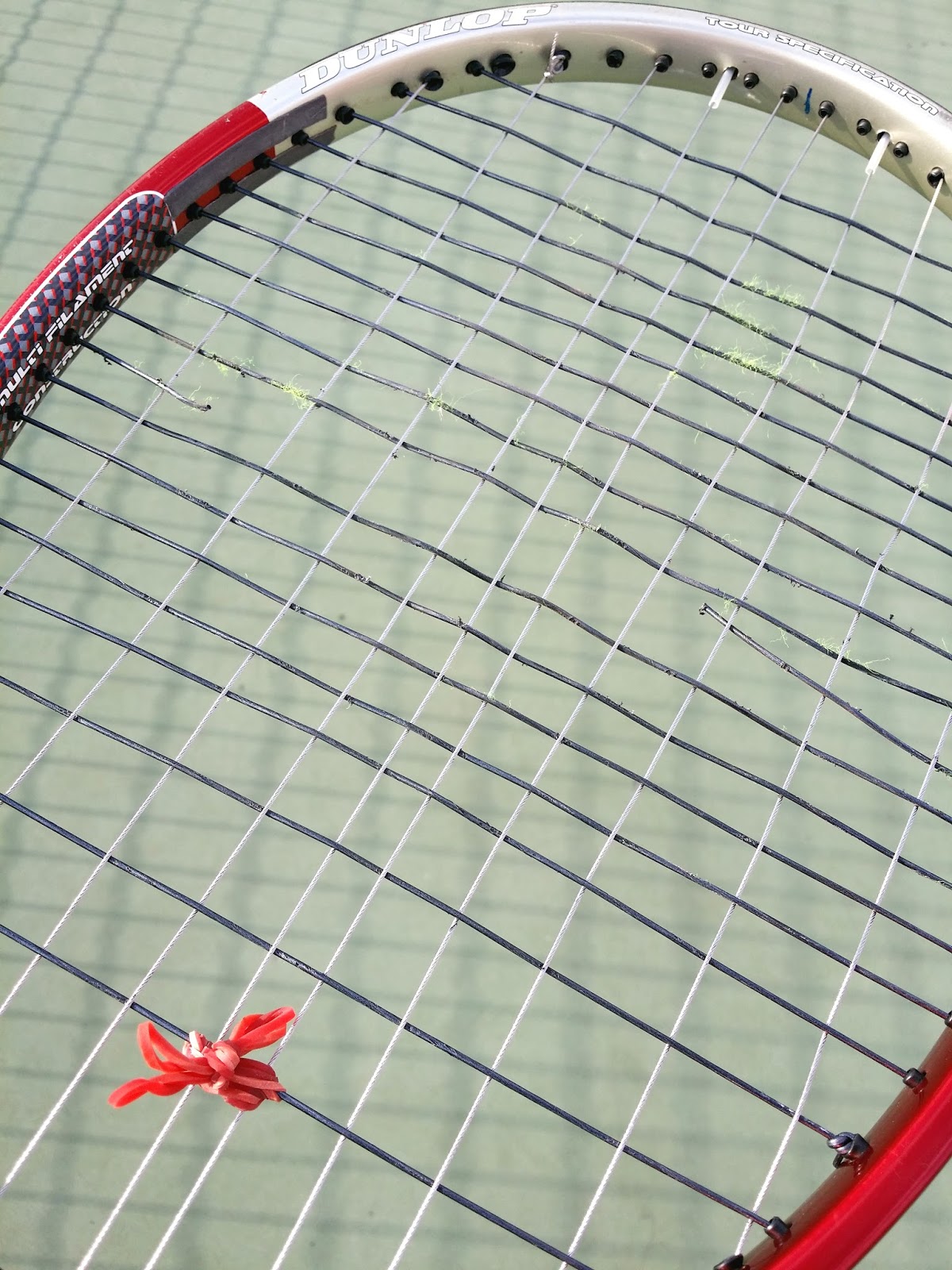
Before anyone asks, I would not be doing this wire stringing for any one. No exceptions.
Thursday, 30 April 2015
Custom Drilling: 10x19 Spin Pattern with Kevlar/Syn Gut
Both previous attempts with 15g syn gut/poly (link) and 15g syn gut/17g syn gut (link) suffered string breakages after a few hours.
All other aspects like comfort, spin, power and control performed much better than expected. So I thought of installing some bullet-proof kevlar in the mains to see if I could beef up durability a little.
The kevlar/syn gut combo played the most spinny among them, with slightly better control and a bit less power.
Unfortunately, this setup also lasted only 2+ hours. (Note the instant frame distortion after the mains snapped)

With such a ridiculous open pattern, something has to give. And in this case, it was durability.
Given how enjoyable the 2+ hours was, and how easy it was to string and weave this racket, I think it was worth the trouble.
All other aspects like comfort, spin, power and control performed much better than expected. So I thought of installing some bullet-proof kevlar in the mains to see if I could beef up durability a little.
The kevlar/syn gut combo played the most spinny among them, with slightly better control and a bit less power.
Unfortunately, this setup also lasted only 2+ hours. (Note the instant frame distortion after the mains snapped)
With such a ridiculous open pattern, something has to give. And in this case, it was durability.
Given how enjoyable the 2+ hours was, and how easy it was to string and weave this racket, I think it was worth the trouble.
Monday, 6 April 2015
Kelvar / Fishing Line
Since it was so near April Fools' day when I posted the natural gut/fishing line combo (link), some asked if I was pulling a prank again (link).
Not this time!
The slick fishing line really paired very well with the natural gut mains. So well, that two playing partners asked if I could switch to another racket instead. They just didn't like to be on the receiving end of those two strings combo.
It was so addictive that I just strung up a kevlar/fishing line to see how much more I could accentuate the already spinny kevlar!


Not this time!
The slick fishing line really paired very well with the natural gut mains. So well, that two playing partners asked if I could switch to another racket instead. They just didn't like to be on the receiving end of those two strings combo.
It was so addictive that I just strung up a kevlar/fishing line to see how much more I could accentuate the already spinny kevlar!
Monday, 30 March 2015
Natural Gut / Fishing Line?
After reading about my past fishing line experiments, an acquaintance got really curious. He pestered me to string one up for him to try.
With the ridiculous amount of time needed for string prep and prestretch, coupled with the low success rate and very short playing durability, I put on a straight face and quoted him something absurd.
Within seconds, he stuffed that amount into my hands. Ouch!!! Guess I have to re-live my nightmare on elm street again...
Thus far, fishing line was the only "string" that snapped and cut my hand and face during tensioning. When the string slipped, it also sent my flying clamps literally flying. The dropweight also crashed into and dented my table top. My pinky was also cut when tugging at the knot.
(If you have not read how difficult it was to string with fishing line, you can click here to find out)
While digging through my spools, and looking at the shimmering slick smooth surface, I wondered how would it perform as a cross with natural gut mains. Could it outperform poly?
Since I had plenty leftover from a previous "sponsor" and a worn set of poly needing replacement...


(Just a note that this was my personal setup. That friend had requested for something else to be paired with fishing line.)
Playtest:
- Just by tugging the mains aside and releasing it, I could see how fast and easy the snapback was.
- On court, it did not disappoint. The spin was fantastic and the strings always remained straight.
- The feel was actually identical to a freshly strung gut/poly stringjob - soft, comfortable, powerful, controlled and spinny. Perhaps a little softer since there was no poly.
- The differences was there was zero break-in needed.
- With poly, sometimes the first hits were a little tight and low-powered. Then it played better after an hour. But since fishing line behaved more like a nylon, there was much more liveliness to it.
- I would describe the fishing cross string to have "the comfort of syn gut with the slickness of poly".
- Another distinction was the consistency of tension holding. After two hours, it seemed to hold up much better than poly.
- Among all the natural gut combinations I have tried, I have no hesitations ranking this as the best for spin, comfort, power and control. The incredible slickness of the fishing line simply allowed much more free sliding between gut/fish and even fish/fish.
- The paramount task now, would be to hunt down my fishing line sponsor and find out which brand and specs of the fishing line he passed to me previously!
- The next few sessions would be interesting.

With the ridiculous amount of time needed for string prep and prestretch, coupled with the low success rate and very short playing durability, I put on a straight face and quoted him something absurd.
Within seconds, he stuffed that amount into my hands. Ouch!!! Guess I have to re-live my nightmare on elm street again...
Thus far, fishing line was the only "string" that snapped and cut my hand and face during tensioning. When the string slipped, it also sent my flying clamps literally flying. The dropweight also crashed into and dented my table top. My pinky was also cut when tugging at the knot.
(If you have not read how difficult it was to string with fishing line, you can click here to find out)
While digging through my spools, and looking at the shimmering slick smooth surface, I wondered how would it perform as a cross with natural gut mains. Could it outperform poly?
Since I had plenty leftover from a previous "sponsor" and a worn set of poly needing replacement...
(Just a note that this was my personal setup. That friend had requested for something else to be paired with fishing line.)
Playtest:
- Just by tugging the mains aside and releasing it, I could see how fast and easy the snapback was.
- On court, it did not disappoint. The spin was fantastic and the strings always remained straight.
- The feel was actually identical to a freshly strung gut/poly stringjob - soft, comfortable, powerful, controlled and spinny. Perhaps a little softer since there was no poly.
- The differences was there was zero break-in needed.
- With poly, sometimes the first hits were a little tight and low-powered. Then it played better after an hour. But since fishing line behaved more like a nylon, there was much more liveliness to it.
- I would describe the fishing cross string to have "the comfort of syn gut with the slickness of poly".
- Another distinction was the consistency of tension holding. After two hours, it seemed to hold up much better than poly.
- Among all the natural gut combinations I have tried, I have no hesitations ranking this as the best for spin, comfort, power and control. The incredible slickness of the fishing line simply allowed much more free sliding between gut/fish and even fish/fish.
- The paramount task now, would be to hunt down my fishing line sponsor and find out which brand and specs of the fishing line he passed to me previously!
- The next few sessions would be interesting.
Friday, 20 March 2015
Big Butts!
I am an oldie. I like older rackets with heavier frames, especially their impeccable feel.
To me, oldies play superior. They just don't make rackets like they do anymore. New ones feel so light, stiff and hollow. Neither do I feel that I am missing out that much on new racket technologies.
However, after trying out a friend's modern stick for an entire session, there was something that lingered...
Long after I returned the racket, I could not stop thinking about that stock grip. Specifically, that huge butt on that 4¼" grip size.
Usually, playing with any grip smaller than a 4⅜" meant I had to use my "death grip" to prevent the racket from flying further than the ball. With that racket, it did not happen!
The feeling was probably best described by Seamus Heaney in the first two lines of his poem, "Digging":
"Between my finger and my thumb
Thesquat pen racket butt rests; snug as a gun."
Despite being nostalgic for old sticks, I cannot ignore the impact topspin has on today's game. Many commented on how much easier and extra spin they obtained just by using that spin stick.
After using that, I would attribute a big chunk of that phenomenal spin generation to the "modern" combination of a slightly undersized grip with a much larger butt diameter. This combination was exceptionally pronounced in Richard Gasquet's racket grip shape. Google it!
Other than the spin, the larger butt sits tight and secure in the hollow right in the middle of the palm. That adds tremendous stability to the racket hoop, especially on serves, return of serves and volleys, while allowing a very gentle hold.
And the good news is, it is extremely easy to "modernise" your racket grip. Either a long strip of foam or an old used overgrip gets it done. Somewhat like the pics in this post.
Spin away!!!
To me, oldies play superior. They just don't make rackets like they do anymore. New ones feel so light, stiff and hollow. Neither do I feel that I am missing out that much on new racket technologies.
However, after trying out a friend's modern stick for an entire session, there was something that lingered...
Long after I returned the racket, I could not stop thinking about that stock grip. Specifically, that huge butt on that 4¼" grip size.
Usually, playing with any grip smaller than a 4⅜" meant I had to use my "death grip" to prevent the racket from flying further than the ball. With that racket, it did not happen!
The feeling was probably best described by Seamus Heaney in the first two lines of his poem, "Digging":
"Between my finger and my thumb
The
Despite being nostalgic for old sticks, I cannot ignore the impact topspin has on today's game. Many commented on how much easier and extra spin they obtained just by using that spin stick.
After using that, I would attribute a big chunk of that phenomenal spin generation to the "modern" combination of a slightly undersized grip with a much larger butt diameter. This combination was exceptionally pronounced in Richard Gasquet's racket grip shape. Google it!
Other than the spin, the larger butt sits tight and secure in the hollow right in the middle of the palm. That adds tremendous stability to the racket hoop, especially on serves, return of serves and volleys, while allowing a very gentle hold.
And the good news is, it is extremely easy to "modernise" your racket grip. Either a long strip of foam or an old used overgrip gets it done. Somewhat like the pics in this post.
Spin away!!!
Tuesday, 17 February 2015
Custom Drilling: 10x19 Spin Pattern (Part 2)
Following the poor tension holding of the poly cross (link), I decided to re-string with full synthetic gut to test how this would perform.
A thicker gauge for the mains would be paired with a thinner one for the crosses.
Playtest:
- With full synthetic gut and without looking at the racket, I could not believe there were only 10 main strings!
- Comfort went further up a notch over the previous strings and control became as good as I could remember for this racket before the conversion.
- The amount of spin did not drop at all. It maintained as vigorous as with the poly cross.
- The loud crackling sound of the mains moving during ball impact remained, followed by the ball kicking furiously towards my partner's face level.
- I felt much more relaxed and confident with this strings and thus swung smoother and harder than with the earlier poly cross. Perhaps this was why spin levels maintained, simply due to a harder hit?
- Visually, and with my partner's verbal confirmation, full syn gut generated a heavier ball. My partner recounted more racket twists (on his own racket) receiving off-centred hits than with my previous strings. In his words, he described my shots moving "fast and furious".
- On my side, I would attribute this to the extra power from the very open stringbed, rather than me exerting greater effort. I did not do anything differently.
- Throughout the 2 hours, I did not adjust the main strings at all. There was full snapback.
- Both serves and flat shots were equally good and accurate. No mis-directions.
- A group who booked the courts after my session noticed my racket and asked if they could try it. I relented after seeing their Pro Staff RF97 Autograph and the Pro Staff 95s in exchange. They were similarly impressed!
- Again, towards the 3 hours mark, a main string snapped. The difference this time was it played well till it broke.
- Another significant difference was the hoop width compressed 1.0 cm immediately after just one main string snapped. This showed how much extra stress the lesser number of mains were withstanding compared to the crosses. Pics below.

Hoop width after one main snapped.

Close-up to eliminate parallax error. Width was 25.0 cm.


Hoop width after strings cut was 26.0 cm. Difference of 1.0 cm.

See the difference below? I was lucky the hoop survived!

A thicker gauge for the mains would be paired with a thinner one for the crosses.
Playtest:
- With full synthetic gut and without looking at the racket, I could not believe there were only 10 main strings!
- Comfort went further up a notch over the previous strings and control became as good as I could remember for this racket before the conversion.
- The amount of spin did not drop at all. It maintained as vigorous as with the poly cross.
- The loud crackling sound of the mains moving during ball impact remained, followed by the ball kicking furiously towards my partner's face level.
- I felt much more relaxed and confident with this strings and thus swung smoother and harder than with the earlier poly cross. Perhaps this was why spin levels maintained, simply due to a harder hit?
- Visually, and with my partner's verbal confirmation, full syn gut generated a heavier ball. My partner recounted more racket twists (on his own racket) receiving off-centred hits than with my previous strings. In his words, he described my shots moving "fast and furious".
- On my side, I would attribute this to the extra power from the very open stringbed, rather than me exerting greater effort. I did not do anything differently.
- Throughout the 2 hours, I did not adjust the main strings at all. There was full snapback.
- Both serves and flat shots were equally good and accurate. No mis-directions.
- Again, towards the 3 hours mark, a main string snapped. The difference this time was it played well till it broke.
- Another significant difference was the hoop width compressed 1.0 cm immediately after just one main string snapped. This showed how much extra stress the lesser number of mains were withstanding compared to the crosses. Pics below.
Hoop width after one main snapped.
Close-up to eliminate parallax error. Width was 25.0 cm.
Hoop width after strings cut was 26.0 cm. Difference of 1.0 cm.
See the difference below? I was lucky the hoop survived!
Sunday, 8 February 2015
Custom Drilling: 10x19 Spin Pattern
The open pattern spin craze has been around for a while now. So far, all of these open string patterns have been focused on reducing the number of cross strings.
But what if I skip some mains instead? How would that play? Would control be intact? Would spin increase more than reducing crosses?
I could not find any rackets with less mains than crosses. Add to that, being recently overdosed on boring and comforming modifications and stringjobs, I needed to break the mold again.
Below was the last pic in its 16x19 stock form before I started...

New holes were drilled to create the string pattern I desired.


Lots of paint chips but structure appeared intact and sound.

The original throat grommets were cut apart to allow me to choose which string hole to use.


After the throat area was completed, the top holes were drilled.

Then strung with very thick 15g synthetic gut to preserve control and durability! Unsure if the extra holes could hold up, I have never felt so much fear pulling tension before.

Fortunately, the mains completed without a hitch! Then the poly crosses. Hey! It's got ONLY ten main strings! Weaving was a breeze!

Conversion to 10x19 done. Hoop length and width measurements were perfectly in line with the original 16x19 pattern. Zero distortion achieved!

"Powerpads" were used at the throat to offer a bit more support for the third mains and to ensure the string stays away from the drilled inside edge.
At the newly drilled hole on top (2nd mains), tubing was used as I did not want to mess with the original grommets.
String spacing for the mains was planned to incorporate some "proportional stringing" in the drill pattern.
Put simply, the sweetspot area was designed to have a slightly denser string pattern than the outer mains. This adds control within the centre 6 mains while softening off-centre contacts around the peripheral.
Also, this ensures compliance with the ITF tennis rules regarding the stringbed (link), specifically, part "b", where:
"The stringing pattern must be generally uniform and, in particular, not less dense in the centre than in any other area."
Playtest:
- Sweetspot was really huge and forgiving, yet control remained very good.
- The typical high rebound angle of open string patterns was not felt here. Unlike my earlier attempts at skipping crosses (link) where the rebound angle became high and sometimes unpredictable.
- Volleys were extremely easy - in power, comfort and directional control. The large sweetspot helped too.
- Power was very good, and it came with more than enough control to direct it effectively and offensively.
- For serves, the spin was wicked! Compared to its former self, the extra power now meant the focus was on where to place it and how much to spin it. Less effort better result!
- Mains snapback was impressive. I could literally hear the strings crackling back and forth during ball impacts. When I pulled the mains aside and let go, it snapped back straightaway.
- Groundstrokes on both wings were good. No mis-directions other than my own mis-hits. Very impressive spin all around.
- Slices entered into "obscenity eliciting" territory for my playing partner. Hit one slice, get one !@#$%^)*.
- After an hour, a slight string buzz appeared. The mains still snapped back instantaneously when pulled and released. Not so with the poly crosses. It seemed the crosses had been the one doing the control work and became "fatigued".
- The above was based on about an hour with this setup. So far, it seemed that skipping mains generated better spin than skipping crosses. Very impressed and excited to test it out more against different players.
17Feb2015 update:
- From the start of the 2nd session of use, tension loss from the poly was very significant.
- While spin was still very good, control dipped badly. I had to focus very intently to be sure my shots landed close to where I aimed.
- I continued playing just to experience how long the mains would last and how it felt when the poly cross tension dropped further.
- At around the 3 hour mark (total use), a sweetspot hit snapped a main string.
- Overall, I was impressed by the spin and comfort this setup gave. Durability in terms of tension holding and string life was not up to my expectations, so I would be re-testing it with another string setup.
But what if I skip some mains instead? How would that play? Would control be intact? Would spin increase more than reducing crosses?
I could not find any rackets with less mains than crosses. Add to that, being recently overdosed on boring and comforming modifications and stringjobs, I needed to break the mold again.
Below was the last pic in its 16x19 stock form before I started...
New holes were drilled to create the string pattern I desired.
Lots of paint chips but structure appeared intact and sound.
The original throat grommets were cut apart to allow me to choose which string hole to use.
After the throat area was completed, the top holes were drilled.
Then strung with very thick 15g synthetic gut to preserve control and durability! Unsure if the extra holes could hold up, I have never felt so much fear pulling tension before.
Fortunately, the mains completed without a hitch! Then the poly crosses. Hey! It's got ONLY ten main strings! Weaving was a breeze!
Conversion to 10x19 done. Hoop length and width measurements were perfectly in line with the original 16x19 pattern. Zero distortion achieved!
"Powerpads" were used at the throat to offer a bit more support for the third mains and to ensure the string stays away from the drilled inside edge.
At the newly drilled hole on top (2nd mains), tubing was used as I did not want to mess with the original grommets.
String spacing for the mains was planned to incorporate some "proportional stringing" in the drill pattern.
Put simply, the sweetspot area was designed to have a slightly denser string pattern than the outer mains. This adds control within the centre 6 mains while softening off-centre contacts around the peripheral.
Also, this ensures compliance with the ITF tennis rules regarding the stringbed (link), specifically, part "b", where:
"The stringing pattern must be generally uniform and, in particular, not less dense in the centre than in any other area."
Playtest:
- Sweetspot was really huge and forgiving, yet control remained very good.
- The typical high rebound angle of open string patterns was not felt here. Unlike my earlier attempts at skipping crosses (link) where the rebound angle became high and sometimes unpredictable.
- Volleys were extremely easy - in power, comfort and directional control. The large sweetspot helped too.
- Power was very good, and it came with more than enough control to direct it effectively and offensively.
- For serves, the spin was wicked! Compared to its former self, the extra power now meant the focus was on where to place it and how much to spin it. Less effort better result!
- Mains snapback was impressive. I could literally hear the strings crackling back and forth during ball impacts. When I pulled the mains aside and let go, it snapped back straightaway.
- Groundstrokes on both wings were good. No mis-directions other than my own mis-hits. Very impressive spin all around.
- Slices entered into "obscenity eliciting" territory for my playing partner. Hit one slice, get one !@#$%^)*.
- After an hour, a slight string buzz appeared. The mains still snapped back instantaneously when pulled and released. Not so with the poly crosses. It seemed the crosses had been the one doing the control work and became "fatigued".
- The above was based on about an hour with this setup. So far, it seemed that skipping mains generated better spin than skipping crosses. Very impressed and excited to test it out more against different players.
17Feb2015 update:
- From the start of the 2nd session of use, tension loss from the poly was very significant.
- While spin was still very good, control dipped badly. I had to focus very intently to be sure my shots landed close to where I aimed.
- I continued playing just to experience how long the mains would last and how it felt when the poly cross tension dropped further.
- At around the 3 hour mark (total use), a sweetspot hit snapped a main string.
- Overall, I was impressed by the spin and comfort this setup gave. Durability in terms of tension holding and string life was not up to my expectations, so I would be re-testing it with another string setup.
Thursday, 22 January 2015
ProStaff 6.0 85 with Gut/Poly
Now that the weather in Singapore is turning dry, I thought it might be an opportune time for my second "pilgrimage" with the ProStaff 6.0 85. The first was completed here.
Gut/Poly hybrid is a holy grail all ProStaff 6.0 owners must try. It is touted to open up the sweetspot, add controlled power, offer incredible comfort and maximum topspin anyone can muster.

This racket has a drill pattern with skips at 7 & 9, top and bottom. With natural gut in the mains, the blocked holes can create problems for the crosses later. Using an awl or even a scrap piece of string to "unblock" the holes can stress or easily snap the completed natural gut mains.
Since I had about 20 ft of natural gut from the half-set, I calculated there was more than enough for the mains.
So, while doing the mains, I filled the top 2 and bottom 2 crosses before completing the last mains. That solved all the blocked holes problem.

Specifically (T=Top, B=Bottom):
- Complete mains 1 to 6 for both left and right sides,
- Fill 7th main on right side but do not tension,
- Using left mains, complete crosses 7B & 9B,
- Fill and tension 7th main on left side,
- Tension 7th main on right side, then complete crosses 7T & 9T,
- Complete both outer mains and tie-off at bottom.
(Or you can complete mains 1 to 6, then box the rest. However, you may need to open up a new tie-off hole.)
Other than preventing problems with blocked holes, any tension loss from tie-off is isolated from spreading to the inner mains. This offers better tension stability.
Instead of discarding the excess natural gut, using it the fill the outermost crosses helps to soften the dead spots a little, reducing vibrations. A little shorter length, maybe 3-4 ft less, of cross strings was needed to fill the rest of the crosses too.
Another advantage was having an easier time weaving the dreaded final poly cross string since there was more space away from the 6 o'clock mounting. You can see the difference immediately from the pic below!

Natural gut is a beautiful string to look at. That golden translucent glow is mesmerizing. Here's a close-up pic.

For those who think it takes a lot to wield the 85 square inch racket, know that the difference between an 85 and 95 square inch is very minor. You can see the comparison here.
Compared to syn gut, multi, or poly, gut/poly is definitely more expensive. Probably by about twice or thrice. However, most users, who were not chronic string breakers, were able to eke out at least double the playable string life, compared to their non-gut setup.
Some even claimed their gut combos lasted more than 50 hours! If you do the sums, paying twice the amount for five times as long durability, isn't gut cheaper?
Playtest:
Here's how it looked after about 2 hours of ball bashing. No need to straighten strings and absolutely zero notching.

- Comfort --> Extremely Good
- Spin --> Extremely Good
- Power --> Extremely Good
- Control --> Extremely Good
- Durability --> Still testing
- The greatest difference was how much easier gut/poly made the game. There were so many shots that I could not execute with other strings that were easily achieved with this. It's almost like legalized cheating!
Gut/Poly hybrid is a holy grail all ProStaff 6.0 owners must try. It is touted to open up the sweetspot, add controlled power, offer incredible comfort and maximum topspin anyone can muster.
This racket has a drill pattern with skips at 7 & 9, top and bottom. With natural gut in the mains, the blocked holes can create problems for the crosses later. Using an awl or even a scrap piece of string to "unblock" the holes can stress or easily snap the completed natural gut mains.
Since I had about 20 ft of natural gut from the half-set, I calculated there was more than enough for the mains.
So, while doing the mains, I filled the top 2 and bottom 2 crosses before completing the last mains. That solved all the blocked holes problem.
Specifically (T=Top, B=Bottom):
- Complete mains 1 to 6 for both left and right sides,
- Fill 7th main on right side but do not tension,
- Using left mains, complete crosses 7B & 9B,
- Fill and tension 7th main on left side,
- Tension 7th main on right side, then complete crosses 7T & 9T,
- Complete both outer mains and tie-off at bottom.
(Or you can complete mains 1 to 6, then box the rest. However, you may need to open up a new tie-off hole.)
Other than preventing problems with blocked holes, any tension loss from tie-off is isolated from spreading to the inner mains. This offers better tension stability.
Instead of discarding the excess natural gut, using it the fill the outermost crosses helps to soften the dead spots a little, reducing vibrations. A little shorter length, maybe 3-4 ft less, of cross strings was needed to fill the rest of the crosses too.
Another advantage was having an easier time weaving the dreaded final poly cross string since there was more space away from the 6 o'clock mounting. You can see the difference immediately from the pic below!
Natural gut is a beautiful string to look at. That golden translucent glow is mesmerizing. Here's a close-up pic.
Compared to syn gut, multi, or poly, gut/poly is definitely more expensive. Probably by about twice or thrice. However, most users, who were not chronic string breakers, were able to eke out at least double the playable string life, compared to their non-gut setup.
Some even claimed their gut combos lasted more than 50 hours! If you do the sums, paying twice the amount for five times as long durability, isn't gut cheaper?
Playtest:
Here's how it looked after about 2 hours of ball bashing. No need to straighten strings and absolutely zero notching.
- Comfort --> Extremely Good
- Spin --> Extremely Good
- Power --> Extremely Good
- Control --> Extremely Good
- Durability --> Still testing
- The greatest difference was how much easier gut/poly made the game. There were so many shots that I could not execute with other strings that were easily achieved with this. It's almost like legalized cheating!
Tuesday, 16 December 2014
StringSavers with Used/Worn Poly Works!!!
A playing partner, CK, lamented on how fast his poly setup "dies".
My understanding of poly death could be attributed to two areas - tension loss and no more snapback.
Since both issues were previously addressed satisfactorily (link), I whipped out the "String Glide" and inserted sixteen pieces.

Compared to before the string savers, CK felt the stringbed firmed up. He also heard the strings sliding and snapping back much better.
I hit a few shots with his racket as well. Even with more than 10 hours of play on that set of 1.10mm poly strings, I felt the stringbed tightness was restored good enough for me. I could trust the strings for directional control and swung freely. Spin was very good too. Much better than the 4-hours-old poly stringjob I was using in my racket that session.
In another session, I planted sixteen pieces into another playing partner, M's stringbed.
M was initially skeptical but allowed me to proceed anyway.

After some hits, and swapping back and forth with his other matched racket with exact strings setup, M commented:
- the stringbed felt a little more dampened with less vibrations which he enjoyed, and
- pocketing was deeper and it felt the ball stayed longer on the strings which gave him more time to shape or re-direct the ball at the last minute.
From my side, the result was very clear. M's shot dispersion and control was unmistakable between his three rackets. I could tell immediately when he picked up the one with stringsavers.
After the initial impressions, both CK and M popped the same question:
"Where did you buy the stringsavers?"
The verdict is clear.
Since string savers are so much cheaper than a stringjob, I believe this could be a viable method to extend the playing life of the poly strings.
As always, if you choose to do so, pay extra attention to how your wrist, arm, elbow and shoulder feels. Live to play another day!
18Dec2014 update:
After hearing positive feedback from CK and M, DL adopted the use of stringsavers in his open strings racket (link) as well.

After insertion, DL commented:
- the slight dampening reduced some stringbed vibrations without the need of a dampener,
- it played more comfortable with better pocketing, and
- added more spin and control.
Coincidentally, these stringsavers have all been tested with positive results in full poly (CK), poly/syn gut (M) and full syn gut (DL).
My understanding of poly death could be attributed to two areas - tension loss and no more snapback.
Since both issues were previously addressed satisfactorily (link), I whipped out the "String Glide" and inserted sixteen pieces.
Compared to before the string savers, CK felt the stringbed firmed up. He also heard the strings sliding and snapping back much better.
I hit a few shots with his racket as well. Even with more than 10 hours of play on that set of 1.10mm poly strings, I felt the stringbed tightness was restored good enough for me. I could trust the strings for directional control and swung freely. Spin was very good too. Much better than the 4-hours-old poly stringjob I was using in my racket that session.
In another session, I planted sixteen pieces into another playing partner, M's stringbed.
M was initially skeptical but allowed me to proceed anyway.
After some hits, and swapping back and forth with his other matched racket with exact strings setup, M commented:
- the stringbed felt a little more dampened with less vibrations which he enjoyed, and
- pocketing was deeper and it felt the ball stayed longer on the strings which gave him more time to shape or re-direct the ball at the last minute.
From my side, the result was very clear. M's shot dispersion and control was unmistakable between his three rackets. I could tell immediately when he picked up the one with stringsavers.
After the initial impressions, both CK and M popped the same question:
"Where did you buy the stringsavers?"
The verdict is clear.
Since string savers are so much cheaper than a stringjob, I believe this could be a viable method to extend the playing life of the poly strings.
As always, if you choose to do so, pay extra attention to how your wrist, arm, elbow and shoulder feels. Live to play another day!
18Dec2014 update:
After hearing positive feedback from CK and M, DL adopted the use of stringsavers in his open strings racket (link) as well.
After insertion, DL commented:
- the slight dampening reduced some stringbed vibrations without the need of a dampener,
- it played more comfortable with better pocketing, and
- added more spin and control.
Coincidentally, these stringsavers have all been tested with positive results in full poly (CK), poly/syn gut (M) and full syn gut (DL).
Subscribe to:
Posts (Atom)