Being a former high string tension user myself, I now advise others to string as low as they can still control the ball with.
By high-tension in today's viewpoint, I mean 60 lbs and above with full poly or most poly hybrids.
Dropping tension has more advantages than disadvantages. While not everyone would be able to adapt, most should find no big problems, with only slight changes in their swings.
With full permission from this chap I have been speaking with, I reproduced below what I thought was an interesting myth regarding tension and accuracy. Let's call him "K".
For as long as I can remember, K has been stringing his 16x19 stringbed with full 16g poly at 68 lbs. K is a strong guy. He hits hard and snaps thinner poly strings frequently.
Like many hard hitters, K prefers his stringbed as dead and as low-powered as possible. He believed in minimizing all power variables and allowing himself to be the sole power generator. Thus maximizing control and accuracy.
We couldn't find any paper with us, hence we drew on the back of an envelope...
Below is a graph depicting string "Pocketing Depth" vs "Time". Time "0" is when ball impacts stringbed.
"A" is a soft string, like natural gut or multifilament.
"B" is a stiff string, typically poly.
Both "A1" and "B1" show the respective string's rebound after it has lost tension.
So, when freshly strung, the softer string "A" offers more pocketing than the stiffer "B". As a result, the dwell time, or how long the ball stays on the string, is longer for "A" and shorter for "B" too. This is true even after "B" loses tension to become "B1".
In K's opinion, the shorter the dwell time, the better.
If you refer to the bottom half of the above drawing, it shows a right-hander hitting a ball with a racket. The contact point is "X", and "Y" is the point where the ball leaves the stringbed. So the time between "X" and "Y" is the dwell time.
K's argument was, since the ideal ball impact location is way in front of our body, a long dwell time would mean the ball leaving the strings too late. By then, the racket face would have rotated inwards. The shot would go left instead of straight.
That was the only complaint K had.
So I did some simplified calculations with him to prove my point:
Average dwell time generally accepted: 5 milliseconds
K's fastest swing speed: 78 miles per hour
5 ms = 5/1000 second = 0.005 second
78 mph = 124.8 km/h = 124800 m/h = 2080 m/min = 34.67 m/s
So, during the duration of the 5 ms dwell time, based on K's swing speed, his racket would have travelled a distance of:
34.67 metres per second X 0.005 seconds
= 0.17335 metres or 17.335 cm or 6.82 inches
My point is, all K needed to do, was to chase the ball forward with the racket, or even upwards for topspin, after impact.
6.8 inches is slightly less than the diameter of three tennis balls. Perhaps that's why coaches keep barking:
"Hit through the ball"
"Visualize hitting through 3 or 4 tennis balls"
Whether it is a string tension problem, long dwell time problem or swing timing problem, I left it for K to mull over.
Showing posts with label natural gut. Show all posts
Thursday, 31 March 2016
Thursday, 10 March 2016
"Annual Pilgrimage" with Budget Natural Gut
Over Christmas, after the gift exchanges, a friend gave a set of budget natural gut to me. He received it but did not care for it.
I happily accepted it and offered to post my review.
It was in a transparent plastic bag. No names nor labels. Just a type-written sticker pasted over the sealed bag, saying "Naturel Gut".
The gut looks very smooth and had a translucent glow, something like Klip and Babolat VS. Other than the packaging, it does not look like budget stuff to me.
After clearing most of the backlog of work and stringing requests, I thought maybe it's time for my annual pilgrimage with the ProStaff 6.0 again... (link1)(link2)(link3)...
All the standard steps were strictly adhered to. Things like cleaning clamps, prestretching gut to remove coil memory, checking grommets for sharp edges, etc.
However, the natural gut snapped during tensioning. I had only completed 6 mains when it happened. All at a modest tension of 55 lbs.
Fortunately, the snap point still left me enough gut to fill only the centre mains in the ProStaff 6.0, like in the "Lendl Pattern" (link).
So I filled the outer perimeter with poly first, then started on the mains very very carefully and slowly...
But just when I was tensioning the second last main string, the natural gut snapped again! Somehow, the first snap point triggered a second snap point in the natural gut!!!
Of the three snaps so far, none occurred at the clamps.
Could installing budget natural gut into the ProStaff 6.0 be disrespectful and blasphemous? Was that why the gut kept snapping? Because the ProStaff 6.0 rejected it?
After one hour, two failed attempts, with three snap points, I was beginning to understand why my friend was so "generous" to give me that pack.
Since I had gone so far, I decided to continue with the remaining half-set in the pack and be done with it. Successful or not!
At last!
Ended up with so many short pieces of snapped natural gut!
It played very well, but I doubt I would use these budget stuff again. Really a waste of time!
I happily accepted it and offered to post my review.
It was in a transparent plastic bag. No names nor labels. Just a type-written sticker pasted over the sealed bag, saying "Naturel Gut".
The gut looks very smooth and had a translucent glow, something like Klip and Babolat VS. Other than the packaging, it does not look like budget stuff to me.
After clearing most of the backlog of work and stringing requests, I thought maybe it's time for my annual pilgrimage with the ProStaff 6.0 again... (link1)(link2)(link3)...
All the standard steps were strictly adhered to. Things like cleaning clamps, prestretching gut to remove coil memory, checking grommets for sharp edges, etc.
However, the natural gut snapped during tensioning. I had only completed 6 mains when it happened. All at a modest tension of 55 lbs.
Fortunately, the snap point still left me enough gut to fill only the centre mains in the ProStaff 6.0, like in the "Lendl Pattern" (link).
So I filled the outer perimeter with poly first, then started on the mains very very carefully and slowly...
But just when I was tensioning the second last main string, the natural gut snapped again! Somehow, the first snap point triggered a second snap point in the natural gut!!!
Of the three snaps so far, none occurred at the clamps.
Could installing budget natural gut into the ProStaff 6.0 be disrespectful and blasphemous? Was that why the gut kept snapping? Because the ProStaff 6.0 rejected it?
After one hour, two failed attempts, with three snap points, I was beginning to understand why my friend was so "generous" to give me that pack.
Since I had gone so far, I decided to continue with the remaining half-set in the pack and be done with it. Successful or not!
At last!
Ended up with so many short pieces of snapped natural gut!
It played very well, but I doubt I would use these budget stuff again. Really a waste of time!
Thursday, 21 January 2016
Divorced Mains and Crosses
Despite suffering a serious bout of tennis elbow from dead poly, M still could not give up the spin. So he wanted gut/poly to see if the comfort would increase.
To isolate variables, we tried different setups on similar matched racket. Among them, there were two gut/poly hybrids that caught my attention.
Strangely, one played dead from the start while the other played perfectly.
The dead one felt too tight, like it was over-tensioned. We could not load the strings. There was no pocketing, no dwell time. The ball just "touched and flew off".
M felt he did not have enough time to spin nor shape the shot. This was done only in the the low 50s lbs. I figured it may need some time to break-in.
The good one performed perfectly from the first hit. As expected from gut/poly, it was comfortable, powerful, fast, spinny and had great control. However, it did not last long. Maybe 2 sessions?
Since gut was not cheap, M continued playing with both.
After several sessions with others, we met up and played again. When hitting with both setups, the pocketing had grown so deep it felt like a fishing net!
But yet, after it reached it's maximum stretch, we could feel the strings deflecting the ball back out. The dwell time was long and extended. Both were still playable but rebound angle was high.
Then it dawned on us, that it could be because one string of the hybrid had completely lost tension. Most likely the poly. The other string was actually doing most of the work during ball impact!
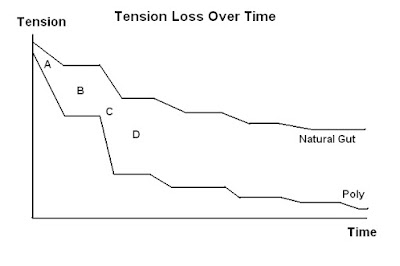
Probably something like this chart below?
At point "A", both strings start to lose tension right off the stringing machine. Poly's loss is higher than natural gut.
"B", "D" and the other horizontal lines indicate rest periods where the racket was left unused in a room.
The second big tension drop occurs during "C", which was the first session of play after stringing.
Regardless who strings the rackets, both "A" and "C" would always register the biggest tension loss. Subsequent drops would be slow and gradual.
So, it seems that the poly in M's setup could not hold tension. And the tension gap between the gut and poly had grown too huge. So huge, that their actions during ball impact became divorced, with one string doing almost all the work and the other idling.
And how did I know this feeling?
I once strung up only the mains on an old test racket and hit some balls with it...
Strangely, one played dead from the start while the other played perfectly.
The dead one felt too tight, like it was over-tensioned. We could not load the strings. There was no pocketing, no dwell time. The ball just "touched and flew off".
M felt he did not have enough time to spin nor shape the shot. This was done only in the the low 50s lbs. I figured it may need some time to break-in.
The good one performed perfectly from the first hit. As expected from gut/poly, it was comfortable, powerful, fast, spinny and had great control. However, it did not last long. Maybe 2 sessions?
Since gut was not cheap, M continued playing with both.
After several sessions with others, we met up and played again. When hitting with both setups, the pocketing had grown so deep it felt like a fishing net!
But yet, after it reached it's maximum stretch, we could feel the strings deflecting the ball back out. The dwell time was long and extended. Both were still playable but rebound angle was high.
Then it dawned on us, that it could be because one string of the hybrid had completely lost tension. Most likely the poly. The other string was actually doing most of the work during ball impact!
Probably something like this chart below?
At point "A", both strings start to lose tension right off the stringing machine. Poly's loss is higher than natural gut.
"B", "D" and the other horizontal lines indicate rest periods where the racket was left unused in a room.
The second big tension drop occurs during "C", which was the first session of play after stringing.
Regardless who strings the rackets, both "A" and "C" would always register the biggest tension loss. Subsequent drops would be slow and gradual.
So, it seems that the poly in M's setup could not hold tension. And the tension gap between the gut and poly had grown too huge. So huge, that their actions during ball impact became divorced, with one string doing almost all the work and the other idling.
And how did I know this feeling?
I once strung up only the mains on an old test racket and hit some balls with it...
Thursday, 17 December 2015
Budget Natural Gut
If natural gut could be made more affordable, then there would be much less arm injuries.
Maybe, more than half of the current string brands could also close down due to poor demand.
Other than price, there is nothing to hold anyone back from trying or using natural gut. That string alone is capable of elevating anyone's game. Natural gut excels in power, control, spin and comfort like no other.
That's why the lure of cheap gut is irresistible... (Thanks to Cullin Kin for sharing his review here)
As with most new strings, I like to weigh them and check the exact gauge. It's 14 grams for half a set of this budget natural gut. That's very heavy.
Although touted to be 16 gauge, it measured closer to 1.50mm. That's about 14L or 15 gauge! Thick!
The string felt much stiffer and coarser than all other natural guts I had tried. Whatever coating it had appeared very little and somewhat inconsistent. There were many "weak spots" where the gut had no coatings at all.
Coil memory was minimal. It just expanded apart when the cable tie was cut.
From the packing, the string was downright oily! Probably had as much oil as my breakfast bacon. Did they deep fry the natural gut before packing it?!?
Took a few pieces of tissue just to wipe off most of the oil. If not cleaned properly, it would wreck havoc on the string clamps and gripper later on during stringing.
Despite that, more oil seeped out from the string during tensioning. So it became - thread, wipe, tension, wipe, wipe...
Compared to any other natural guts, this had very little elongation during tensioning. It felt stiff, like a poly.
Most of the whitish spots in the close-up pic below were weak spots with almost zero coating. Just plain natural gut fibres twisted together. It held up well after tensioning though.
Strung as a gut/poly hybrid in a 16x19 frame at 52/48 lbs, it played terribly.
The stringbed responded ONLY to all out 100% full swings. Shots hit softer felt dead, stiff and boardy. Nothing like natural gut at all. It resembled dead full poly more than a fresh bed of gut/poly.
Giving it a benefit of doubt, my friend clobbered balls against the wall to see if the string would "break-in". But it remained dead, even after several hours of play over a few sessions.
So we moved on to try another pack that measured thinner although all were labelled as 16 gauge.
Gauge was inconsistent throughout that same piece of 6.5 metres half-set. Some parts measured 1.25mm, other area about 1.40mm.
Fortunately, this second pack was overall thinner than the first pack we tried. However, 16 gauge would mean about 1.30mm, or 1.32mm at most. This 1.40mm diameter would still put it squarely into the 15 gauge category. So gauge wise, it remained unacceptably inconsistent to me.
Using about 3 feet from the end, I pulled tensioned at 52 lbs, marked and measured the elongation and let it stay under tension for about 10 minutes. The creep, frequency and string diameter all behaved close to other natural guts I have used.
To ensure consistency with the first pack, this was strung in another identical frame, with the same poly cross, at the same tension and with the same tie-offs. Literally ceteris paribus.
Even during stringing, I could tell this would play much better. The string no longer resisted stretching like a poly. It was much softer and pliable.
However, the inconsistent gauge seemed to affect elongation slightly. Within the 8 centre mains, which are very close in length (due to the Yonex isometric head shape), the same amount of slack provided for near the string gripper DID NOT allow the tension arm to be as near parallel as it should.
Translated, this meant there would be "hot spots" on the stringbed that may be exceptionally lively and powerful. And there would be "dead spots" where the gut would yield less and have less power. All within just the centre 8 main strings.
The chap whom I strung this for, M, seemed to enjoy this setup very much. While the performance could not be rated similar to better guts, the price/performance ratio was good enough for him to consider converting to this setup. It all depends how long the playability would last.
Exactly what I meant when I mentioned the lure of cheap gut earlier.
Maybe, more than half of the current string brands could also close down due to poor demand.
Other than price, there is nothing to hold anyone back from trying or using natural gut. That string alone is capable of elevating anyone's game. Natural gut excels in power, control, spin and comfort like no other.
That's why the lure of cheap gut is irresistible... (Thanks to Cullin Kin for sharing his review here)
As with most new strings, I like to weigh them and check the exact gauge. It's 14 grams for half a set of this budget natural gut. That's very heavy.
Although touted to be 16 gauge, it measured closer to 1.50mm. That's about 14L or 15 gauge! Thick!
The string felt much stiffer and coarser than all other natural guts I had tried. Whatever coating it had appeared very little and somewhat inconsistent. There were many "weak spots" where the gut had no coatings at all.
Coil memory was minimal. It just expanded apart when the cable tie was cut.
From the packing, the string was downright oily! Probably had as much oil as my breakfast bacon. Did they deep fry the natural gut before packing it?!?
Took a few pieces of tissue just to wipe off most of the oil. If not cleaned properly, it would wreck havoc on the string clamps and gripper later on during stringing.
Despite that, more oil seeped out from the string during tensioning. So it became - thread, wipe, tension, wipe, wipe...
Compared to any other natural guts, this had very little elongation during tensioning. It felt stiff, like a poly.
Most of the whitish spots in the close-up pic below were weak spots with almost zero coating. Just plain natural gut fibres twisted together. It held up well after tensioning though.
Strung as a gut/poly hybrid in a 16x19 frame at 52/48 lbs, it played terribly.
The stringbed responded ONLY to all out 100% full swings. Shots hit softer felt dead, stiff and boardy. Nothing like natural gut at all. It resembled dead full poly more than a fresh bed of gut/poly.
Giving it a benefit of doubt, my friend clobbered balls against the wall to see if the string would "break-in". But it remained dead, even after several hours of play over a few sessions.
So we moved on to try another pack that measured thinner although all were labelled as 16 gauge.
Gauge was inconsistent throughout that same piece of 6.5 metres half-set. Some parts measured 1.25mm, other area about 1.40mm.
Fortunately, this second pack was overall thinner than the first pack we tried. However, 16 gauge would mean about 1.30mm, or 1.32mm at most. This 1.40mm diameter would still put it squarely into the 15 gauge category. So gauge wise, it remained unacceptably inconsistent to me.
Using about 3 feet from the end, I pulled tensioned at 52 lbs, marked and measured the elongation and let it stay under tension for about 10 minutes. The creep, frequency and string diameter all behaved close to other natural guts I have used.
To ensure consistency with the first pack, this was strung in another identical frame, with the same poly cross, at the same tension and with the same tie-offs. Literally ceteris paribus.
Even during stringing, I could tell this would play much better. The string no longer resisted stretching like a poly. It was much softer and pliable.
However, the inconsistent gauge seemed to affect elongation slightly. Within the 8 centre mains, which are very close in length (due to the Yonex isometric head shape), the same amount of slack provided for near the string gripper DID NOT allow the tension arm to be as near parallel as it should.
Translated, this meant there would be "hot spots" on the stringbed that may be exceptionally lively and powerful. And there would be "dead spots" where the gut would yield less and have less power. All within just the centre 8 main strings.
The chap whom I strung this for, M, seemed to enjoy this setup very much. While the performance could not be rated similar to better guts, the price/performance ratio was good enough for him to consider converting to this setup. It all depends how long the playability would last.
Exactly what I meant when I mentioned the lure of cheap gut earlier.
Friday, 26 June 2015
Kevlar / Natural Gut Hybrid
Some deem this wasteful. To them, it makes no sense to pair the deadest string with the liveliest (and most expensive) one.
The most famous user of this setup was Andre Agassi in the 1990s.
This has been on my to-do list for very long, so I strung one up to experience first hand what's so special about it...(secretly hoping that I could return serves like Agassi!)
Compared to kevlar/syn gut, natural gut added a lot more comfort, power and spin.
No break-in was needed. It was comfortable from the first hit. The most impressionable item was the extra amounts of dampening.
With syn gut crosses, kevlar felt a little harsh with a soft "pingy" vibration at impact even with a dampener. Natural gut crosses almost eliminated this ping. Sweetspot hits felt as comfortable as a full syn gut stringjob. But much more powerful.
What I did not expect from natural gut crosses was more spin. Compared to syn gut, natural gut was dry and "gummy". However, the kevlar glided smoothly, adding easy spin to serves and rallies without sacrificing power nor control. That is a huge plus.
The two major disadvantages were rapid fraying and that I could not use it in wet weather.
First pic below was after 3 sessions of about 2 hours each. Visible fraying commenced.
Given the marginal improvement over syn gut crosses, I am unlikely to try this combination again. However, I am glad to have this item completed from my to-do checklist!
The most famous user of this setup was Andre Agassi in the 1990s.
This has been on my to-do list for very long, so I strung one up to experience first hand what's so special about it...(secretly hoping that I could return serves like Agassi!)
Compared to kevlar/syn gut, natural gut added a lot more comfort, power and spin.
No break-in was needed. It was comfortable from the first hit. The most impressionable item was the extra amounts of dampening.
With syn gut crosses, kevlar felt a little harsh with a soft "pingy" vibration at impact even with a dampener. Natural gut crosses almost eliminated this ping. Sweetspot hits felt as comfortable as a full syn gut stringjob. But much more powerful.
What I did not expect from natural gut crosses was more spin. Compared to syn gut, natural gut was dry and "gummy". However, the kevlar glided smoothly, adding easy spin to serves and rallies without sacrificing power nor control. That is a huge plus.
The two major disadvantages were rapid fraying and that I could not use it in wet weather.
First pic below was after 3 sessions of about 2 hours each. Visible fraying commenced.
Pic below was after 7 sessions. Spin seemed to decrease gradually with each session but comfort and power was consistent.
Given the marginal improvement over syn gut crosses, I am unlikely to try this combination again. However, I am glad to have this item completed from my to-do checklist!
Monday, 30 March 2015
Natural Gut / Fishing Line?
After reading about my past fishing line experiments, an acquaintance got really curious. He pestered me to string one up for him to try.
With the ridiculous amount of time needed for string prep and prestretch, coupled with the low success rate and very short playing durability, I put on a straight face and quoted him something absurd.
Within seconds, he stuffed that amount into my hands. Ouch!!! Guess I have to re-live my nightmare on elm street again...
Thus far, fishing line was the only "string" that snapped and cut my hand and face during tensioning. When the string slipped, it also sent my flying clamps literally flying. The dropweight also crashed into and dented my table top. My pinky was also cut when tugging at the knot.
(If you have not read how difficult it was to string with fishing line, you can click here to find out)
While digging through my spools, and looking at the shimmering slick smooth surface, I wondered how would it perform as a cross with natural gut mains. Could it outperform poly?
Since I had plenty leftover from a previous "sponsor" and a worn set of poly needing replacement...
(Just a note that this was my personal setup. That friend had requested for something else to be paired with fishing line.)
Playtest:
- Just by tugging the mains aside and releasing it, I could see how fast and easy the snapback was.
- On court, it did not disappoint. The spin was fantastic and the strings always remained straight.
- The feel was actually identical to a freshly strung gut/poly stringjob - soft, comfortable, powerful, controlled and spinny. Perhaps a little softer since there was no poly.
- The differences was there was zero break-in needed.
- With poly, sometimes the first hits were a little tight and low-powered. Then it played better after an hour. But since fishing line behaved more like a nylon, there was much more liveliness to it.
- I would describe the fishing cross string to have "the comfort of syn gut with the slickness of poly".
- Another distinction was the consistency of tension holding. After two hours, it seemed to hold up much better than poly.
- Among all the natural gut combinations I have tried, I have no hesitations ranking this as the best for spin, comfort, power and control. The incredible slickness of the fishing line simply allowed much more free sliding between gut/fish and even fish/fish.
- The paramount task now, would be to hunt down my fishing line sponsor and find out which brand and specs of the fishing line he passed to me previously!
- The next few sessions would be interesting.
With the ridiculous amount of time needed for string prep and prestretch, coupled with the low success rate and very short playing durability, I put on a straight face and quoted him something absurd.
Within seconds, he stuffed that amount into my hands. Ouch!!! Guess I have to re-live my nightmare on elm street again...
Thus far, fishing line was the only "string" that snapped and cut my hand and face during tensioning. When the string slipped, it also sent my flying clamps literally flying. The dropweight also crashed into and dented my table top. My pinky was also cut when tugging at the knot.
(If you have not read how difficult it was to string with fishing line, you can click here to find out)
While digging through my spools, and looking at the shimmering slick smooth surface, I wondered how would it perform as a cross with natural gut mains. Could it outperform poly?
Since I had plenty leftover from a previous "sponsor" and a worn set of poly needing replacement...
(Just a note that this was my personal setup. That friend had requested for something else to be paired with fishing line.)
Playtest:
- Just by tugging the mains aside and releasing it, I could see how fast and easy the snapback was.
- On court, it did not disappoint. The spin was fantastic and the strings always remained straight.
- The feel was actually identical to a freshly strung gut/poly stringjob - soft, comfortable, powerful, controlled and spinny. Perhaps a little softer since there was no poly.
- The differences was there was zero break-in needed.
- With poly, sometimes the first hits were a little tight and low-powered. Then it played better after an hour. But since fishing line behaved more like a nylon, there was much more liveliness to it.
- I would describe the fishing cross string to have "the comfort of syn gut with the slickness of poly".
- Another distinction was the consistency of tension holding. After two hours, it seemed to hold up much better than poly.
- Among all the natural gut combinations I have tried, I have no hesitations ranking this as the best for spin, comfort, power and control. The incredible slickness of the fishing line simply allowed much more free sliding between gut/fish and even fish/fish.
- The paramount task now, would be to hunt down my fishing line sponsor and find out which brand and specs of the fishing line he passed to me previously!
- The next few sessions would be interesting.
Monday, 2 February 2015
My Gut/Poly Experience
Natural gut always attract a lot of interest and attention. It is a pricey string, but it also plays second to none.
As soon as I posted my second "pilgrimage" (link), I received a barrage of questions on how the setup plays, how long it lasts, is tension holding really that amazing, how much it costs, etc.
To save myself from becoming a broken record, I compiled some observations in this post.
Stringing
- Before opening the pack of natural gut, every grommet hole must be carefully inspected for sharp edges. Any found must be gently and smoothly sanded down. Then checked again.
- New grommets or new unstrung rackets should not have natural gut as their first stringjobs.
- Gut kinks easily. Previously, I accidentally dropped the gut after snipping off the cable tie and the entire 40 ft tangled up in a huge mess! (link). A light prestretch is a must. Not optional.
- After the prestretch, I always inspect the gut for any kinks or bad patches before stringing. If found, photos were taken and sent to the owners to decide if they want to proceed at their risk.
- To prevent friction burns, either with the grommets or the crosses, waxing is a must. I do it twice - before and after stringing.
- All clamps, including the string gripper, should be cleaned and adjusted before stringing. Too tight and the gut flattens or snaps. Too loose and it slips.
Playing
- Some claimed gut needed a break-in period. Mine played well from the first hit.
- Gut/poly was very lively, crisp and pocketed the ball very well. The string rebound was fast and powerful. The long dwell time allowed me to execute a lot of strokes I usually could not. Even late hits or last minute saves sometimes became offensive shots!
- Spin was very easy and serves were effortless. Mid-game, when I swapped back to my full syn gut for a test, I had to swing so much harder for my serves. And I lost a lot of control and double-faulted!
- Visually, my partners and I noticed my ball speed was much slower with syn gut. They could chase and return what would have been winning passing shots with natural gut.
- Comfort was supreme! The ball must have enjoyed the hits! It probably felt more like landing on a plush pillow than being bashed by a tight stringbed.
- Even with the small 85 square inch frame, I felt gut/poly opened up the sweetspot larger than on a 100 square inch frame with other strings. It inspired confidence to just let go and rip the ball back. And most times, it turned out perfectly, just like on TV! So much so, that at times, I believed I could execute some of those shots-of-the-day by the touring pros.
- Instantly, just by using gut/poly, it gave me about a 30% improvement in my overall game.
Tension Holding
- Tension stability was impressive. Nothing comes close.
- Stringbed frequency measurements below:
- As a comparison, most other strings usually drop about 30 to 40 Hz overnight after stringing without play. This setup lost only 22 Hz after 8 hours of play.
- Playing conditions (in Singapore) for the 8 hours was in the low 30s degrees Celcius. New pressurized balls were used, sometimes new Wilson trainers.
- Being excited with the setup, I stood slightly further back from the baseline than usual and swung much more freely than with my usual syn gut. In other words, I bashed the ball much harder than usual.
Poly String Death
- Since I restring myself, and none of my strings were used beyond 10 hours, I am very sensitive to flat strings.
- Somewhere around the 4th or 5th hour of use, I started struggling with this stringbed. Initially, I thought I was not performing well that session. Felt sluggish, lacked power and sprayed some shots wide. I stepped up and swung harder.
- Then, the tennis balls felt a little flat. So I changed to new balls. Immediately, control dipped. Shots flew long.
- The rebound timing of the stringbed was off. When fresh, the ball pocketed deep, then came off the strings enthusiastically, powerfully. Now it felt tired. It pocketed, but returned much slower and weaker. This longer dwell time meant a later part of my follow-through was now determining the ball trajectory.
- By the 5th session of use, which was going into its 7th and 8th hour, the sweetspot almost completely disappeared. Most of my impacts felt more like framed-shots with some light string buzzing.
- My serve lost so much pace and control. Volleys were so weak the ball kept dropping into my side of the net.
- The racket became very difficult to use and dragged me down. Shots that previously could be pulled off all fell flat.
- For the first time, the kevlar/graphite composite PS6.0 felt stiff with jarring vibrations! Both my wrist and elbow felt very uncomfortable too.
- As a simple test of resiliency, I pulled several gut mains apart and released. All snapped back very quickly. Pulling the poly crosses aside was so much easier. Less strength was needed and less resistance encountered. Not a single cross string snapped back when released. (See crosses 3 to 11 above, all pulled aside)
- Clearly, the gut was still behaving very well, and was supporting the bulk of the ball impact. However, the huge tension loss in the poly created too much "slack" for it to be of any further use.
Replacing Only the Crosses
- The beauty of a gut/poly hybrid is, you can restring ONLY the dead poly!!! (If your stringer would not do it, find another who would!)
- Beware! Hybriding poly with gut WILL NOT insure you against wrist pain nor tennis elbow. Mine hurt after merely 6 hours of use. The poly "died". Use poly safely. Always replace them after 8 to 10 hours, or less.
- While removing the cut poly strings, a sharp edge caught on the gut and snapped the 7th main. Fortunately, the tension loss was contained within the top 2 and bottom 2 crosses due to the way I had strung earlier (link).
- I clamped the 4th main on both sides, re-worked and re-tensioned only the 5th and 6th main strings. Thus converted the gut to fill only the centre 12 mains. The centre 8 mains were completely untouched from its initial stringjob.
- I smeared some coconut oil on the gut strings to lubricate it. Then filled all the rest with synthetic gut and saved a snapped gut string job!
Playtest
- The stringbed came to life again!
- All the earlier felt components - power, control and comfort came back in full force! Only spin was slightly less than before.
- At my first session after this re-work, my partner, "F", commented via a sms message after our game:
"Actually today your shots were pretty accurate, percentage higher than all other times. Strings or skill?!"
- It had to be the natural gut! How could I improve so fast?
As soon as I posted my second "pilgrimage" (link), I received a barrage of questions on how the setup plays, how long it lasts, is tension holding really that amazing, how much it costs, etc.
To save myself from becoming a broken record, I compiled some observations in this post.
Stringing
- Before opening the pack of natural gut, every grommet hole must be carefully inspected for sharp edges. Any found must be gently and smoothly sanded down. Then checked again.
- New grommets or new unstrung rackets should not have natural gut as their first stringjobs.
- Gut kinks easily. Previously, I accidentally dropped the gut after snipping off the cable tie and the entire 40 ft tangled up in a huge mess! (link). A light prestretch is a must. Not optional.
- After the prestretch, I always inspect the gut for any kinks or bad patches before stringing. If found, photos were taken and sent to the owners to decide if they want to proceed at their risk.
- To prevent friction burns, either with the grommets or the crosses, waxing is a must. I do it twice - before and after stringing.
- All clamps, including the string gripper, should be cleaned and adjusted before stringing. Too tight and the gut flattens or snaps. Too loose and it slips.
Playing
- Some claimed gut needed a break-in period. Mine played well from the first hit.
- Gut/poly was very lively, crisp and pocketed the ball very well. The string rebound was fast and powerful. The long dwell time allowed me to execute a lot of strokes I usually could not. Even late hits or last minute saves sometimes became offensive shots!
- Spin was very easy and serves were effortless. Mid-game, when I swapped back to my full syn gut for a test, I had to swing so much harder for my serves. And I lost a lot of control and double-faulted!
- Visually, my partners and I noticed my ball speed was much slower with syn gut. They could chase and return what would have been winning passing shots with natural gut.
- Comfort was supreme! The ball must have enjoyed the hits! It probably felt more like landing on a plush pillow than being bashed by a tight stringbed.
- Even with the small 85 square inch frame, I felt gut/poly opened up the sweetspot larger than on a 100 square inch frame with other strings. It inspired confidence to just let go and rip the ball back. And most times, it turned out perfectly, just like on TV! So much so, that at times, I believed I could execute some of those shots-of-the-day by the touring pros.
- Instantly, just by using gut/poly, it gave me about a 30% improvement in my overall game.
Tension Holding
- Tension stability was impressive. Nothing comes close.
- Stringbed frequency measurements below:
| Total Usage (hours) | Frequency (Hz) |
|---|---|
Strung
|
659.0
|
1.5
|
648.0
|
3.0
|
643.8
|
4.0
|
640.9
|
6.0
|
639.3
|
8.0
|
637.0
|
- As a comparison, most other strings usually drop about 30 to 40 Hz overnight after stringing without play. This setup lost only 22 Hz after 8 hours of play.
- Playing conditions (in Singapore) for the 8 hours was in the low 30s degrees Celcius. New pressurized balls were used, sometimes new Wilson trainers.
- Being excited with the setup, I stood slightly further back from the baseline than usual and swung much more freely than with my usual syn gut. In other words, I bashed the ball much harder than usual.
Poly String Death
- Since I restring myself, and none of my strings were used beyond 10 hours, I am very sensitive to flat strings.
- Somewhere around the 4th or 5th hour of use, I started struggling with this stringbed. Initially, I thought I was not performing well that session. Felt sluggish, lacked power and sprayed some shots wide. I stepped up and swung harder.
- Then, the tennis balls felt a little flat. So I changed to new balls. Immediately, control dipped. Shots flew long.
- The rebound timing of the stringbed was off. When fresh, the ball pocketed deep, then came off the strings enthusiastically, powerfully. Now it felt tired. It pocketed, but returned much slower and weaker. This longer dwell time meant a later part of my follow-through was now determining the ball trajectory.
- By the 5th session of use, which was going into its 7th and 8th hour, the sweetspot almost completely disappeared. Most of my impacts felt more like framed-shots with some light string buzzing.
- My serve lost so much pace and control. Volleys were so weak the ball kept dropping into my side of the net.
- The racket became very difficult to use and dragged me down. Shots that previously could be pulled off all fell flat.
- For the first time, the kevlar/graphite composite PS6.0 felt stiff with jarring vibrations! Both my wrist and elbow felt very uncomfortable too.
- As a simple test of resiliency, I pulled several gut mains apart and released. All snapped back very quickly. Pulling the poly crosses aside was so much easier. Less strength was needed and less resistance encountered. Not a single cross string snapped back when released. (See crosses 3 to 11 above, all pulled aside)
- Clearly, the gut was still behaving very well, and was supporting the bulk of the ball impact. However, the huge tension loss in the poly created too much "slack" for it to be of any further use.
Replacing Only the Crosses
- The beauty of a gut/poly hybrid is, you can restring ONLY the dead poly!!! (If your stringer would not do it, find another who would!)
- Beware! Hybriding poly with gut WILL NOT insure you against wrist pain nor tennis elbow. Mine hurt after merely 6 hours of use. The poly "died". Use poly safely. Always replace them after 8 to 10 hours, or less.
- While removing the cut poly strings, a sharp edge caught on the gut and snapped the 7th main. Fortunately, the tension loss was contained within the top 2 and bottom 2 crosses due to the way I had strung earlier (link).
- I clamped the 4th main on both sides, re-worked and re-tensioned only the 5th and 6th main strings. Thus converted the gut to fill only the centre 12 mains. The centre 8 mains were completely untouched from its initial stringjob.
- I smeared some coconut oil on the gut strings to lubricate it. Then filled all the rest with synthetic gut and saved a snapped gut string job!
Playtest
- The stringbed came to life again!
- All the earlier felt components - power, control and comfort came back in full force! Only spin was slightly less than before.
- At my first session after this re-work, my partner, "F", commented via a sms message after our game:
"Actually today your shots were pretty accurate, percentage higher than all other times. Strings or skill?!"
- It had to be the natural gut! How could I improve so fast?
Thursday, 22 January 2015
ProStaff 6.0 85 with Gut/Poly
Now that the weather in Singapore is turning dry, I thought it might be an opportune time for my second "pilgrimage" with the ProStaff 6.0 85. The first was completed here.
Gut/Poly hybrid is a holy grail all ProStaff 6.0 owners must try. It is touted to open up the sweetspot, add controlled power, offer incredible comfort and maximum topspin anyone can muster.
This racket has a drill pattern with skips at 7 & 9, top and bottom. With natural gut in the mains, the blocked holes can create problems for the crosses later. Using an awl or even a scrap piece of string to "unblock" the holes can stress or easily snap the completed natural gut mains.
Since I had about 20 ft of natural gut from the half-set, I calculated there was more than enough for the mains.
So, while doing the mains, I filled the top 2 and bottom 2 crosses before completing the last mains. That solved all the blocked holes problem.
Specifically (T=Top, B=Bottom):
- Complete mains 1 to 6 for both left and right sides,
- Fill 7th main on right side but do not tension,
- Using left mains, complete crosses 7B & 9B,
- Fill and tension 7th main on left side,
- Tension 7th main on right side, then complete crosses 7T & 9T,
- Complete both outer mains and tie-off at bottom.
(Or you can complete mains 1 to 6, then box the rest. However, you may need to open up a new tie-off hole.)
Other than preventing problems with blocked holes, any tension loss from tie-off is isolated from spreading to the inner mains. This offers better tension stability.
Instead of discarding the excess natural gut, using it the fill the outermost crosses helps to soften the dead spots a little, reducing vibrations. A little shorter length, maybe 3-4 ft less, of cross strings was needed to fill the rest of the crosses too.
Another advantage was having an easier time weaving the dreaded final poly cross string since there was more space away from the 6 o'clock mounting. You can see the difference immediately from the pic below!
Natural gut is a beautiful string to look at. That golden translucent glow is mesmerizing. Here's a close-up pic.
For those who think it takes a lot to wield the 85 square inch racket, know that the difference between an 85 and 95 square inch is very minor. You can see the comparison here.
Compared to syn gut, multi, or poly, gut/poly is definitely more expensive. Probably by about twice or thrice. However, most users, who were not chronic string breakers, were able to eke out at least double the playable string life, compared to their non-gut setup.
Some even claimed their gut combos lasted more than 50 hours! If you do the sums, paying twice the amount for five times as long durability, isn't gut cheaper?
Playtest:
Here's how it looked after about 2 hours of ball bashing. No need to straighten strings and absolutely zero notching.
- Comfort --> Extremely Good
- Spin --> Extremely Good
- Power --> Extremely Good
- Control --> Extremely Good
- Durability --> Still testing
- The greatest difference was how much easier gut/poly made the game. There were so many shots that I could not execute with other strings that were easily achieved with this. It's almost like legalized cheating!
Gut/Poly hybrid is a holy grail all ProStaff 6.0 owners must try. It is touted to open up the sweetspot, add controlled power, offer incredible comfort and maximum topspin anyone can muster.
This racket has a drill pattern with skips at 7 & 9, top and bottom. With natural gut in the mains, the blocked holes can create problems for the crosses later. Using an awl or even a scrap piece of string to "unblock" the holes can stress or easily snap the completed natural gut mains.
Since I had about 20 ft of natural gut from the half-set, I calculated there was more than enough for the mains.
So, while doing the mains, I filled the top 2 and bottom 2 crosses before completing the last mains. That solved all the blocked holes problem.
Specifically (T=Top, B=Bottom):
- Complete mains 1 to 6 for both left and right sides,
- Fill 7th main on right side but do not tension,
- Using left mains, complete crosses 7B & 9B,
- Fill and tension 7th main on left side,
- Tension 7th main on right side, then complete crosses 7T & 9T,
- Complete both outer mains and tie-off at bottom.
(Or you can complete mains 1 to 6, then box the rest. However, you may need to open up a new tie-off hole.)
Other than preventing problems with blocked holes, any tension loss from tie-off is isolated from spreading to the inner mains. This offers better tension stability.
Instead of discarding the excess natural gut, using it the fill the outermost crosses helps to soften the dead spots a little, reducing vibrations. A little shorter length, maybe 3-4 ft less, of cross strings was needed to fill the rest of the crosses too.
Another advantage was having an easier time weaving the dreaded final poly cross string since there was more space away from the 6 o'clock mounting. You can see the difference immediately from the pic below!
Natural gut is a beautiful string to look at. That golden translucent glow is mesmerizing. Here's a close-up pic.
Compared to syn gut, multi, or poly, gut/poly is definitely more expensive. Probably by about twice or thrice. However, most users, who were not chronic string breakers, were able to eke out at least double the playable string life, compared to their non-gut setup.
Some even claimed their gut combos lasted more than 50 hours! If you do the sums, paying twice the amount for five times as long durability, isn't gut cheaper?
Playtest:
Here's how it looked after about 2 hours of ball bashing. No need to straighten strings and absolutely zero notching.
- Comfort --> Extremely Good
- Spin --> Extremely Good
- Power --> Extremely Good
- Control --> Extremely Good
- Durability --> Still testing
- The greatest difference was how much easier gut/poly made the game. There were so many shots that I could not execute with other strings that were easily achieved with this. It's almost like legalized cheating!
Monday, 10 November 2014
Budget Strings?
The lure of fresh strings is difficult to resist. If not for its price, everyone would follow the restringing patterns of their favourite players on tour.
When sufficient unfulfilled needs arise, a business opportunity comes by. So budget strings popped up, some at merely ¼ or less the price of original brand names they claim to replicate.
Since I have yet to figure out how to grow money on trees, I jumped on the bandwagon too. Then got off. And on. And off. Multiple times. (No brands nor models will be mentioned here)
There are multitudes who "swear by" the quality of these strings. And probably an equal number who threw out unused reels.
So far, I have succumbed to cheap natural guts, syn guts, polys and kevlar. Out of about nine different strings I tried (many multiple times), I thought a few polys were not bad, playing almost 70-80% similar to the real deal.
Usually, two similar sticks were strung, one with original strings, one dud. They were rotated during play every fifteen minutes. A single new can of balls was used.
At 15 minutes, both were almost indistinguishable. At 30 minutes, significant tension loss started creeping in. At 45 minutes, control and spin departed to string heaven. Budget price for budget durability too?
The kevlar did not feel like kevlar to me. More like garden wire. (link) The syn gut was completely devoid of any feel or feedback. It gave me the impression it was strung with coaxial cable.
Buying and stringing the budget natural gut was like playing russian roulette. One batch was kinked with white fold-lines straight out the package. Could have been the shipping, so after some negotiation, I settled on 50% price for a replacement and some freebies.
Nevertheless, I strung it up at 52 lbs. And it snapped in the bag overnight, right at the kinked spot. The replacement arrived in better shape. However, my gripe was the huge variability in gauge from start to end. I think it ranged between a 15g to 17g. And it was uncoated.
As it is, my tennis game is pathetic enough. Add to that my Mr Bean styled footwork is enough to make anyone collapse in laughter. Unless I'm bent on working towards ntrp 0.0, I would be giving all these budget strings a miss.
Or I could save them for competitors who beat the crap out of me everytime...
When sufficient unfulfilled needs arise, a business opportunity comes by. So budget strings popped up, some at merely ¼ or less the price of original brand names they claim to replicate.
Since I have yet to figure out how to grow money on trees, I jumped on the bandwagon too. Then got off. And on. And off. Multiple times. (No brands nor models will be mentioned here)
There are multitudes who "swear by" the quality of these strings. And probably an equal number who threw out unused reels.
So far, I have succumbed to cheap natural guts, syn guts, polys and kevlar. Out of about nine different strings I tried (many multiple times), I thought a few polys were not bad, playing almost 70-80% similar to the real deal.
Usually, two similar sticks were strung, one with original strings, one dud. They were rotated during play every fifteen minutes. A single new can of balls was used.
At 15 minutes, both were almost indistinguishable. At 30 minutes, significant tension loss started creeping in. At 45 minutes, control and spin departed to string heaven. Budget price for budget durability too?
The kevlar did not feel like kevlar to me. More like garden wire. (link) The syn gut was completely devoid of any feel or feedback. It gave me the impression it was strung with coaxial cable.
Buying and stringing the budget natural gut was like playing russian roulette. One batch was kinked with white fold-lines straight out the package. Could have been the shipping, so after some negotiation, I settled on 50% price for a replacement and some freebies.
Nevertheless, I strung it up at 52 lbs. And it snapped in the bag overnight, right at the kinked spot. The replacement arrived in better shape. However, my gripe was the huge variability in gauge from start to end. I think it ranged between a 15g to 17g. And it was uncoated.
As it is, my tennis game is pathetic enough. Add to that my Mr Bean styled footwork is enough to make anyone collapse in laughter. Unless I'm bent on working towards ntrp 0.0, I would be giving all these budget strings a miss.
Or I could save them for competitors who beat the crap out of me everytime...
Saturday, 1 November 2014
Difficulties of Hybriding Strings
Many asked for recommendations how to hybrid and pair strings.
Most commonly:
- What tensions for mains and crosses? Any differentials?
- Which string for mains?
- Which for crosses?
- What gauge?
- Prestretch?
Personally, I do not enjoy hybrids. (I have even tried tri-brids and quad-brids!) No matter what I pair together - kevlar, syn gut, multifilament, natural gut, soft poly, stiff poly, fishing line, steel wire or grass trimmer line, it was extremely difficult to balance them well.
Inevitably, one string would dominate over the other. Usually, the feel and playing characteristics of the mains prevail. Once in a while, the crosses.
I am far from solving this puzzle, but I believe it has something to do with how the strings behave at different tensions.
When pulled to 55 lbs, the amount of total stretch observed in the following strings were:
- natural gut 6~7%
- synthetic gut 9~10%
- multifilament 10~12%
- poly 3~4%
- kevlar 1~2%
The numbers were in a range due to different batches and brands.
These same strings, when pulled an extra 10 lbs, bringing them to 65 lbs, yielded an incremental stretch of:
- natural gut 0.4~0.7%
- synthetic gut 0.8~1.1%
- multifilament 0.5~1.2%
- poly 0.1~0.3%
- kevlar 0%
The conventional wisdom is to string the softer string a couple pounds tighter. Using poly/syn gut at 53/55 lbs for example, would see them stretch about 3.5% and 9.5% respectively when strung.
However, during ball impact, the amount of additional poly stretch available is less than half that of the syn gut. Even though the strings are inter-weaved together, hard impacts bring the poly into deformation territories.
In other words, poly gets stretched beyond its elastic range and loses tension. Over time, the feel of the syn gut increases. (see "Impact Loss" in table below)
And that's only assuming one plays with the racket immediately off the stringing machine.
When allowed to rest from being strung at 51 lbs each, the "Actual Pre-Impact Tension" has already dropped to 30/39 lbs! This differential would only get wider with every ball hit.
Having established this, then how about we string poly higher instead? Would that help to compensate for its larger pre-impact tension loss compared to syn gut?
Probably yes. But only for a while before impact tension loss brings down the tension again. How fast this happens depends on how tightly strung it initially was and how hard one hits the ball.
Another often overlooked factor is string gauge while pairing. Many choose the same gauge for hybrids, typically 17g or about 1.25mm.
Using the same example of poly/syn gut earlier, from my own measurements, the 1.25/1.25 mm combination would thin out to about 1.20/1.13 mm.
Below pic shows a 1.40mm syn gut became 1.25mm strung.
Below shows a 1.25mm syn gut thin to 1.10mm strung.
An easy way to calculate this diameter change would be to use the percentage stretch as a proxy. A 1.25mm string with 10% stretch, usually becomes 1.13mm (0.90 x 1.25) strung.
Simple engineering dictates, the thicker the material, the stronger the support. This could be another factor why the poly mains dominate when paired with syn gut in the same gauge. Well, but many people like it, so it's their choice.
Perhaps after reading this, one could start deducing why Federer is touted to be using 1.30mm gut mains and 1.25mm poly crosses:
0.93 x 1.30 = 1.209 mm
0.96 x 1.25 = 1.200 mm
The same gauge combination of 16G gut and 16L poly for Serena Williams as well? (link) And Sharapova? (link) And Nishikori? (link)
That said, my personal preference is still a full bed of the same string. Primarily for its ease of adjustment and consistency after play. If I were to cut strings out after every hour of play, then it might change.
After all, according to the Luxilon String Analysis at the 2013 US Open (link, refer pg 6-10), more than 70% of the competitors used the SAME STRING in both mains and crosses.
Special thanks to Irvin for highlighting that report. (link)
Most commonly:
- What tensions for mains and crosses? Any differentials?
- Which string for mains?
- Which for crosses?
- What gauge?
- Prestretch?
Personally, I do not enjoy hybrids. (I have even tried tri-brids and quad-brids!) No matter what I pair together - kevlar, syn gut, multifilament, natural gut, soft poly, stiff poly, fishing line, steel wire or grass trimmer line, it was extremely difficult to balance them well.
Inevitably, one string would dominate over the other. Usually, the feel and playing characteristics of the mains prevail. Once in a while, the crosses.
I am far from solving this puzzle, but I believe it has something to do with how the strings behave at different tensions.
When pulled to 55 lbs, the amount of total stretch observed in the following strings were:
- natural gut 6~7%
- synthetic gut 9~10%
- multifilament 10~12%
- poly 3~4%
- kevlar 1~2%
The numbers were in a range due to different batches and brands.
These same strings, when pulled an extra 10 lbs, bringing them to 65 lbs, yielded an incremental stretch of:
- natural gut 0.4~0.7%
- synthetic gut 0.8~1.1%
- multifilament 0.5~1.2%
- poly 0.1~0.3%
- kevlar 0%
The conventional wisdom is to string the softer string a couple pounds tighter. Using poly/syn gut at 53/55 lbs for example, would see them stretch about 3.5% and 9.5% respectively when strung.
However, during ball impact, the amount of additional poly stretch available is less than half that of the syn gut. Even though the strings are inter-weaved together, hard impacts bring the poly into deformation territories.
In other words, poly gets stretched beyond its elastic range and loses tension. Over time, the feel of the syn gut increases. (see "Impact Loss" in table below)
And that's only assuming one plays with the racket immediately off the stringing machine.
(from Tennis Warehouse University String Performance Database link)
When allowed to rest from being strung at 51 lbs each, the "Actual Pre-Impact Tension" has already dropped to 30/39 lbs! This differential would only get wider with every ball hit.
Having established this, then how about we string poly higher instead? Would that help to compensate for its larger pre-impact tension loss compared to syn gut?
Probably yes. But only for a while before impact tension loss brings down the tension again. How fast this happens depends on how tightly strung it initially was and how hard one hits the ball.
Another often overlooked factor is string gauge while pairing. Many choose the same gauge for hybrids, typically 17g or about 1.25mm.
Using the same example of poly/syn gut earlier, from my own measurements, the 1.25/1.25 mm combination would thin out to about 1.20/1.13 mm.
Below pic shows a 1.40mm syn gut became 1.25mm strung.
An easy way to calculate this diameter change would be to use the percentage stretch as a proxy. A 1.25mm string with 10% stretch, usually becomes 1.13mm (0.90 x 1.25) strung.
Simple engineering dictates, the thicker the material, the stronger the support. This could be another factor why the poly mains dominate when paired with syn gut in the same gauge. Well, but many people like it, so it's their choice.
Perhaps after reading this, one could start deducing why Federer is touted to be using 1.30mm gut mains and 1.25mm poly crosses:
0.93 x 1.30 = 1.209 mm
0.96 x 1.25 = 1.200 mm
The same gauge combination of 16G gut and 16L poly for Serena Williams as well? (link) And Sharapova? (link) And Nishikori? (link)
That said, my personal preference is still a full bed of the same string. Primarily for its ease of adjustment and consistency after play. If I were to cut strings out after every hour of play, then it might change.
After all, according to the Luxilon String Analysis at the 2013 US Open (link, refer pg 6-10), more than 70% of the competitors used the SAME STRING in both mains and crosses.
Special thanks to Irvin for highlighting that report. (link)
Subscribe to:
Comments (Atom)