Showing posts with label racket test. Show all posts

Tuesday, 28 January 2020

Warped Hoop - Head Gravity

The recently launched Head Gravity series of tennis rackets are really soft and arm friendly. 

This rare flex got many players on board, especially previous users of the Babolat Pure Drives and Aero Pros.

However, their feedback has been mixed. Some loved the Gravity while many others hated its inconsistency and lack of accuracy.

In stock form, I find the power and stability lacking.

However, it is the incredibly soft hoop that poses the biggest problems. It is almost as soft as the old but very popular Head Prestige.

Maintaining hoop shape while stringing this Gravity is challenging. I received so many badly warped hoops that rendered the racket unplayable.

Take a look yourself at the three videos below...

The stringjob in this first video was done by another stringer. You can see the Head logo stenciled. The hoop was approximately 24.8cm wide.


In the second video below, the hoop width was approximately 25.3cm after the strings were cut and removed.


The third video showed the width to be almost exactly 25.3cm after I restrung it. No stencil. Almost zero distortion.


Naturally, the player loved the distortion free stringjob.

If you have a Head Gravity playing inconsistently, it could be the stringing. Try measuring the hoop width without and with strings.

PS: Sorry about the lousy video quality...somehow it deteriorated after uploading


Friday, 15 March 2019

Wilson Clash Customization

The latest Wilson Clash seemed interesting. 

Marketing generated so much hype that even during pre-launch in late 2018, I received many questions from players about its potential to up their game.

It did not take long before both versions were sent in to me for stringing and modifications.

I had a few hits with some that were sent to me strung. Surprisingly, many were strung with poly/multi or full multi. Few were with full poly. 

Dampener or not, the feel was very muted yet included a lot of buzz and trembling. This felt exactly like "hoop wobble" (link). Immediately, this hinted a potentially very soft hoop. Extra care needed when stringing. 


When lacing up the centre main, what struck me was how big the modern grommet holes were. Every hole was large enough to be a tie-off hole. That made threading strings very easy.


My earlier suspicions were confirmed when tensioning the mains. Previous soft hoops I worked on warped more when outer mains like 6, 7 or 8 were tensioned. The Clash started warping significantly from inner mains like 3, 4 and 5. That is a very significant change and carries huge implications.


Crosses start very high and have smaller gaps near 12 o'clock. These gaps almost double near the last few bottom crosses. Another hint of potential erratic stringbed response especially nearer the top quarter or top third which most professional players like to contact the ball at.

When weaving the crosses, the gaps kept reminding me of the earlier Burn series. It was so wide it created control issues for many. And those that could somehow control the ball snapped strings too quickly. Would this happen with the Clash open gaps? (I was later updated by several their strings notched extra fast in the Clash compared to their own 16x19 stringbeds)


As I examined the throat area, I noticed a notched recessed area inside the throat. (Somewhere beside the "o" and "n" of the red "Wilson" wordings) This must be where the racket is flexing on impact. Interesting. Few rackets I can think of, other than wood, flex at such a low and faraway point away from impact point.

Not long after, another Clash came in. Brand new unstrung. For very heavy customizations for a touring professional.


Armed with the feedback from the earlier few Clashes, I took up the challenge. 

It was a challenge because the Clash was marketed as a very powerful frame. Many complained of timing issues and erratic hot spots on the stringbed. And it had very open strings coupled with a very soft flex of about 55. All these pointed to control issues.

To add power or weight meant doubling up on these control problems.

Nevertheless, I did the calculations and it all added up nicely. So I proceeded.

First step, strip the grommets.


Now that you see how much lead tape I am adding, can you understand why I said it was a challenge to add control and keep the ball in? For a professional full time tennis player!

(I scribbled on the lead tape too!)


Grommet installation was very very easy. Took me about 4 seconds. Fastest I have ever reinstalled top grommets after adding lead tape.


For this ease of reinstallation, I have to thank Wilson for this modern grommet design. The centre pieces always cause the biggest obstructions. So they cleverly separated the centre 10 grommets from the bumper guard. And the drilling featured extra large holes for easy grommet installation. Well done Wilson!! And thank you!!


Typical of a new unstrung before racket, the grommets need to be seated properly to ensure a playable string job. Look at the red circles area below, compare the properly seated grommet with the "unseated" one.

Do not assume this happens automatically when you pull tension. I have several strung frames sent in to me with the grommets still "unseated".
 

Until now I do not understand why so many are enamored and mesmerized by silicone in the butt. Everyone I customize for asked for it!


Final checks before handing the frame over to the player. So far the hoop size QC seems very consistent. All Clash and Clash Tour I worked on measured 326mm length and 251mm width for the inside hoop from base of grommet to base of grommet. Zero hoop distortion achieved.


PS: No details of racket weights, specs nor string tensions would be revealed as these players are still actively competing. So please do not ask. 


Wednesday, 26 April 2017

Oldie: Wilson Profile Tour 95


A player I was working with gave this oldie to me. It belonged to his dad who has long stopped using this racquet.

I changed the grips, restrung it and re-balanced it to my preference. Ended up almost 370 grams with swingweight about mid-350s.


Very rare for a stick from the 80s or 90s to have a trap door in the butt cap. Made adjustments very easy!


It played very well. The flex recovery was very fast. All my playing partners felt there was no flex at all. But it was there! All in the hoop, nothing at the throat at all.

Really a beast of a racket to play with. Enormous power, with surprisingly, fantastic built-in dampening. 


Only problem was it was not really a 95 square inch. Probably much closer to 90. I aligned the Wilson Profile Tour with the ProStaff 90 and it was only marginally larger. 

No wonder I struggled finding the sweetspot sometimes.

Nevertheless, an absolute delight to play with!


Monday, 27 March 2017

Replicating a Pro Stock - Wilson ProStaff 90

A tennis coach cum former tour player asked if I could replicate a pro stock racket he had bought some time ago.

To me, pro stock is just a customized frame based on a particular user's requirements. 


That said, of course the manufacturer's pro room would be able to do much more, such as the grip, flex profile, string pattern, graphite layup, etc


This coach just wanted something close to what he had. 
I have never met him, so there was no way to verify if his racket was indeed pro stock. 

After I received the funds, I procured the racket and start tweaking it to his specs.

He asked me to post some pics of the modifications process in this blog. No details though. So here they are...


Tuesday, 6 December 2016

Replicating an ATP Top Ten Professional Racket Specs

Through an introduction from someone I have worked with, I met a chap who claimed to be a ntrp 4.5-5.0 player and needed some help.

Everytime I hear about someone's self-rated ntrp rating, it was always inflated. So I took it with a pinch of salt.

We met for coffee.

He requested for anonymity so I cannot post too much details. I'll call him "RX".

In a nutshell, RX was a college player who dabbled in several futures tournaments. He trained and played through pain, and is now paying the price with recurring tennis elbow. 

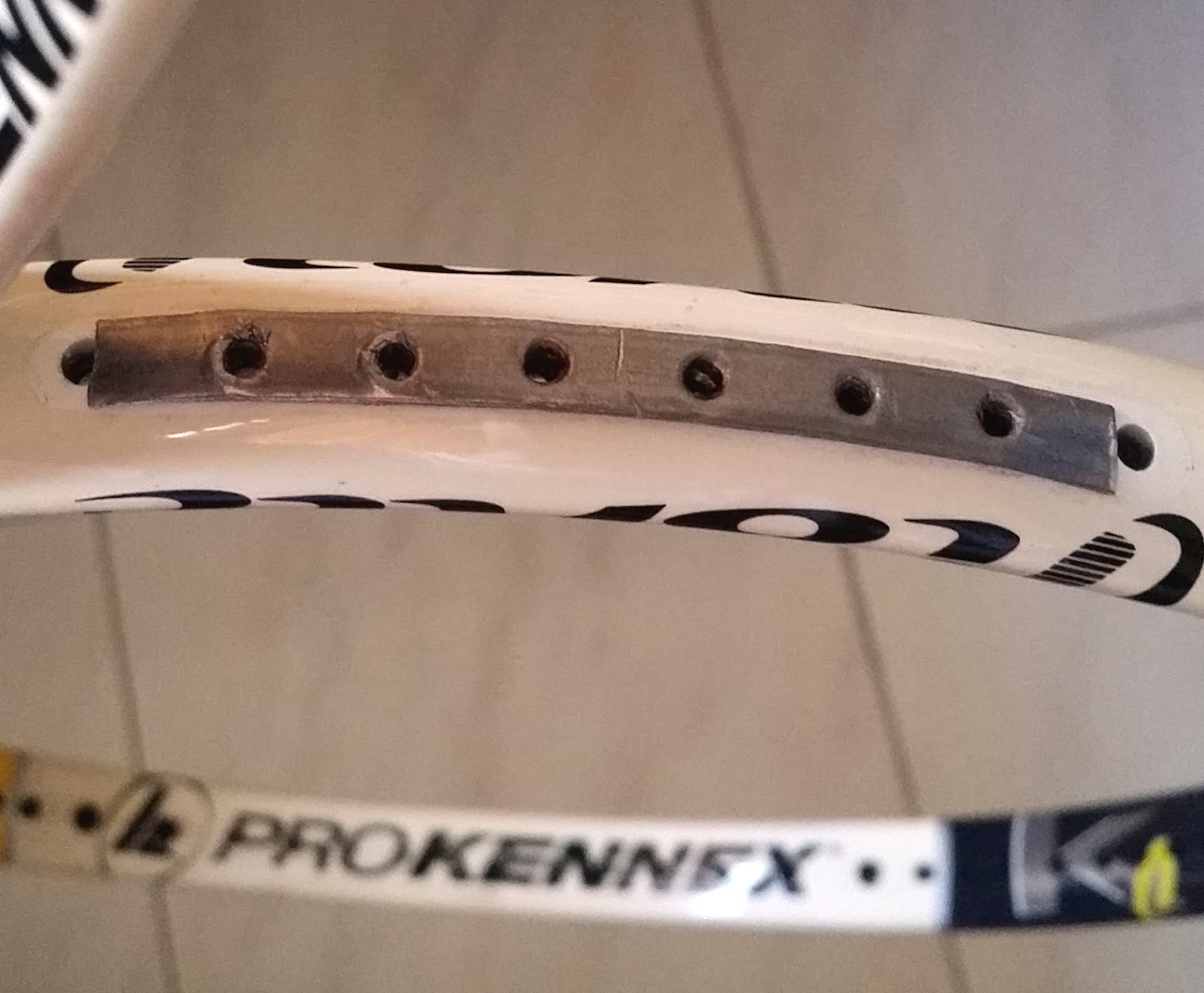
Surprisingly, he has never heard of ProKennex rackets. And the racket manufacturer's claim that it helps with tennis elbow! 

If you missed the test report by the professor from Massachusetts Institute of Technology, it was quite impressive! (link)

The question RX kept asking was whether this comfort-oriented racket could perform for a high level player. Other than Andreas Seppi, he could not google anyone else using a ProKennex on tour. 

RX was not the first, nor the only high-level player asking me that question. So I had expected it.

Ultimately, there was only one way to find out. RX gave me his racket specs and asked if I would be willing to modify one of my ProKennex to his exact specs. Then let him test. He offered to bear all materials cost plus labour.

I accepted. 

What intrigued me was that his specs was similar to a current ATP top ten male player. I have always wondered how would such a stick wield. How could I turn away this chance to kill two birds with one stone? And I still get to keep my racket after!!!

If you are a hardcore follower of tour pro's racket specs, you will know there are only three variables that determine every other aspect of the racket.

RX allowed me to share only one digit from each of the three variables. See if you can make any sense out of it:
x6x
x5x
x2x

Here's some pics of the process...


Added three layers of lead tape under the bumper in above pic.


Added three layers of lead tape inside throat grommets.


Can still see the thick layers of lead tape after replacing the throat grommet.


This was the peek inside the butt before some silicone and lead was inserted. If you are attempting this, please remove the rusty staples first.

These were just a part of the changes made. There were others that I agreed to keep confidential.

When all was completed, I went to RX's apartment for a playtest with his hitting partner. I observed.

As RX was here on holiday and recuperating from his tennis elbow, he was a little rusty. His timing was off for some difficult shots. But during co-operative hitting, I was amazed at his consistency, depth, direction and spin. It looked so effortless!

It rained last night so I could see the ball marks where his shots landed. For that co-operative hitting, I could fit 90% of his shots within a 4 ft by 4 ft square! And they were not pushing, blocking nor dinking the ball!

Search youtube for tour pro practice videos. That's how it looked like. Very humbling for a hacker like me. With their kind of pace and spin, I would not have lasted more than 3-4 shots in their usual 15-20 shots rallies.

And the sound of their ball impacts were loud and crisp. The ball crushing came with loud distinct pops.


Then they played a match while I sat miserably staring at my phone.

Almost two hours and very little pain or discomfort. I could see RX was back to swinging the racket freely. He was no longer held back by pain, nor fear of pain. 

When I had my chance later, the racket was quite maneuverable. Heavy but not completely unwieldy. Not as difficult to use as I had imagined it to be. I liked the plowthrough and stability!

Thanks RX, I enjoyed working with you and have learnt much too!


Thursday, 10 November 2016

It's the Racket & Strings!!!!

During my game, I noticed a group of teenagers playing a doubles match next court under the watchful eyes of their coach.

School team players I suppose. After my session, I sat outside to chill and see if I could learn a thing or two from them.

Between sips, I observed their footwork, movement, anticipation, strategy, serves, strokes, style of play, etc. 

As the coach barked instructions, it appeared clear to me that all four players were struggling not because of technique, but due to "inferior" equipment.

Among them were two Babolats, one Wilson and one Head racket. From the impact sound, all were strung with poly strings. New tournament balls were used.

Those are all good rackets. By "inferior", I meant ill-fitting. It seemed like they were selecting based on marketing hype rather than proper fit. (link1)(link2)

Physically, all four of them were about 1.6+ metres tall, and probably only low-60s kg. All were tanned and skinny.

The table below summed up my observations, assuming their rackets were unmodified:


Other than Player "C", the rest were all late on contact for serves and return of serves. It was evident the swingweights of 335, 327 and 332 were too much for Players "A", "B" and "D" respectively. Second serves were all suicide serves.

Neither could they control their serve returns accurately. Other than "C", most of their serve returns were either mere blocks or mis-hits. "C" hit some beautiful down-the-lines and passed the net guy, and some lob returns as well.

Groundstrokes were the only part of the game they did well in. But ironically, players "B" and "C" who were using the spinnest rackets were hitting the flattest groundstrokes! 

From my estimate, about two-thirds to three-quarters of "B" and "C" topspin shots were sitters which their opponents slammed down on. That could be why they hit flat to keep the bounce low.

For volleys, only "A" managed some consistency in imparting backspin and placing the shots into blank spaces. Even "C", who used the lowest swingweight, struggled. Could be pain in his elbow. 

A soft spoken lady, I presume to be the mother of one of the boys, saw me shaking my head incessantly, and came over to ask why.

I asked which kid was hers and shared the same information I posted above. Being a long-time tennis player herself, she agreed. However, the kid was insistent not to lose his strongest part of the game - groundstrokes.

From the impact sounds, the bite, dwell time and the way the ball comes off the strings, I felt the poly strings were all past their prime or tensioned way too high. In my opinion, none needed poly strings.

If they would heed advice, this would be one group where a racket and string change would yield almost immediate improvements to their game. I have made it happen many times.

But well..... like the mother said, they are entitled to their own choices.


Tuesday, 26 April 2016

Babolat AeroPro Drive (2007)


I'm late to the Babolat party...

On many occasions, I tried different versions of the APD on court. It is such a popular racket that someone would surely show up with it.

However, this time I set aside my own and hit exclusively with the 2007 APD for about 20+ hours. Both to test the racket and some exotic strings which would remain unknown.

While the specs (link) may claim a total weight of about 320 grams with 324 swingweight, the one I tested was 330 grams strung and gripped. Swingweight was very close to 330.

Not a big deal to me since I am no stranger to heavy sticks. (link)

Strangely, this APD felt slow and unwieldy. My timing was late. Everything including serves, serve returns and forehands. I could not understand it. It felt like I just finished the ironman triathlon minutes before playing tennis.

Naturally, I ended up arming/muscling the racket through. But I was still late. And the power threw my control haywire. I could not control the ball depth nor direction!

After struggling like a clown, my NTRP 4.5+ friend, a decade-long APD user, chuckled and pointed out the "secret tip" to me...

"It's a swinger's stick... try standing further back..." he said. (link)

Ahhh....! Then I got it! My forehand and backhand started falling in place. The loud "thwack" of the ball impact on the full poly stringbed sounded and the spin started kicking. 

Serves took a little longer to get in tune as I had to adjust my toss and timing so I could "throw" the racket at the ball. 

Once attuned, I aced a few second serves. The spin turned the ball down when all four of us thought it was flying long. Then kicked forward to catch the receiver totally off-guard. Certainly not something I normally delivered.

I became very impressed by the APD. Just loosen up, grip down, start the foreward swing a tad earlier, and enjoy letting the release of the wrist-hinge slap through the ball. So effortless!

As long as I was early with both footwork and racket prep, sweetspot and near-sweetspot ball impacts felt plush and comfy. There was no hint of any frame stiffness at all. (Of course, the secret string played a part!!!)

Conversely, when I was late, like under attack or read the ball wrongly, the APD was very demanding to move. 

Like I had stacked too many plates on the barbell. Attempts to direct the racket at this stage meant a stiffening of the grip pressure. This engages the forearm and biceps while locking up the wrist. 

Instinctive, but very wrong and deadly move!

The punishment for this was the full, jarring impact of the ball landing on the hand, wrist, elbow or shoulder. Especially with the lack of racket momentum to buffer the incoming "punch" from the heavy ball.

It was nasty!

Another issue was power.

When I was in full balance and contacted out front, I could unleash the full swing, load the stringbed well, and let the topspin keep the ball in the court. When late, the power was too much.

To curb that power, many tightened up the tension. Or selected a much stiffer low-powered string. Then they ended up "arming" the ball even more. 

Disastrously, that was how the APD destroyed several of my former playing partners' elbows.

The polarization of weight in the APD is so deceptive. It fooled me and many into thinking it was fast and easy to maneuver. But it is not.

Don't be deceived. In my opinion, the APD is a player's frame. Beginners like it for it's easy power so learning tennis becomes faster. 

However, it is a very demanding frame that expects good read of the ball, fast footwork and very early swing prep. Without which, it could cause some serious havoc with the player's arm.

Now I understand why many deemed this the indisputable "arm killer".

Play safe!


Wednesday, 4 November 2015

Heavy Rackets Again: 400 grams

For at least about 100 years, between the 1870s to the 1970s, tennis was most commonly played with wooden rackets. (link)

At that time, 13 to 14 ounces rackets (368-400 grams) was the norm. Everyone who wanted to play, had to get used to the weight, including women and children.

The last time I used very heavy rackets (370-390 grams) was about 2 years ago. (link) I stopped after injuring my wrist.

Now, with a better understanding of my limited capabilities, plus knowing how to tweak the racket weights and strings, I thought I should give this another try...


This time, I kept swingweight down to "only" about 365 kg/cm².

Air swings after the final adjustments felt good. The swing speed was definitely slower than lighter rackets, but the heavy plow felt really nice, and familiar.


Surprisingly, the first two sessions on court was very good. It did not take me long to get in tune with the weight and timing. It was like bumping into an old friend on the street, and continuing exactly where we left off last time.

However, my partners suffered. Both LOVED receiving heavy balls. So I did not hold back and let it all out.

The first partner showed no emotions throughout. After the session, my partner showed me the red and swollen index finger base knuckle. Apparently, my shots had been pushing back my partner's stick every impact and the hand bore the brunt of the shock.

The second partner uses a racket about 90 grams lighter than mine. Almost all my shots were returned to me very short. Just barely passing the net a meter or so. I had to tone down to get a decent rally going.


At another session with another partner, the outcome was totally different. He was initially surprised by how heavy and spinny the ball was (see ball fur pic above). But got used to it in about 10 minutes.

Instead of blocking my shots, he took compact back swings with full follow-throughs, just like return of serves, and simply re-directed my pace back at me. I do not recall ever seeing him hit such fast paced shots and so deftly placed. He was using MY energy!

I switched back to my normal racket and immediately saw him struggle to generate pace. His balls fell so short it did not even clear the service line. Or they flew out due to loss of control. In the end, he reverted back to flatter shots hit straight to me.

What was unexpected, was that the change back to a lighter stick was much more difficult to adapt than when picking up a heavier stick. My timing became too fast, my footwork wrong, control became very poor, spin levels dipped and volleys were suddenly so unstable!

If you have never tried heavy sticks and think this is ridiculous, you could have missed the point. There are reasons why top pros insist on such heavy rackets. And these heavy sticks are not as unwieldy nor cumbersome as most people think! 

Don't believe me? 

Take a look at how fast and easily these 10 to 12 years old kids adapted to a male tour pro's heavy racket, and with no warmup:
https://www.youtube.com/watch?v=CCw2gZM-eNg
https://www.youtube.com/watch?v=9d07GAyQuuY
https://www.youtube.com/watch?v=WMeXWXzoJqs
https://www.youtube.com/watch?v=JugXpLT3EVI
https://www.youtube.com/watch?v=-uSl3UycOoo

For me, the acid test is when I meet "M" and pit it against his nuclear powered stick. (link) That would be the "Clash of the Titans!"


5th November 2015 update:


Mission accomplished. 

Happy to cross swords with the 200G now!


Wednesday, 28 October 2015

My Thoughts on Low-Powered Setups

In all sports, participants compete with one another on technique, power, speed, control and stamina.

So when someone comes to me asking for the "lowest power string setup", I don't get it (link). Do they have a bionic arm installed? How do they get excess energy to burn?

A short conversation often reveals the true problem - imbalance.

Many recreational players only rally back and forth with about 60-70% of their strokes focused on their forehands. Their backhands remain weak and slow. (Forget about serves and return of serves, they are not interested.)

Among the many self-rated NTRP 3.5 to 5.0+ I played with, most have a huge variance between their strongest and weakest strokes. 

One had serves closer to 5.5. He could hit them flat, with side spin or top spin, aim consistently down the "T" or pull out wide. Not different from what I saw on TV from the pros. But his backhands was around 3.0 at best. Lack of practice partners, he claimed.

Another could execute ANY shot and place it anywhere with his double-backhand, but all other aspects were lacking.

Even among top pros, like Federer, his forehand is superior to his backhand. And Santiago Giraldo most famous for his return of serves (link), although his form is inconsistent.

Just like the way most of us are right-handed, these imbalances are unavoidable.

But when modern rackets are becoming lighter, faster and more powerful, the "problem" arises. This discrepancy between their strong and weak strokes becomes enormous! 

Their stronger wing becomes EVEN stronger! Their weaker wing could not tap fully into the power of the new racket as it still lacks control. So they turned to "taming" the power instead!


Broadly, the tennis game has four components:
- Serve
- Return of Serve
- Groundstrokes
- Net Play

We should train all aspects regularly. 


My recommendation is always to use as heavy a racket as one can handle comfortably, and as powerful a setup as one can control the shots with. Be efficient!


Thursday, 15 October 2015

Restringing the Dunlop Max 200G

When I bought this for M (link), I knew I would have to restring it. 

With a tight 18x20 string pattern, 12 shared holes in a tiny 80+ square inch headsize, I was not looking forward to it.

Since it was strung, I took a picture before I cut out the old strings just to ensure I adhere to the correct string pattern.


Just for my own reference (T=Top B=Bottom):
String Pattern: 18x20
Mains Skip 9B
Shared Holes: 7T, 8T, 9T  &  7B, 8B, 10B

Then I cut out the old strings.


There was plenty of hoop squeaks and movements when I cut the strings. This was clear indication of the very soft and flexy hoop. Something to look out for during stringing - to maintain hoop shape.

The mains was extremely easy to do. In the entire frame, there were only 12 grommets. 6 at the throat and the rest scattered at approximately 11 & 1 o'clock, 3 & 9 o'clock and 4 & 8 o'clock. 

Not sure why it was designed that way, but the grommet-less mains holes were huge, super easy to find and thread through. I felt reassured that the shared holes would not pose a huge problem.


It was not difficult to thread through the shared holes at all. Very smooth stringing.


Looks good with the black strings too.