Playing with my custom drilled 10x19 racket was fun except for very poor string durability. (link) Even kevlar lasts only about two hours. So I needed something MORE durable!!!
I rang up my old friend who is a fishing enthusiast. Knowing that I was using it for tennis, he bought me a set of 49 strand stainless steel wire meant for shark fishing!!! (link1)(link2)
It fit the job perfectly! Since I was no stranger to stringing with steel wire (link), I accepted the strings happily!
With only 10 main strings, I laced them all up before tensioning.
The wire was extremely sharp, especially the ends when it frayed. Despite applying super glue to keep it together, I still suffered a lot of pokes, nicks, scratches and cuts.
To protect the clamps, I placed small pieces of cardboard on the string before clamping.
With normal strings, weaving was extremely easy on this super open pattern. However, given the very rough textured mains, there was too much friction. I had to go super slow.
Even then, strands of synthetic gut was peeled off by the mains while pulling through. My finger tips were cut while weaving too.
Towards the last few crosses, I guess the syn gut has had enough and snapped while tensioning!
Not wanting to re-do from scratch, I used a third piece of string to fill the bottom four crosses. So it's six tie-offs in total.
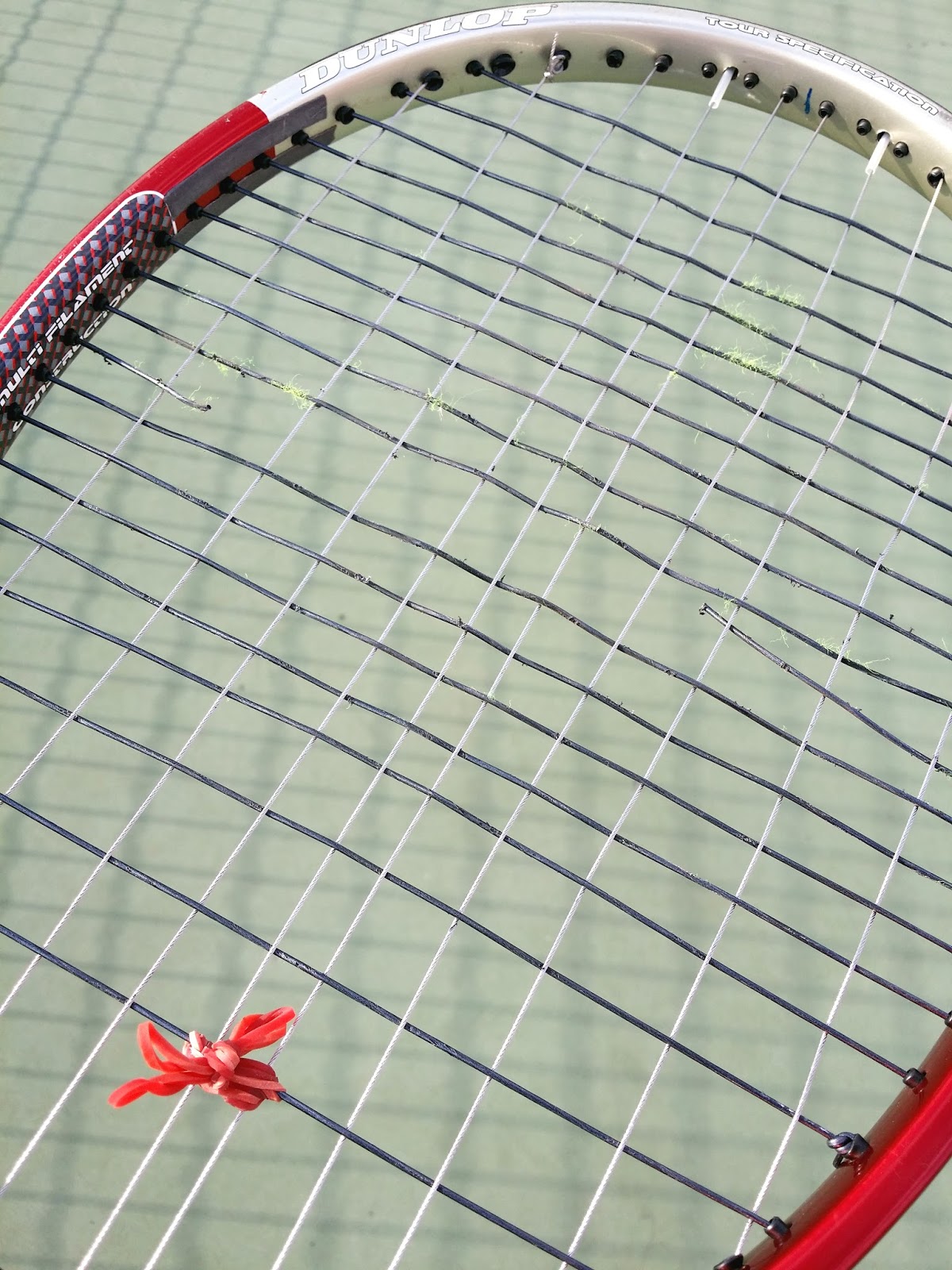
Here's how it looks when done. Haven't decided whether to snip off the tails of the tied mains yet...
If you decide to string this wire, here are some learning points on hindsight:
- Wear gloves or tape up your finger tips before weaving.
- Wear safety goggles.
- Try this only on an old racket you don't mind risking damage.
- Do not straighten the mains with your fingers after tensioning. It cuts very deep!
- Plan for blocked holes. It was very difficult to move the wire aside.
- Steel wire is very heavy so a light racket with a lower SW than you normally use would be good.
Playtest:
(Opinions from 2 other hitting partners were included below)
- No surprise here. It felt similar to the previous steel wire.
- Not boardy at all! In fact, most freshly strung full polys played stiffer and deader. This had a little more power. I suspect it was due to the huge tension loss from tie-offs.
- The feel was something between a kevlar/syn gut and poly/syn gut hybrid. Soft, but the ball bite and impact feel was really good here.
- Some pocketing could be felt during impacts but the rebound angle was really low so I had to aim up. Good for folks who tend to hit the ball out.
- In short, tight, controlled and very very spinny. Plus a decent sized sweetspot!
- Downside was it lasted me only 15 minutes. If you click and zoom in on the pic below, you would see how rough the syn gut had been abraded by the wire, especially at the sweet spot.
Before anyone asks, I would not be doing this wire stringing for any one. No exceptions.
Before you start thinking this is outrageous and report this to some "Society of Prevention of Cruelty to Tennis Rackets", know that steel wire strings HAVE BEEN USED quite widely in the past. (link1)(link2)(link3)
I have not gone bonkers! What enticed me were online reports of some friends' friend's racket that they claim generated tremendous spin when they tried it. And yes, they attributed it to the steel strings.
I tested several different types of steel wires and found that some aspects of steel wire were actually very close to kevlar!
Both kevlar and steel wire:
- have very little stretch during initial tension,
- suffer huge tension loss at tie-offs, and
- "tightens back" when the crosses were installed.
My last grommets fiasco (link) has taught me to be more careful. Moreover, any blocked holes by this steel wire would probably be completely unpassable. So proper planning is crucial.
I "converted" the original 18x20 Dunlop Aerogel 200 to a 16x19 in order to:
1. eliminate blocked holes,
2. protect the grommets by tying off differently, and
3. allow more "give" in the stringbed since steel has almost zero stretch.
Before any of the more adventurous ones try stringing this, please read this first.
Before stringing, a weigh-in was done.
Steel wire is extremely kinky after being packed in coils for so long. Threading was very slow to prevent cuts to the hands and grommets. Lots of other precautions were also taken.
A closer look below.
Below pic shows how I used the grommet from the first cross string to tie-off the mains onto the mains.
I had chosen a thin wire to prevent adding too much weight after stringing. Even 23grams feel quite significant when swinging the racket around.
Playtest:
- This is playable!
- It was not uncomfortable or harsh at all. Ball impacts felt very similar to a poly/syn gut hybrid.
- Surprisingly, there is still some soft pocketing even though the stringbed felt very tight and stable. It was very easy to aim with this stick.
- Coming from my preferred ELT setups, the rebound angle of this is very low. No problem though, all I had to do is just aim higher and bash the ball fearlessly.
- Power levels are very similar to a poly/syn gut hybrid. The feel is definitely not dead. Even volleying is not difficult!
- When swinging, there is the added joy of hearing the "swishing" sound of the metal strings. After a while, I was able to distinguish how the "swish" sounds like for good shots. Bad shots either did not have the "swish" sound, or it "swished" too early before impact. Too steep a swingpath from low-to-high (to generate more spin) also produced a very different "swish" tone. I think this is a very interesting instructional cum feedback tool!
- Spin is really good. I don't understand how it could be so, but it just works. Topspin, slices and spin serves were all great and accurate!
- Sadly, to keep the weight down, I had chosen too thin a gauge. This steel wire is only 0.7mm thick. A flat serve I attempted snapped four mains simultaneously...
- This pic was taken immediately after the strings snapped. Interestingly, if you observe the gap between the four snapped strings, the spacing is similar. Does this indicate that this steel wire has some stretch and can hold tension? Maybe a thicker gauge next time?