Showing posts with label mfil300. Show all posts

Thursday, 10 September 2015

Can a 18x20 String Pattern Be Open?

Before the popularity of spin patterns (eg 16x15), there were only two dominant string patterns - 16x19 or 18x20. The former was known as an "open pattern" and the latter a "closed/dense pattern".

But can those definitions of open or closed be universally applied to all 16x19s and 18x20s?

Even with the same racket headsize, I found it was not so straightforward. 

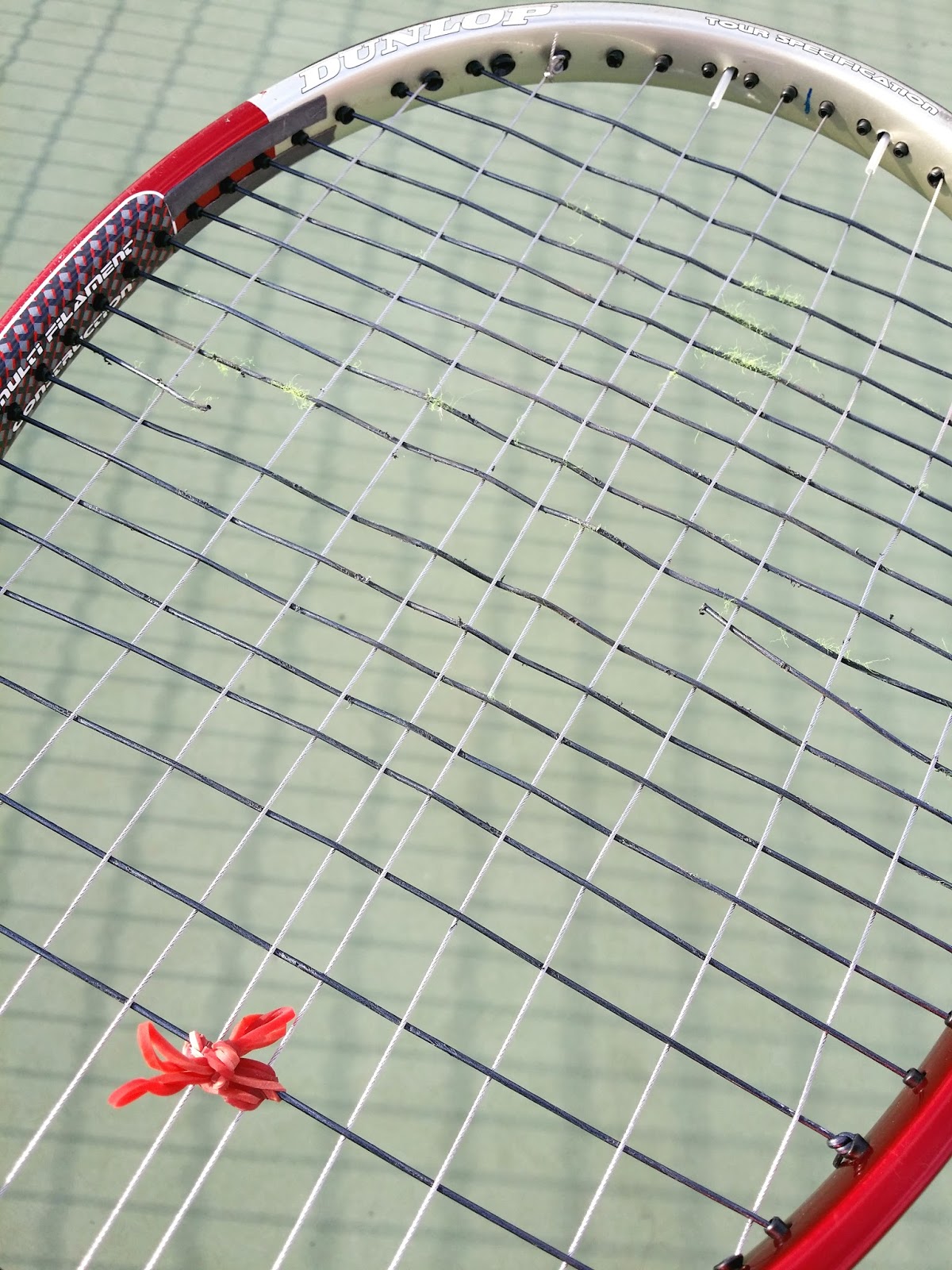
Take a look at the 18x20 ProKennex Black Ace 98 versus the 16x19 Dunlop M-Fil300 below. Both are 98 square inches.


If you examine the string gaps carefully, it would be difficult to ascertain which racket's string gaps are larger, isn't it? The difference is so minute!


The total width of the 18 main strings in the BA98 is about 19.1 cm. For the Mfil300, the 16 mains are about 18.1 cm apart. So on average, each racket's main string are about 1.06 cm and 1.13 cm apart, respectively. With a tiny difference of only 0.07 cm, or 0.7 mm!!!

What about the cross strings' gap then?


All the crosses in the BA98 span over 25.5 cm versus 24.0 cm for the Mfil300. This translates to an average cross string gap of about 1.275 cm and 1.263cm respectively.

To me, both rackets have equally open strings!

It is very important to dispel the generalizations between open and closed string patterns because this has huge implications on tension and string selection, which in turn determines spin, power, string durability, comfort and control. 


Wednesday, 19 August 2015

Signum Pro Poly Plasma (SPPP) ...again...

Since I was given quite a few packets of SPPP, I thought I'll just continue testing this string to see how to make it work. 

This time, I strung it straight-up at 40 lbs based on feedback from my previous attempt. (link) If you look carefully at the pic below, it was done two piece with four knots this time.


Even at this low tension, the extreme low-power remained. I passed this racket around my partners. None liked it. Not even those who were previously fascinated by SPPP's legendary tension holding. Neither those who gave me the string.

Comments mirror those from the previous attempt:
- too low power (note my racket's stock SW is 331)
- low spin
- stiff, uncomfortable strings
- need to bash the ball
- very difficult to serve

I persisted using this up to 8 full hours of play to see if there would be any change. Still equally dead, lifeless and very low spin regardless of type of balls used. My shoulder and elbow ached.

So I decided to try it one last time in my very open 10x19 string pattern. (link) This string pattern needed really strong strings!


Such an open pattern would really stress the strings and help me load the ball with my measly swing! Even kevlar mains (link) lasted only 2+ hours in this racket!

Well... it did perform much better! The power could easily match any string setup in an AeroPro Drive. 

Ball rebound and launch angle was only slightly higher than normal. This clearly indicated SPPP's incredible stiffness and tension holding. It did not yield much.

Once I adapted to the power and ball rebound angle, I started whipping the racket to test spin. 

It was very, very good! 

Even with its incredible power levels, almost trampoline-like, all out forward drives sent probably only 5-10% of the shots out. Most curled down in time, neatly between the service and baseline in my partner's court, then jumped about 45 degrees upwards and forward, reaching my partner's head height before descending.

By then, they were hitting the ball somewhere between the baseline and the back fence. The topspin kicked my shots about 2+ metres before my partner could hit it.

Even after 10 minutes of hitting, my partner could not get the ball timing right due to the excessive spin. It was very difficult to read and anticipate where the ball would land and how far it would jump.

Hey! Even my backhand was working super well! I could hit winners, crosscourt or down the line, when I was a little late for the ball. The power helped!

No noticeable drop in tension nor control was sensed after about 20 minutes of heavy, intense groundstrokes. So I tried serves.

Both flat and spin were good. I had little problems aiming for corners. For once in my life, I could hit topspin serves like what I saw on TV! Offensive, powerful, fast-paced and high-kicking topspin serves! The combination of power and spin in the stringbed was perfect!

My conclusion?

If you think you are a very hard hitter, this string would suit you fine. Else, reserve it for rackets with very open string patterns. Or you may find your ego very quickly and harshly tamed.


Saturday, 1 August 2015

10x19 Spin Pattern with Shark Fishing Wire / Syn Gut

Playing with my custom drilled 10x19 racket was fun except for very poor string durability. (link) Even kevlar lasts only about two hours. So I needed something MORE durable!!!

I rang up my old friend who is a fishing enthusiast. Knowing that I was using it for tennis, he bought me a set of 49 strand stainless steel wire meant for shark fishing!!! (link1)(link2)


It fit the job perfectly! Since I was no stranger to stringing with steel wire (link), I accepted the strings happily!


With only 10 main strings, I laced them all up before tensioning.


The wire was extremely sharp, especially the ends when it frayed. Despite applying super glue to keep it together, I still suffered a lot of pokes, nicks, scratches and cuts.


To protect the clamps, I placed small pieces of cardboard on the string before clamping.


With normal strings, weaving was extremely easy on this super open pattern. However, given the very rough textured mains, there was too much friction. I had to go super slow. 


Even then, strands of synthetic gut was peeled off by the mains while pulling through. My finger tips were cut while weaving too.


Towards the last few crosses, I guess the syn gut has had enough and snapped while tensioning!


Not wanting to re-do from scratch, I used a third piece of string to fill the bottom four crosses. So it's six tie-offs in total.


Here's how it looks when done. Haven't decided whether to snip off the tails of the tied mains yet... 


If you decide to string this wire, here are some learning points on hindsight:

- Wear gloves or tape up your finger tips before weaving.
- Wear safety goggles.
- Try this only on an old racket you don't mind risking damage.
- Do not straighten the mains with your fingers after tensioning. It cuts very deep!
- Plan for blocked holes. It was very difficult to move the wire aside.
- Steel wire is very heavy so a light racket with a lower SW than you normally use would be good.


Playtest:

(Opinions from 2 other hitting partners were included below)
- No surprise here. It felt similar to the previous steel wire.
- Not boardy at all! In fact, most freshly strung full polys played stiffer and deader. This had a little more power. I suspect it was due to the huge tension loss from tie-offs.
- The feel was something between a kevlar/syn gut and poly/syn gut hybrid. Soft, but the ball bite and impact feel was really good here.
- Some pocketing could be felt during impacts but the rebound angle was really low so I had to aim up. Good for folks who tend to hit the ball out.
- In short, tight, controlled and very very spinny. Plus a decent sized sweetspot!
- Downside was it lasted me only 15 minutes. If you click and zoom in on the pic below, you would see how rough the syn gut had been abraded by the wire, especially at the sweet spot.


Before anyone asks, I would not be doing this wire stringing for any one. No exceptions.


Sunday, 3 May 2015

Tying Together Used Strings for Re-use?

Inspired by Ricardo from this post, I thought I should give it a try too.

The most recently snapped string I had was kevlar (link), and since kevlar have absolutely no life nor stretch, I thought it would be a good test to see if the knots would hold up.

Ricardo recommended the triple fisherman's knot but I could not wrap the stiff kevlar around. So I tied them together using two parnell knots on each string, totalling four parnell knots.


The knot joint was placed at the throat during stringing.


Despite tensioning the used kevlar at 75 lbs, I managed to complete the all the 10 mains strings smoothly without incident.

However, it was mid-way through the syn gut crosses that the kevlar snapped cleanly from the knotted area. The increased tension from the weaving must have stressed the kevlar.


To be fair, I did not use the recommended fishing knot. Secondly, the snapped kevlar was already fraying at some spots, so it was obviously weakened.

I think I would try this again next time with some other strings. Maybe natural gut?


Thursday, 30 April 2015

Custom Drilling: 10x19 Spin Pattern with Kevlar/Syn Gut

Both previous attempts with 15g syn gut/poly (link) and 15g syn gut/17g syn gut (link) suffered string breakages after a few hours.

All other aspects like comfort, spin, power and control performed much better than expected. So I thought of installing some bullet-proof kevlar in the mains to see if I could beef up durability a little.

The kevlar/syn gut combo played the most spinny among them, with slightly better control and a bit less power.

Unfortunately, this setup also lasted only 2+ hours. (Note the instant frame distortion after the mains snapped)


With such a ridiculous open pattern, something has to give. And in this case, it was durability.

Given how enjoyable the 2+ hours was, and how easy it was to string and weave this racket, I think it was worth the trouble.


Tuesday, 17 February 2015

Custom Drilling: 10x19 Spin Pattern (Part 2)

Following the poor tension holding of the poly cross (link), I decided to re-string with full synthetic gut to test how this would perform.

A thicker gauge for the mains would be paired with a thinner one for the crosses.

Playtest:
- With full synthetic gut and without looking at the racket, I could not believe there were only 10 main strings!
- Comfort went further up a notch over the previous strings and control became as good as I could remember for this racket before the conversion.
- The amount of spin did not drop at all. It maintained as vigorous as with the poly cross. 
- The loud crackling sound of the mains moving during ball impact remained, followed by the ball kicking furiously towards my partner's face level.
- I felt much more relaxed and confident with this strings and thus swung smoother and harder than with the earlier poly cross. Perhaps this was why spin levels maintained, simply due to a harder hit?
- Visually, and with my partner's verbal confirmation, full syn gut generated a heavier ball. My partner recounted more racket twists (on his own racket) receiving off-centred hits than with my previous strings. In his words, he described my shots moving "fast and furious".
- On my side, I would attribute this to the extra power from the very open stringbed, rather than me exerting greater effort. I did not do anything differently.
- Throughout the 2 hours, I did not adjust the main strings at all. There was full snapback.
- Both serves and flat shots were equally good and accurate. No mis-directions. 
- A group who booked the courts after my session noticed my racket and asked if they could try it. I relented after seeing their Pro Staff RF97 Autograph and the Pro Staff 95s in exchange. They were similarly impressed!
- Again, towards the 3 hours mark, a main string snapped. The difference this time was it played well till it broke.
- Another significant difference was the hoop width compressed 1.0 cm immediately after just one main string snapped. This showed how much extra stress the lesser number of mains were withstanding compared to the crosses. Pics below.


Hoop width after one main snapped.


Close-up to eliminate parallax error. Width was 25.0 cm.


Hoop width after strings cut was 26.0 cm. Difference of 1.0 cm.


See the difference below? I was lucky the hoop survived!


Sunday, 8 February 2015

Custom Drilling: 10x19 Spin Pattern

The open pattern spin craze has been around for a while now. So far, all of these open string patterns have been focused on reducing the number of cross strings.

But what if I skip some mains instead? How would that play? Would control be intact? Would spin increase more than reducing crosses?


I could not find any rackets with less mains than crosses. Add to that, being recently overdosed on boring and comforming modifications and stringjobs, I needed to break the mold again.


Below was the last pic in its 16x19 stock form before I started...


New holes were drilled to create the string pattern I desired.


Lots of paint chips but structure appeared intact and sound.


The original throat grommets were cut apart to allow me to choose which string hole to use.


After the throat area was completed, the top holes were drilled.


Then strung with very thick 15g synthetic gut to preserve control and durability! Unsure if the extra holes could hold up, I have never felt so much fear pulling tension before.


Fortunately, the mains completed without a hitch! Then the poly crosses. Hey! It's got ONLY ten main strings! Weaving was a breeze!


Conversion to 10x19 done. Hoop length and width measurements were perfectly in line with the original 16x19 pattern. Zero distortion achieved!


"Powerpads" were used at the throat to offer a bit more support for the third mains and to ensure the string stays away from the drilled inside edge.


At the newly drilled hole on top (2nd mains), tubing was used as I did not want to mess with the original grommets. 


String spacing for the mains was planned to incorporate some "proportional stringing" in the drill pattern. 


Put simply, the sweetspot area was designed to have a slightly denser string pattern than the outer mains. This adds control within the centre 6 mains while softening off-centre contacts around the peripheral.


Also, this ensures compliance with the ITF tennis rules regarding the stringbed (link), specifically, part "b", where:


"The stringing pattern must be generally uniform and, in particular, not less dense in the centre than in any other area."


Playtest:

- Sweetspot was really huge and forgiving, yet control remained very good. 
- The typical high rebound angle of open string patterns was not felt here. Unlike my earlier attempts at skipping crosses (link) where the rebound angle became high and sometimes unpredictable. 
- Volleys were extremely easy - in power, comfort and directional control. The large sweetspot helped too.
- Power was very good, and it came with more than enough control to direct it effectively and offensively.
- For serves, the spin was wicked! Compared to its former self, the extra power now meant the focus was on where to place it and how much to spin it. Less effort better result!
- Mains snapback was impressive. I could literally hear the strings crackling back and forth during ball impacts. When I pulled the mains aside and let go, it snapped back straightaway.
- Groundstrokes on both wings were good. No mis-directions other than my own mis-hits. Very impressive spin all around.
- Slices entered into "obscenity eliciting" territory for my playing partner. Hit one slice, get one !@#$%^)*.
- After an hour, a slight string buzz appeared. The mains still snapped back instantaneously when pulled and released. Not so with the poly crosses. It seemed the crosses had been the one doing the control work and became "fatigued".
- The above was based on about an hour with this setup. So far, it seemed that skipping mains generated better spin than skipping crosses. Very impressed and excited to test it out more against different players.


17Feb2015 update:
- From the start of the 2nd session of use, tension loss from the poly was very significant.
- While spin was still very good, control dipped badly. I had to focus very intently to be sure my shots landed close to where I aimed.
- I continued playing just to experience how long the mains would last and how it felt when the poly cross tension dropped further.
- At around the 3 hour mark (total use), a sweetspot hit snapped a main string.
- Overall, I was impressed by the spin and comfort this setup gave. Durability in terms of tension holding and string life was not up to my expectations, so I would be re-testing it with another string setup.


Friday, 29 August 2014

Soft Shaped-Poly Hybrid Test in MFil300

Quite a few of my playing partners use this string and shared good reviews. When I tried their rackets, I was pleasantly surprised at how soft, yet firm this poly played.

A friend whom I string for asked if anything could be done to add a little more "finesse" and pocketing for touch shots like volleys or mid-court put aways. A little more power would be nice too.


From his reel, he cut out about 24 metres and asked me to "play around" with them, then share my findings. To prevent bianess, brand was withheld.


Some simple string test results I did revealed interesting differences from earlier poly strings. 


This third/fourth generation poly string:

- has a much softer material composition that could be dented with my fingernails with some effort,
- appears to have a stiff inner core,
- has an inelastic elongation component only about half of some of my second generation poly strings,
- has its overall elasticity reduced slightly as well.

Since he wanted more pocketing and touch, the best way was to hybrid with a softer string. In this case, a syn gut in the crosses.

With its soft outer layer (not a coating), the poly was easy to string compared with traditional polys. Touch wise, it reminded me a little of pvc coated garden wire.


Playtest:

- Even though we played about 48 hours after stringing, the first few shots felt a little uncomfortable. A muted kind.
- It was not harsh. There was definitely some "cushioning" in the stringbed but insufficient. Somewhat like jogging on a concrete path with a very old pair of running shoes?
- Since I was not a poly lover, I handed it over to another partner to do the breaking-in, and to let me know his opinion only after the entire session.
- After about an hour, I resumed testing.
- The "harshness" was almost completely gone. It started to feel more like a fullbed of stiff and crisp syn gut.
- The "loading" of this hybrid was interesting. The stringbed felt tight for both low and high powered shots. 
- Taps and blocks sometimes felt like it was not enough to load the string. That was fair. Yet, full swings conveyed a "not enough pocketing" kind of feedback sometimes.
- Middle of the range shots produced the best results. Those 60-70% smooth swings elicited soft, controlled feedback with spinny balls. It was very enjoyable and made me want to just rally that way forever.
- Low powered shots were slightly lower powered than other polys. All-out swings were also lower powered than other polys. Smooth swings yielded the closest to "normal" kind of power compared to other strings.
- 
This advantage was, power control could be delegated to the stringbed with less variation in our swings. We could swing away more freely.
- It also made me think, could this be the string company's attempt to market poly to "softer hitters"?