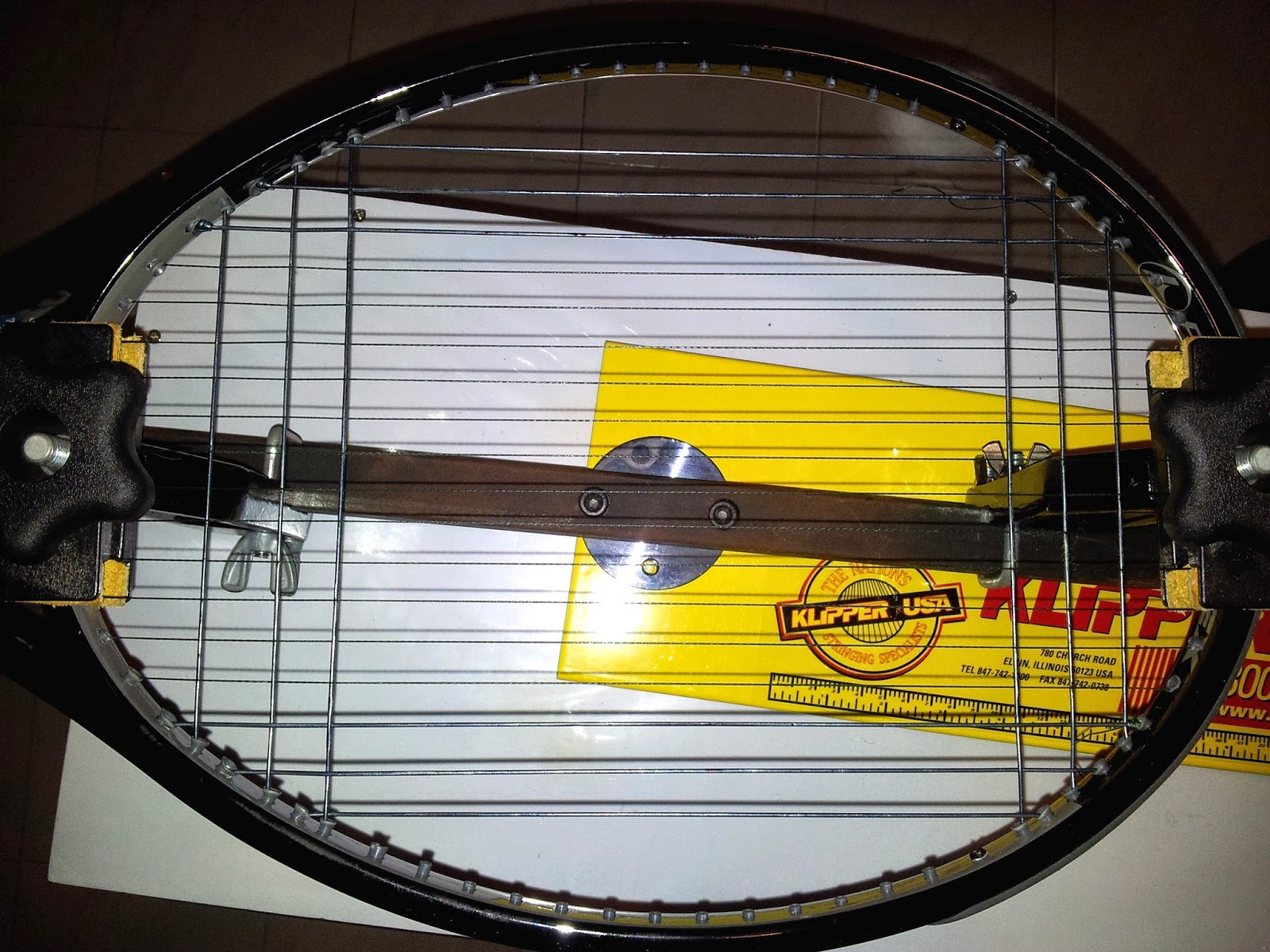
The pre-stretched poly played much better than expected. (link) In total, it lasted about 12 hours before a main snapped. It was truly good till the last hit. Not something I would expect from full poly.
Since I had about half-set of that poly leftover, I used it in the crosses with syn gut mains. Both pre-stretched, of course.
Tension holding and the initial tension drop was similar to the fullbed of poly. After the overnight and initial hits drop, it stabilized.
With syn gut mains, the feel and power was much nicer. I felt I could "load" the strings better for more of my usual shots without trying to crank it up.
Although softer than full poly, control remained more than enough. There was no "mis-behaved" shots that I could attribute directly to the strings. The fault was mine.
The "fast strings" feel was more apparent in this setup. There was more power, more pace. Even serves attempted just after 20 minutes of light use felt good. The stringbed was powerful and responsive enough for me.
With a different partner testing this out with me, I could not tell for sure if spin was better than the pre-stretched full poly. However, it was enough for me, when my partner called the ball in several times, just when I thought it was going long. From that, I deduced the topspin had to be more than my usual, since I interpreted it should have gone long.
My greatest satisfaction from this setup comes from the impeccable stringbed consistency. Over two hours of play, the difference in feel between the first few hits and the last shots was so minute compared to strings without pre-stretch. All along, this was something I could only enjoy with natural gut. Now no longer.
Tension loss, measured through frequency in hertz:
Overnight after strung --> dropped 7.8 hz
After 1 hour play --> dropped 3.1 hz
After 2 hours play --> dropped 0.2 hz
How's that for tension maintenance?
Conventional advice is to tension poly carefully with the slowest pull setting in the machine. That preserves the limited amount of elasticity in the string. (link)
The elasticity of nylon/mutifilaments allow them to stretch about 10-12%, natural gut about 7% and most polys only around 3-4%.
What I could not reconcile with, is that these poly strings, with the worst tension maintenance, is always prescribed for the hardest hitters who break strings frequently. See the dichotomy?
While the string breaking may be taken care of, what about the tension holding? It still becomes unplayable. So, poly users are recommended to restring regularly.
But how is breaking nylon/multi after a few hours different from cutting out spent poly in the same amount of time?
After two months, a full reel of poly, and deriving only about 4 hours of play per racket, both my big hitter friend and myself got tired of this incessant need to restring.
Against conventional wisdom, and encouraged by positive feedbacks of pioneers online, we pre-stretched the poly string before stringing.
To add a layer of protection from the super-boardy elbow-busting string bed we were anticipating, we hybrid the perimeter with softer synthetic gut, also pre-stretched. And used my arm-friendlier Pro Kennex instead of his stiffer rackets.
Playtest:
- Simple bounce tests after stringing indicated the string bed was about as soft as a brick wall. No pocketing at all.
- The frequency was monitored immediately off the stringing machine and at different intervals.
- After an overnight rest unplayed, the first observation was impressive. String bed frequency dropped by only 9 Hz compared to the usual 40 Hz. This loss was similar to a freshly strung gut/poly hybrid left overnight. Unprecedented for any poly or syn gut.
- On court, the entire first hour played stiff and powerless but NOT boardy at all. The usual break-in after about 20 minutes of rally did not happen. It maintained almost exactly the same tight controlled feel as the initial hits, only softer.
- Spin was impressive. Very much better than without pre-stretch. Could be the tightness encouraging us to swing away freely. We had fun hitting some new extreme angles previously impossible, and watching the ball curled in.
- We switched to serve practice. Being the weaker hitter, I served first. It was disastrous. There was not enough power to drive the ball even on flat serves. Comparing the slow-motion video frames with my usual strings, I lost about 25-40% ball speed. Clearly reminded myself why I did not like could not use poly. (link)
- However, in the hands of my hard-hitting partner, it was like a dream come true. Alternating with his other freshly strung unprestretched stick, I could see there was absolutely no doubt nor hesitation with the pre-stretched strings. He just let it go full blast. From video reviews, serve percentage, serve speed, placements were all better.
- That took about an hour and we measured the frequency again. It dropped only another 11 Hz, compared to the usual about 30+ Hz.
- Somewhere after 90 minutes of use, I took over the racket for rallies again. By then, the pocketing and sweet spot opened up significantly. There was more proportionate power. Harder hits had deeper pocketing and softer hits less pocketing. Strangely, it reminded me very much of synthetic gut!
- For once, we could even volley decently, with good feel, using this poly string!
- In my partner's words, another distinct difference was that this poly became a "fast string", like natural gut, instead of its usual "slow and sloppy."
- At the two hour mark, it dropped only another 0.8 Hz.
- Immediately, this chap handed me both his rackets to be re-strung. I think we're onto something significant...
While much have been said about how heat causes tension loss in synthetic gut, I have not read nor heard much about how heat affects poly strings.
So I did a simple experiment comparing poly with synthetic gut...
Objectives
(1) To test effect of heat on string tension, and
(2) To test effect of impact stress on string tension.
Methodology
- A piece each of new synthetic gut and poly string was manually pre-stretched for 120 seconds, then tensioned thrice at 50 lbs in the 6th and 7th main in a tennis racket, then tied-off.
- The pre-stretching and triple tensioning was to reduce tension loss through string relaxation.
- Tie-off tension loss would be very significant but not of interest in this study.
- Each impact stress was simulated by using a ruler to measure and depress each string about 1 cm deep, thrice.
- Note that when each piece (ie 6th main or 7th main) of the same string type is depressed, sometimes the tension differential would change between these two string. So the average is taken for greater accuracy.
- For heat stress, a hairdryer was held 1 cm away from the strings and moved slowly along the string for a total of 1 minute each time. The temperature was constant at about 40 degrees Celsius, which was well below the temperature in a parked car in the sun. (link1)(link2)(link3)
- All tension loss measurements were done through string frequency in Hertz (Hz).
Findings
Remember, the strings were both heavily pre-stretched and tensioned thrice. Despite that, what stood out was, from the total tension loss:
(1) poly lost less through string relaxation compared to syn gut,
(2) syn gut lost almost nothing through impact stress whereas poly suffered badly,
(3) heat affects syn gut twice as badly as poly, and
(4) as long as kept away from heat, syn gut's tension holding is impeccable whereas poly must be restrung very often for hard-hitters.
From my previous 10 full syn gut and 10 full poly string jobs, I felt the strings became unplayable (dead, harsh, no spin, poor control, etc), when the tension loss (in hz) reached about 9% for syn gut and about 6% for poly.
Based on the above, poly became unplayable to me after the 1st impact stress. Syn gut "died" after 2 mere minutes of heat stress.
Keep strung rackets away from heat if possible and restring poly very very often.
Natural gut always attract a lot of interest and attention. It is a pricey string, but it also plays second to none.
As soon as I posted my second "pilgrimage" (link), I received a barrage of questions on how the setup plays, how long it lasts, is tension holding really that amazing, how much it costs, etc.
To save myself from becoming a broken record, I compiled some observations in this post.
Stringing
- Before opening the pack of natural gut, every grommet hole must be carefully inspected for sharp edges. Any found must be gently and smoothly sanded down. Then checked again.
- New grommets or new unstrung rackets should not have natural gut as their first stringjobs.
- Gut kinks easily. Previously, I accidentally dropped the gut after snipping off the cable tie and the entire 40 ft tangled up in a huge mess! (link). A light prestretch is a must. Not optional.
- After the prestretch, I always inspect the gut for any kinks or bad patches before stringing. If found, photos were taken and sent to the owners to decide if they want to proceed at their risk.
- To prevent friction burns, either with the grommets or the crosses, waxing is a must. I do it twice - before and after stringing.
- All clamps, including the string gripper, should be cleaned and adjusted before stringing. Too tight and the gut flattens or snaps. Too loose and it slips.
Playing
- Some claimed gut needed a break-in period. Mine played well from the first hit.
- Gut/poly was very lively, crisp and pocketed the ball very well. The string rebound was fast and powerful. The long dwell time allowed me to execute a lot of strokes I usually could not. Even late hits or last minute saves sometimes became offensive shots!
- Spin was very easy and serves were effortless. Mid-game, when I swapped back to my full syn gut for a test, I had to swing so much harder for my serves. And I lost a lot of control and double-faulted!
- Visually, my partners and I noticed my ball speed was much slower with syn gut. They could chase and return what would have been winning passing shots with natural gut.
- Comfort was supreme! The ball must have enjoyed the hits! It probably felt more like landing on a plush pillow than being bashed by a tight stringbed.
- Even with the small 85 square inch frame, I felt gut/poly opened up the sweetspot larger than on a 100 square inch frame with other strings. It inspired confidence to just let go and rip the ball back. And most times, it turned out perfectly, just like on TV! So much so, that at times, I believed I could execute some of those shots-of-the-day by the touring pros.
- Instantly, just by using gut/poly, it gave me about a 30% improvement in my overall game.
Tension Holding
- Tension stability was impressive. Nothing comes close.
- Stringbed frequency measurements below:
| Total Usage (hours) |
Frequency (Hz) |
|---|
Strung
|
659.0
|
1.5
|
648.0
|
3.0
|
643.8
|
4.0
|
640.9
|
6.0
|
639.3
|
8.0
|
637.0
|
- As a comparison, most other strings usually drop about 30 to 40 Hz overnight after stringing without play. This setup lost only 22 Hz after 8 hours of play.
- Playing conditions (in Singapore) for the 8 hours was in the low 30s degrees Celcius. New pressurized balls were used, sometimes new Wilson trainers.
- Being excited with the setup, I stood slightly further back from the baseline than usual and swung much more freely than with my usual syn gut. In other words, I bashed the ball much harder than usual.
Poly String Death
- Since I restring myself, and none of my strings were used beyond 10 hours, I am very sensitive to flat strings.
- Somewhere around the 4th or 5th hour of use, I started struggling with this stringbed. Initially, I thought I was not performing well that session. Felt sluggish, lacked power and sprayed some shots wide. I stepped up and swung harder.
- Then, the tennis balls felt a little flat. So I changed to new balls. Immediately, control dipped. Shots flew long.
- The rebound timing of the stringbed was off. When fresh, the ball pocketed deep, then came off the strings enthusiastically, powerfully. Now it felt tired. It pocketed, but returned much slower and weaker. This longer dwell time meant a later part of my follow-through was now determining the ball trajectory.
- By the 5th session of use, which was going into its 7th and 8th hour, the sweetspot almost completely disappeared. Most of my impacts felt more like framed-shots with some light string buzzing.
- My serve lost so much pace and control. Volleys were so weak the ball kept dropping into my side of the net.
- The racket became very difficult to use and dragged me down. Shots that previously could be pulled off all fell flat.
- For the first time, the kevlar/graphite composite PS6.0 felt stiff with jarring vibrations! Both my wrist and elbow felt very uncomfortable too.
- As a simple test of resiliency, I pulled several gut mains apart and released. All snapped back very quickly. Pulling the poly crosses aside was so much easier. Less strength was needed and less resistance encountered. Not a single cross string snapped back when released. (See crosses 3 to 11 above, all pulled aside)
- Clearly, the gut was still behaving very well, and was supporting the bulk of the ball impact. However, the huge tension loss in the poly created too much "slack" for it to be of any further use.
Replacing Only the Crosses
- The beauty of a gut/poly hybrid is, you can restring ONLY the dead poly!!! (If your stringer would not do it, find another who would!)
- Beware! Hybriding poly with gut WILL NOT insure you against wrist pain nor tennis elbow. Mine hurt after merely 6 hours of use. The poly "died". Use poly safely. Always replace them after 8 to 10 hours, or less.
- While removing the cut poly strings, a sharp edge caught on the gut and snapped the 7th main. Fortunately, the tension loss was contained within the top 2 and bottom 2 crosses due to the way I had strung earlier (link).
- I clamped the 4th main on both sides, re-worked and re-tensioned only the 5th and 6th main strings. Thus converted the gut to fill only the centre 12 mains. The centre 8 mains were completely untouched from its initial stringjob.
- I smeared some coconut oil on the gut strings to lubricate it. Then filled all the rest with synthetic gut and saved a snapped gut string job!
Playtest
- The stringbed came to life again!
- All the earlier felt components - power, control and comfort came back in full force! Only spin was slightly less than before.
- At my first session after this re-work, my partner, "F", commented via a sms message after our game:
"Actually today your shots were pretty accurate, percentage higher than all other times. Strings or skill?!"
- It had to be the natural gut! How could I improve so fast?
Now that the weather in Singapore is turning dry, I thought it might be an opportune time for my second "pilgrimage" with the ProStaff 6.0 85. The first was completed here.
Gut/Poly hybrid is a holy grail all ProStaff 6.0 owners must try. It is touted to open up the sweetspot, add controlled power, offer incredible comfort and maximum topspin anyone can muster.
This racket has a drill pattern with skips at 7 & 9, top and bottom. With natural gut in the mains, the blocked holes can create problems for the crosses later. Using an awl or even a scrap piece of string to "unblock" the holes can stress or easily snap the completed natural gut mains.
Since I had about 20 ft of natural gut from the half-set, I calculated there was more than enough for the mains.
So, while doing the mains, I filled the top 2 and bottom 2 crosses before completing the last mains. That solved all the blocked holes problem.
Specifically (T=Top, B=Bottom):
- Complete mains 1 to 6 for both left and right sides,
- Fill 7th main on right side but do not tension,
- Using left mains, complete crosses 7B & 9B,
- Fill and tension 7th main on left side,
- Tension 7th main on right side, then complete crosses 7T & 9T,
- Complete both outer mains and tie-off at bottom.
(Or you can complete mains 1 to 6, then box the rest. However, you may need to open up a new tie-off hole.)
Other than preventing problems with blocked holes, any tension loss from tie-off is isolated from spreading to the inner mains. This offers better tension stability.
Instead of discarding the excess natural gut, using it the fill the outermost crosses helps to soften the dead spots a little, reducing vibrations. A little shorter length, maybe 3-4 ft less, of cross strings was needed to fill the rest of the crosses too.
Another advantage was having an easier time weaving the dreaded final poly cross string since there was more space away from the 6 o'clock mounting. You can see the difference immediately from the pic below!
Natural gut is a beautiful string to look at. That golden translucent glow is mesmerizing. Here's a close-up pic.
For those who think it takes a lot to wield the 85 square inch racket, know that the difference between an 85 and 95 square inch is very minor. You can see the comparison here.
Compared to syn gut, multi, or poly, gut/poly is definitely more expensive. Probably by about twice or thrice. However, most users, who were not chronic string breakers, were able to eke out at least double the playable string life, compared to their non-gut setup.
Some even claimed their gut combos lasted more than 50 hours! If you do the sums, paying twice the amount for five times as long durability, isn't gut cheaper?
Playtest:
Here's how it looked after about 2 hours of ball bashing. No need to straighten strings and absolutely zero notching.
- Comfort --> Extremely Good
- Spin --> Extremely Good
- Power --> Extremely Good
- Control --> Extremely Good
- Durability --> Still testing
- The greatest difference was how much easier gut/poly made the game. There were so many shots that I could not execute with other strings that were easily achieved with this. It's almost like legalized cheating!
Notching is the groove created in the string due to wear and tear. Usually, it is the string that moves that notches. Not the one that stays still (link).
Often overlooked, the impact of notching on string tension is huge. To understand that, we must first understand how strings stretch.
Depending on the type of strings, an additional 20 lbs of tension, from 40 to 60, stretches the string only a mere extra 4 to 7 mm.
When a string notches, it weakens. The "U" shaped notch leaves the string with about half its original diameter, or less, to hold tension. As a result, the "U" is always stretched apart, looking more like a wide-mouthed "V". The string lengthens.
Since the cause is wear and tear, notching always occurs around the sweetspot. That would be the centre 8 to 10 mains, and between the middle 8 to 10 crosses.
Translated, that means about a total of 20 strings (10 mains + 10 crosses) could have about 10 notches each. Assuming all notches are equally deep, and each notch lengthens the string by 0.5 mm, that's a total of 5 mm (0.5mm x 10 notches each) relaxation PER STRING!
Based on the string stretch above, almost 20 lbs of tension is lost. It could be more!
The other implication of notching is string deflection. The rules require the mains and crosses to be alternately interweaved. So each string's path is like a sine curve, with peaks and troughs.
Since notching occurs at the intersection between mains and crosses, the peak-to-trough amplitude reduces after notching. With this lower amplitude, the total "distance" each string has to travel from grommet to grommet is reduced. So tension drops some more!
Notching is an inevitable double whammy! It cannot be prevented. We just have to manage it through regular restrings or mitigate its effect with stringsavers.
Or bear with the floppy trampoline stringbed!
Most tennis players severely notch or break their main strings. That is due to the main strings' movement from topspin shots.
A rare few break their crosses more frequently instead. Then they started wondering was it a defective string, poor string job, poor technique or due to shanking the ball.
But since it always snap near the sweetspot, it cannot be any of the above reasons. After observing the players who snap their crosses more often, I noticed two peculiarities.
First, they do not hit with a lot of topspin. Most of their strokes were driven almost flat forward with little upwards follow through. The very much lower net clearance, usually about a foot or less, confirms their flat shots.
Second, they use a lot more sidespin on both wings. Other than the low net clearance, most of their shots skidded off the ground instead of kicking up like topspin shots would.
An examination of their strings also revealed more cross strings movement than mains. Typically, the crosses are pulled upwards towards 12 o'clock. When I pulled the mains aside near the sweetspot, most of the crosses there were already notched.
You can see it clearly in the pic below. Blue mains black crosses. The crosses are deeply notched.
Notching always happens on the string that moves, not on the ones that stay still. For this group that break crosses and yet want a softer feel than full poly, perhaps they should try gut/poly or syn gut/poly since they move the crosses a lot more.
Basically, use the stiffer or more durable string in the cross. It may add a little more sidespin and control as well.
A playing partner, CK, lamented on how fast his poly setup "dies".
My understanding of poly death could be attributed to two areas - tension loss and no more snapback.
Since both issues were previously addressed satisfactorily (link), I whipped out the "String Glide" and inserted sixteen pieces.
Compared to before the string savers, CK felt the stringbed firmed up. He also heard the strings sliding and snapping back much better.
I hit a few shots with his racket as well. Even with more than 10 hours of play on that set of 1.10mm poly strings, I felt the stringbed tightness was restored good enough for me. I could trust the strings for directional control and swung freely. Spin was very good too. Much better than the 4-hours-old poly stringjob I was using in my racket that session.
In another session, I planted sixteen pieces into another playing partner, M's stringbed.
M was initially skeptical but allowed me to proceed anyway.
After some hits, and swapping back and forth with his other matched racket with exact strings setup, M commented:
- the stringbed felt a little more dampened with less vibrations which he enjoyed, and
- pocketing was deeper and it felt the ball stayed longer on the strings which gave him more time to shape or re-direct the ball at the last minute.
From my side, the result was very clear. M's shot dispersion and control was unmistakable between his three rackets. I could tell immediately when he picked up the one with stringsavers.
After the initial impressions, both CK and M popped the same question:
"Where did you buy the stringsavers?"
The verdict is clear.
Since string savers are so much cheaper than a stringjob, I believe this could be a viable method to extend the playing life of the poly strings.
As always, if you choose to do so, pay extra attention to how your wrist, arm, elbow and shoulder feels. Live to play another day!
18Dec2014 update:
After hearing positive feedback from CK and M, DL adopted the use of stringsavers in his open strings racket (link) as well.
After insertion, DL commented:
- the slight dampening reduced some stringbed vibrations without the need of a dampener,
- it played more comfortable with better pocketing, and
- added more spin and control.
Coincidentally, these stringsavers have all been tested with positive results in full poly (CK), poly/syn gut (M) and full syn gut (DL).
Despite having been around for about three decades now, many still seem to have misconceptions about poly strings.
From its infant days, poly has come a very long way. Broadly speaking, we are now in the fourth generation of poly strings.
Without referring to specific brands or models, the first generation poly string was simply slick, stiff and dead. Nothing else.
Elasticity was so low that every ball impact took some tension off through string deformation. String life was so pathetic that it was probably better monitored by the number of shots one hit, rather than by time used.
While the spin was hugely rewarding, the stiffness must have affected quite a few players. As a result, a second generation of poly was born.
Additives were added to soften the string and the term co-poly surfaced. When strung within a specific tension range, from about the mid-40s to low-50s lbs, a higher level of comfort was achieved through greater elasticity.
Within this range, tension holding also improved. However, when strung below or above, it still played as boardy and stiff as the first generation.
I believe it was from this generation of poly that caused many misconceptions about poly's useful tension range, up till today.
The third generation poly was heavily marketed with more "bite". That was when shaped co-polys came aboard. Five-sided pentagonals, hexagonals, spirals, twisted and fused, and many with rough edges became wildly popular. Comfort improved further.
The most popular fourth generation poly string now is Luxilon 4G. Aptly named, as "4G" simply refers to fourth generation. Tension holding and comfort were touted to be "uncommon for a poly".
Somewhere around the third or fourth iteration, the useful tension range widened tremendously. Many reported great results from as low as 20+ lbs (link), to as high as 90 lbs! Yes, with full poly!
Personally, I have tested quite a few between 30 to 70 lbs. Surprisingly, at either 30, or 70 lbs in the same racket, it played almost equally boardy! But the one with lower tension loosened up much more rapidly, whereas the tighter strung took about an hour to "break-in" before playing well.
I could not find much difference in the amount of spin between the four generations. Variances were only on comfort and tension holding.
Whichever generation of poly it is, keep in mind it was introduced solely to generate tons of spin. To achieve that, it has to be made very slick and very stiff to snap back effectively. Slick and soft would not work as well for spin.
As a result, poly demands a strong loading to play well. And that could mean very long loopy full swings, or rackets with high swingweights and open string patterns.
Tennis balls that are a little heavier, have high bounce and are "hard like rocks" for natural gut or synthetic gut could also possibly help with the string loading required. Just be wary of your own shoulder, elbow, arm or wrist tolerances.
Most pros like fresh stringbeds that are usually less than a day old.
Amateurs have varied preferences. Some like them straight off the machine, while others like to leave their new stringjobs at least overnight before playing.
But how long would an unused stringbed stay fresh?
I have tested the daily frequency changes of several freshly strung syn guts over a week. Unused, the greatest drop always occur in the first 24 hours.
Depending on the initial tension, string pattern (ie 16x19 or 18x20), gauge, etc, about 6-8% (by frequency) was lost in the first 24 hours.
Then over the next 72 hours, another 3-5% would be lost, but at a much more gradual pace. On average, total loss would add up to about 10-12% before play.
After this "rest", when play commenced, tension loss was very gradual. Each session saw a drop of only about 1-2%.
When a fresh stringbed was allowed to "rest" overnight, the tension loss after the first session of play was reduced by about half. The other half was lost when unused. This total loss amounted to about 8-10% by frequency.
When "rest" was not given, and it was played as soon as possible after it was strung, it lost about 8-12%.
From these, it appears the initial tension of about 10% (+/- 2%) could not be avoided. It's just a matter of letting it drop before or during play, whichever one prefers.
Out of curiousity (or boredom, or madness), I replaced my guitar's "G" string with a length of new syn gut. It's the black string third from the right in the pic below. The original "G" string lays on top.
It was tuned to 196.00 Hz. (link)
Over the next 24 hours, I re-tuned it multiple times back to 196.00 Hz. By the third day, it almost stabilized.
Then I replaced the syn gut with another fresh piece, tuned to 196.00 Hz and left it untouched. After 24 hours, the frequency dropped almost 9%. After 48 hours, about 10%. Then I re-tuned it. The loss over the next few days was insignificant, but it required re-tuning nevertheless.
So?
I think it is acceptable to re-string with full syn gut and leave it for a while before playing. The tension loss is definitely not a straight line down. It will plateau.
And, the syn gut sounded horrible on the guitar!!! On the other hand, natural gut was extremely and addictively melodious!
While hitting with a partner, I noticed he was hesitant and held back from full swings. Most of his strokes were abbreviated and he did not seem committed.
Naturally, his shots became erratic. Some long, some short and many were mishit.
He was using the Head Graphene Prestige Pro (link) strung with a multi/poly hybrid.
After testing it, I was very impressed by the spin prowess! Like the Prestige Rev Pro I tried (link), the weight was heavily polarised. It whips across very easily and quickly for spin.
Since his stringbed was worn and badly notched, he asked if I could restring it with something that would give more control.
I suggested a fullbed of soft poly and he agreed, even though he was initially hesitant, out of fear that his shoulder pain would recur. I assured him it should not.
On his first outing, he was ecstatic! He won a set against someone he usually lost both to. First serve percentages improved as did overall ball directional control.
However, when I played with him a few days later, I still noticed that same reluctance to take full swings. Although his directional control, depth and ball placement was better than before, but it still felt incomplete.
He suggested we swap sticks to play a set and we did. After three games, I found the problem.
Originally, this racket came with a leather grip. He removed it and used just two overgrips. Other than the gripsize becoming way too small for his hands (I measured his recommended gripsizing to be 4¾ inches), the racket balance went haywire!
For extremely polarised frames, very small changes in weight can have drastic effects in swing timings and control.
The leather grip probably weighed 25 grams. Each overgrip weighs about 5 grams. So, almost 15 grams was removed from the handle. Balance point would have moved up between 10-15mm!
As a result, the racket head moved too fast. It became a case of the racket swinging his hands instead of him controlling the racket!
Any wonder why he was hesitant to take full swings?
According to him, after replacing the leather grip, it played much better.
Since the thin fishing lines kept snapping, we decided to try something stronger. The next step up would be Dyneema/ Spectra braided fishing lines.
We selected the pre-stretched spool. Even at 0.6mm, the breaking strength was rated at 150 lbs! So it's thinner and stronger.
In addition, this eight strand braided has a coefficient of friction of only 0.09, which is as slick as the most slippery poly strings we have. Another plus for spin!
Stringing it was challenging, as usual, since it was not designed to be used in a tennis racket. Clamps slippage was the major issue. Nevertheless, I got the job done. Just an extra dose of patience and time was needed.
Take a look how fine the line was at 0.6mm, compared to the 1.25mm syn gut it was paired with.
Playtest:
- Initial hits felt very good. The thin line provided impressive feel with very good bite and spin.
- Shots that I feared hitting out previously were executed with the perfect amount of spin to curl it down instead of flying out.
- Serves could be powerful or spinny depending how I hit it.
- However, the joy was short-lived.
- Despite further pre-stretching before stringing, the dyneema line still elongated a lot with every ball impact.
- After about 50 hits, including several serves, the stringbed became exceptionally loose. "Floppy" would be an appropriate word to describe it.
- Not only that, the hoop warped so much that the width compressed about 1cm or more. Afraid that the frame may crack (since I tensioned it quite high), I snipped the crosses immediately to release the pressure.
- Dyneema is still better reserved for fishing.
Over a cuppa with my fishing line "sponsor" (link), we discussed how to further improve fishing line's playing characteristics.
Since both that thin fishing line and poly have high tension loss, we had to pre-stretch and string both at very high tensions.
That led to racket warp and poor string durability. And poly STILL lost heaps of tension.
We liked the slick poly for the fish mains to slide and snapback. So we couldn't eliminate it. Then we thought, how about reducing a few poly crosses and filling them with something else?
That's how this quad-brid came about! Yep, four different strings with eight knots!
A thick fishing line, leftover from some previous stringing experiments was used. After some planning on where to tie the knots and estimating the tension adjustments, the stringing started.
The frame narrowed by only 1mm to 26.2cm this time, so the tensioning was quite evenly balanced out.
Playtest:
- After hitting for 15 minutes or so for the strings to break-in, I started wondering if tension holding was too good.
- It felt more like a board than a set of strings. But this was a good problem to have since we wanted to lower tension to increase durability!
- The only two things I did not like about the "boardy feel" was the extremely low power and reduced spin. Control and ball feel remained very good.
- As usual, a centre main string was snapped by a flat serve.
Up till now, fishing line remains the most challenging string I have worked with.
Many friends and playing partners dismissed me as crazy until they had a go with my rackets. Then some got hooked as well!!!
If you have not tried it, don't start. Once hooked, it is very difficult to accept any other strings.
Maybe some of my failures below could act as a deterrent?
The initial problem was poor tension holding, which was solved by some ridiculous pre-stretch before stringing. Then the line kept snapping during tensioning or tie-offs.
So I tried using fishing crimps instead of tying knots. Unfortunately, that did not work well. Some crimps slipped, some snapped the string, some did not sit down well after crimping while others slid through the grommet hole.
To overcome the constant snapping, I tried a "divide and conquer" strategy. The 12 centre mains were divided into 3 pieces of 4 mains each, resulting in 6 knots, hopefully, to mitigate the amount of re-work if/when each line snaps.
However, the tension loss during tie-offs was more severe than anticipated, despite adding 15 lbs per tie-off. This, in turn, caused uneven pressures between the mains and crosses.
Above, the left racket (note the six orange knots) width was 25.3cm and the right, 26.3cm. The sweetspot disappeared for the left racket, just like this case (link).
This is why flexible hoops are a little more difficult to string well compared to stiff hoops.
The line was cut out immediately and re-strung. Back to a more conventional two tie-off knots this time.
There's some parallax error in the pic above, but the width read 26.3cm after the restring. It took me just two attempts before succeeding this time. Not too bad.
All in all, about four hours was spent pursuing this.
Still keen to try fishing line?
20May2014 update:
- The racket in the last picture above was strung with fishing line mains and a shaped-poly cross.
- It was a bad decision as the mains snapped in just 30 minutes of play, severely notched by the sharp poly edge.