Over Christmas, after the gift exchanges, a friend gave a set of budget natural gut to me. He received it but did not care for it.
I happily accepted it and offered to post my review.
It was in a transparent plastic bag. No names nor labels. Just a type-written sticker pasted over the sealed bag, saying "Naturel Gut".
The gut looks very smooth and had a translucent glow, something like Klip and Babolat VS. Other than the packaging, it does not look like budget stuff to me.
After clearing most of the backlog of work and stringing requests, I thought maybe it's time for my annual pilgrimage with the ProStaff 6.0 again... (link1)(link2)(link3)...
All the standard steps were strictly adhered to. Things like cleaning clamps, prestretching gut to remove coil memory, checking grommets for sharp edges, etc.
However, the natural gut snapped during tensioning. I had only completed 6 mains when it happened. All at a modest tension of 55 lbs.
Fortunately, the snap point still left me enough gut to fill only the centre mains in the ProStaff 6.0, like in the "Lendl Pattern" (link).
So I filled the outer perimeter with poly first, then started on the mains very very carefully and slowly...
But just when I was tensioning the second last main string, the natural gut snapped again! Somehow, the first snap point triggered a second snap point in the natural gut!!!
Of the three snaps so far, none occurred at the clamps.
Could installing budget natural gut into the ProStaff 6.0 be disrespectful and blasphemous? Was that why the gut kept snapping? Because the ProStaff 6.0 rejected it?
After one hour, two failed attempts, with three snap points, I was beginning to understand why my friend was so "generous" to give me that pack.
Since I had gone so far, I decided to continue with the remaining half-set in the pack and be done with it. Successful or not!
At last!
Ended up with so many short pieces of snapped natural gut!
It played very well, but I doubt I would use these budget stuff again. Really a waste of time!
Showing posts with label hybrid. Show all posts
Thursday, 10 March 2016
Saturday, 13 February 2016
Fishing Line...again...
Over coffee with a friend who reads this blog, he asked when would I be using fishing line again.
He added lots of very persuasive talk. I knew, of course, that he just wanted to enjoy the incredible feel, bite and spin of fishing line again.
However, some things he said resonated.
Like, would there have been any improvements in fishing line technology to make it more durable and less likely to snap?
And, have I tried applying some of my newer stringing techniques to deal with the frequently snapping fishing line?
These questions started me thinking...
...then my hands and feet just followed...
One major problem I had previously was knot slippage. The fishing line was SO THIN, tying knots became incredibly difficult.
Pull too tight and it'll snap. Pull with my bare hands and it cut straight into my flesh. Double knots snapped the string too. And those knots that I succeeded, often slipped into the grommet hole and the string lost tension!
So I tried a double knot over the "Dead Man's Knot". It worked beautifully! No slippage. No need to pull too tight. No tension loss. No grommet damage. Perfect!
For prestretch, I used a friend's fishing line reel line winder which he built himself using an electric drill! Something like this. I told him what I was after, left the fishing line with him for a few days and "Voila" it's done! So simple!
I think this was my smoothest and most peaceful fishing line stringjob ever! Success in one attempt! If you do not understand the challenges, just read my past posts on fishing line. To me, this is a big deal!
And the other good news was the thin fishing line did not even notch after the initial 90 minutes!
Yes! It was blissful hitting with it. My partner that day commented not only on the extra spin but accurate placements as well. And I could pull him extra wide on those sidelines serves!
Hmmm... why did I forsake fishing line?!?!
He added lots of very persuasive talk. I knew, of course, that he just wanted to enjoy the incredible feel, bite and spin of fishing line again.
However, some things he said resonated.
Like, would there have been any improvements in fishing line technology to make it more durable and less likely to snap?
And, have I tried applying some of my newer stringing techniques to deal with the frequently snapping fishing line?
These questions started me thinking...
...then my hands and feet just followed...
Pull too tight and it'll snap. Pull with my bare hands and it cut straight into my flesh. Double knots snapped the string too. And those knots that I succeeded, often slipped into the grommet hole and the string lost tension!
So I tried a double knot over the "Dead Man's Knot". It worked beautifully! No slippage. No need to pull too tight. No tension loss. No grommet damage. Perfect!
For prestretch, I used a friend's fishing line reel line winder which he built himself using an electric drill! Something like this. I told him what I was after, left the fishing line with him for a few days and "Voila" it's done! So simple!
I think this was my smoothest and most peaceful fishing line stringjob ever! Success in one attempt! If you do not understand the challenges, just read my past posts on fishing line. To me, this is a big deal!
And the other good news was the thin fishing line did not even notch after the initial 90 minutes!
Yes! It was blissful hitting with it. My partner that day commented not only on the extra spin but accurate placements as well. And I could pull him extra wide on those sidelines serves!
Hmmm... why did I forsake fishing line?!?!
Thursday, 21 January 2016
Divorced Mains and Crosses
Despite suffering a serious bout of tennis elbow from dead poly, M still could not give up the spin. So he wanted gut/poly to see if the comfort would increase.
To isolate variables, we tried different setups on similar matched racket. Among them, there were two gut/poly hybrids that caught my attention.
Strangely, one played dead from the start while the other played perfectly.
The dead one felt too tight, like it was over-tensioned. We could not load the strings. There was no pocketing, no dwell time. The ball just "touched and flew off".
M felt he did not have enough time to spin nor shape the shot. This was done only in the the low 50s lbs. I figured it may need some time to break-in.
The good one performed perfectly from the first hit. As expected from gut/poly, it was comfortable, powerful, fast, spinny and had great control. However, it did not last long. Maybe 2 sessions?
Since gut was not cheap, M continued playing with both.
After several sessions with others, we met up and played again. When hitting with both setups, the pocketing had grown so deep it felt like a fishing net!
But yet, after it reached it's maximum stretch, we could feel the strings deflecting the ball back out. The dwell time was long and extended. Both were still playable but rebound angle was high.
Then it dawned on us, that it could be because one string of the hybrid had completely lost tension. Most likely the poly. The other string was actually doing most of the work during ball impact!
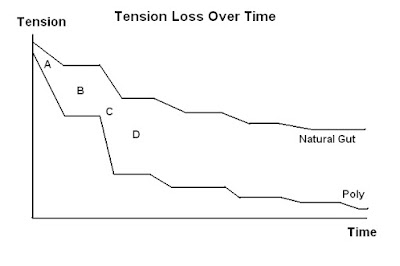
Probably something like this chart below?
At point "A", both strings start to lose tension right off the stringing machine. Poly's loss is higher than natural gut.
"B", "D" and the other horizontal lines indicate rest periods where the racket was left unused in a room.
The second big tension drop occurs during "C", which was the first session of play after stringing.
Regardless who strings the rackets, both "A" and "C" would always register the biggest tension loss. Subsequent drops would be slow and gradual.
So, it seems that the poly in M's setup could not hold tension. And the tension gap between the gut and poly had grown too huge. So huge, that their actions during ball impact became divorced, with one string doing almost all the work and the other idling.
And how did I know this feeling?
I once strung up only the mains on an old test racket and hit some balls with it...
Strangely, one played dead from the start while the other played perfectly.
The dead one felt too tight, like it was over-tensioned. We could not load the strings. There was no pocketing, no dwell time. The ball just "touched and flew off".
M felt he did not have enough time to spin nor shape the shot. This was done only in the the low 50s lbs. I figured it may need some time to break-in.
The good one performed perfectly from the first hit. As expected from gut/poly, it was comfortable, powerful, fast, spinny and had great control. However, it did not last long. Maybe 2 sessions?
Since gut was not cheap, M continued playing with both.
After several sessions with others, we met up and played again. When hitting with both setups, the pocketing had grown so deep it felt like a fishing net!
But yet, after it reached it's maximum stretch, we could feel the strings deflecting the ball back out. The dwell time was long and extended. Both were still playable but rebound angle was high.
Then it dawned on us, that it could be because one string of the hybrid had completely lost tension. Most likely the poly. The other string was actually doing most of the work during ball impact!
Probably something like this chart below?
At point "A", both strings start to lose tension right off the stringing machine. Poly's loss is higher than natural gut.
"B", "D" and the other horizontal lines indicate rest periods where the racket was left unused in a room.
The second big tension drop occurs during "C", which was the first session of play after stringing.
Regardless who strings the rackets, both "A" and "C" would always register the biggest tension loss. Subsequent drops would be slow and gradual.
So, it seems that the poly in M's setup could not hold tension. And the tension gap between the gut and poly had grown too huge. So huge, that their actions during ball impact became divorced, with one string doing almost all the work and the other idling.
And how did I know this feeling?
I once strung up only the mains on an old test racket and hit some balls with it...
Friday, 26 June 2015
Kevlar / Natural Gut Hybrid
Some deem this wasteful. To them, it makes no sense to pair the deadest string with the liveliest (and most expensive) one.
The most famous user of this setup was Andre Agassi in the 1990s.
This has been on my to-do list for very long, so I strung one up to experience first hand what's so special about it...(secretly hoping that I could return serves like Agassi!)
Compared to kevlar/syn gut, natural gut added a lot more comfort, power and spin.
No break-in was needed. It was comfortable from the first hit. The most impressionable item was the extra amounts of dampening.
With syn gut crosses, kevlar felt a little harsh with a soft "pingy" vibration at impact even with a dampener. Natural gut crosses almost eliminated this ping. Sweetspot hits felt as comfortable as a full syn gut stringjob. But much more powerful.
What I did not expect from natural gut crosses was more spin. Compared to syn gut, natural gut was dry and "gummy". However, the kevlar glided smoothly, adding easy spin to serves and rallies without sacrificing power nor control. That is a huge plus.
The two major disadvantages were rapid fraying and that I could not use it in wet weather.
First pic below was after 3 sessions of about 2 hours each. Visible fraying commenced.
Given the marginal improvement over syn gut crosses, I am unlikely to try this combination again. However, I am glad to have this item completed from my to-do checklist!
The most famous user of this setup was Andre Agassi in the 1990s.
This has been on my to-do list for very long, so I strung one up to experience first hand what's so special about it...(secretly hoping that I could return serves like Agassi!)
Compared to kevlar/syn gut, natural gut added a lot more comfort, power and spin.
No break-in was needed. It was comfortable from the first hit. The most impressionable item was the extra amounts of dampening.
With syn gut crosses, kevlar felt a little harsh with a soft "pingy" vibration at impact even with a dampener. Natural gut crosses almost eliminated this ping. Sweetspot hits felt as comfortable as a full syn gut stringjob. But much more powerful.
What I did not expect from natural gut crosses was more spin. Compared to syn gut, natural gut was dry and "gummy". However, the kevlar glided smoothly, adding easy spin to serves and rallies without sacrificing power nor control. That is a huge plus.
The two major disadvantages were rapid fraying and that I could not use it in wet weather.
First pic below was after 3 sessions of about 2 hours each. Visible fraying commenced.
Pic below was after 7 sessions. Spin seemed to decrease gradually with each session but comfort and power was consistent.
Given the marginal improvement over syn gut crosses, I am unlikely to try this combination again. However, I am glad to have this item completed from my to-do checklist!
Thursday, 30 April 2015
Custom Drilling: 10x19 Spin Pattern with Kevlar/Syn Gut
Both previous attempts with 15g syn gut/poly (link) and 15g syn gut/17g syn gut (link) suffered string breakages after a few hours.
All other aspects like comfort, spin, power and control performed much better than expected. So I thought of installing some bullet-proof kevlar in the mains to see if I could beef up durability a little.
The kevlar/syn gut combo played the most spinny among them, with slightly better control and a bit less power.
Unfortunately, this setup also lasted only 2+ hours. (Note the instant frame distortion after the mains snapped)
With such a ridiculous open pattern, something has to give. And in this case, it was durability.
Given how enjoyable the 2+ hours was, and how easy it was to string and weave this racket, I think it was worth the trouble.
All other aspects like comfort, spin, power and control performed much better than expected. So I thought of installing some bullet-proof kevlar in the mains to see if I could beef up durability a little.
The kevlar/syn gut combo played the most spinny among them, with slightly better control and a bit less power.
Unfortunately, this setup also lasted only 2+ hours. (Note the instant frame distortion after the mains snapped)
With such a ridiculous open pattern, something has to give. And in this case, it was durability.
Given how enjoyable the 2+ hours was, and how easy it was to string and weave this racket, I think it was worth the trouble.
Tuesday, 21 April 2015
Pre-Stretched Syn Gut/Poly Hybrid
The pre-stretched poly played much better than expected. (link) In total, it lasted about 12 hours before a main snapped. It was truly good till the last hit. Not something I would expect from full poly.
Since I had about half-set of that poly leftover, I used it in the crosses with syn gut mains. Both pre-stretched, of course.
Tension holding and the initial tension drop was similar to the fullbed of poly. After the overnight and initial hits drop, it stabilized.
With syn gut mains, the feel and power was much nicer. I felt I could "load" the strings better for more of my usual shots without trying to crank it up.
Although softer than full poly, control remained more than enough. There was no "mis-behaved" shots that I could attribute directly to the strings. The fault was mine.
The "fast strings" feel was more apparent in this setup. There was more power, more pace. Even serves attempted just after 20 minutes of light use felt good. The stringbed was powerful and responsive enough for me.
With a different partner testing this out with me, I could not tell for sure if spin was better than the pre-stretched full poly. However, it was enough for me, when my partner called the ball in several times, just when I thought it was going long. From that, I deduced the topspin had to be more than my usual, since I interpreted it should have gone long.
My greatest satisfaction from this setup comes from the impeccable stringbed consistency. Over two hours of play, the difference in feel between the first few hits and the last shots was so minute compared to strings without pre-stretch. All along, this was something I could only enjoy with natural gut. Now no longer.
Tension loss, measured through frequency in hertz:
Overnight after strung --> dropped 7.8 hz
After 1 hour play --> dropped 3.1 hz
After 2 hours play --> dropped 0.2 hz
How's that for tension maintenance?
Since I had about half-set of that poly leftover, I used it in the crosses with syn gut mains. Both pre-stretched, of course.
Tension holding and the initial tension drop was similar to the fullbed of poly. After the overnight and initial hits drop, it stabilized.
With syn gut mains, the feel and power was much nicer. I felt I could "load" the strings better for more of my usual shots without trying to crank it up.
Although softer than full poly, control remained more than enough. There was no "mis-behaved" shots that I could attribute directly to the strings. The fault was mine.
The "fast strings" feel was more apparent in this setup. There was more power, more pace. Even serves attempted just after 20 minutes of light use felt good. The stringbed was powerful and responsive enough for me.
With a different partner testing this out with me, I could not tell for sure if spin was better than the pre-stretched full poly. However, it was enough for me, when my partner called the ball in several times, just when I thought it was going long. From that, I deduced the topspin had to be more than my usual, since I interpreted it should have gone long.
My greatest satisfaction from this setup comes from the impeccable stringbed consistency. Over two hours of play, the difference in feel between the first few hits and the last shots was so minute compared to strings without pre-stretch. All along, this was something I could only enjoy with natural gut. Now no longer.
Tension loss, measured through frequency in hertz:
Overnight after strung --> dropped 7.8 hz
After 1 hour play --> dropped 3.1 hz
After 2 hours play --> dropped 0.2 hz
How's that for tension maintenance?
Thursday, 9 April 2015
Kevlar Crosses!?!?
Through M's introduction, T asked if I could take a look and see if I could recommend something for his existing strings setup.
The first glance at his racket strings shocked me!
Not only was the kevlar and syn gut hybrid set in the wrong order - with kevlar in the crosses, there was also a double string knot tied at the bottom 6th main.
My first question was, if there has been any pain or discomfort in his wrist or elbow from playing with that setup. Luckily, the racket was very flexible. Else it would have been disastrous!
Since T hits flat, I advised him to cut this out and re-string it with plain old synthetic gut.
The weight printed on the racket throat stated 275 grams but did not specify if that was strung or unstrung. So a quick check on the scale was done. 302 grams strung and with dampener.
Then I measured the inside hoop length and width with the syn gut/kevlar setup. Length was 322mm and width 255mm.
Then I cut out the strings and checked the unstrung inside hoop dimensions. About 326mm by 256mm. So the syn gut/kevlar caused a distortion of 4mm and 1mm respectively.
The racket was then strung with a full bed of synthetic gut. Strung inside hoop was 326mm and 254mm. Distortion from unstrung was 0mm and 2mm respectively.
T also mentioned the butt cap was shaky. So I removed the staples and checked if the pallet or foam was intact.
A common mistake is to use super glue to hold the butt cap stable. It will work for a while, but then the entire foam would disintegrate as super glue melts foam.
So I used thick double-sided adhesive tape to tighten the fit, then sprayed a squirt of rubbing alcohol to activate the tape before pushing the butt cap in firmly. Then stapled it down. That took care of the wobble.
T's grip was a little too big for him. To reduce it by half a size (1/16"), I stretched out the replacement grip a little before wrapping it back. That brought the grip size down from 4 3/8" to 4 5/16".
Hopefully the grip stays and he has a more enjoyable game with this.
This post was meant to document the changes made for T, and perhaps a reminder to fellow tennis players that kevlar should never be used in the crosses. Unless one wants his wrist or elbow destroyed.
The first glance at his racket strings shocked me!
My first question was, if there has been any pain or discomfort in his wrist or elbow from playing with that setup. Luckily, the racket was very flexible. Else it would have been disastrous!
Since T hits flat, I advised him to cut this out and re-string it with plain old synthetic gut.
The weight printed on the racket throat stated 275 grams but did not specify if that was strung or unstrung. So a quick check on the scale was done. 302 grams strung and with dampener.
Then I measured the inside hoop length and width with the syn gut/kevlar setup. Length was 322mm and width 255mm.
Then I cut out the strings and checked the unstrung inside hoop dimensions. About 326mm by 256mm. So the syn gut/kevlar caused a distortion of 4mm and 1mm respectively.
The racket was then strung with a full bed of synthetic gut. Strung inside hoop was 326mm and 254mm. Distortion from unstrung was 0mm and 2mm respectively.
T also mentioned the butt cap was shaky. So I removed the staples and checked if the pallet or foam was intact.
A common mistake is to use super glue to hold the butt cap stable. It will work for a while, but then the entire foam would disintegrate as super glue melts foam.
So I used thick double-sided adhesive tape to tighten the fit, then sprayed a squirt of rubbing alcohol to activate the tape before pushing the butt cap in firmly. Then stapled it down. That took care of the wobble.
T's grip was a little too big for him. To reduce it by half a size (1/16"), I stretched out the replacement grip a little before wrapping it back. That brought the grip size down from 4 3/8" to 4 5/16".
Hopefully the grip stays and he has a more enjoyable game with this.
This post was meant to document the changes made for T, and perhaps a reminder to fellow tennis players that kevlar should never be used in the crosses. Unless one wants his wrist or elbow destroyed.
Monday, 6 April 2015
Kelvar / Fishing Line
Since it was so near April Fools' day when I posted the natural gut/fishing line combo (link), some asked if I was pulling a prank again (link).
Not this time!
The slick fishing line really paired very well with the natural gut mains. So well, that two playing partners asked if I could switch to another racket instead. They just didn't like to be on the receiving end of those two strings combo.
It was so addictive that I just strung up a kevlar/fishing line to see how much more I could accentuate the already spinny kevlar!
Not this time!
The slick fishing line really paired very well with the natural gut mains. So well, that two playing partners asked if I could switch to another racket instead. They just didn't like to be on the receiving end of those two strings combo.
It was so addictive that I just strung up a kevlar/fishing line to see how much more I could accentuate the already spinny kevlar!
Monday, 30 March 2015
Natural Gut / Fishing Line?
After reading about my past fishing line experiments, an acquaintance got really curious. He pestered me to string one up for him to try.
With the ridiculous amount of time needed for string prep and prestretch, coupled with the low success rate and very short playing durability, I put on a straight face and quoted him something absurd.
Within seconds, he stuffed that amount into my hands. Ouch!!! Guess I have to re-live my nightmare on elm street again...
Thus far, fishing line was the only "string" that snapped and cut my hand and face during tensioning. When the string slipped, it also sent my flying clamps literally flying. The dropweight also crashed into and dented my table top. My pinky was also cut when tugging at the knot.
(If you have not read how difficult it was to string with fishing line, you can click here to find out)
While digging through my spools, and looking at the shimmering slick smooth surface, I wondered how would it perform as a cross with natural gut mains. Could it outperform poly?
Since I had plenty leftover from a previous "sponsor" and a worn set of poly needing replacement...
(Just a note that this was my personal setup. That friend had requested for something else to be paired with fishing line.)
Playtest:
- Just by tugging the mains aside and releasing it, I could see how fast and easy the snapback was.
- On court, it did not disappoint. The spin was fantastic and the strings always remained straight.
- The feel was actually identical to a freshly strung gut/poly stringjob - soft, comfortable, powerful, controlled and spinny. Perhaps a little softer since there was no poly.
- The differences was there was zero break-in needed.
- With poly, sometimes the first hits were a little tight and low-powered. Then it played better after an hour. But since fishing line behaved more like a nylon, there was much more liveliness to it.
- I would describe the fishing cross string to have "the comfort of syn gut with the slickness of poly".
- Another distinction was the consistency of tension holding. After two hours, it seemed to hold up much better than poly.
- Among all the natural gut combinations I have tried, I have no hesitations ranking this as the best for spin, comfort, power and control. The incredible slickness of the fishing line simply allowed much more free sliding between gut/fish and even fish/fish.
- The paramount task now, would be to hunt down my fishing line sponsor and find out which brand and specs of the fishing line he passed to me previously!
- The next few sessions would be interesting.
With the ridiculous amount of time needed for string prep and prestretch, coupled with the low success rate and very short playing durability, I put on a straight face and quoted him something absurd.
Within seconds, he stuffed that amount into my hands. Ouch!!! Guess I have to re-live my nightmare on elm street again...
Thus far, fishing line was the only "string" that snapped and cut my hand and face during tensioning. When the string slipped, it also sent my flying clamps literally flying. The dropweight also crashed into and dented my table top. My pinky was also cut when tugging at the knot.
(If you have not read how difficult it was to string with fishing line, you can click here to find out)
While digging through my spools, and looking at the shimmering slick smooth surface, I wondered how would it perform as a cross with natural gut mains. Could it outperform poly?
Since I had plenty leftover from a previous "sponsor" and a worn set of poly needing replacement...
(Just a note that this was my personal setup. That friend had requested for something else to be paired with fishing line.)
Playtest:
- Just by tugging the mains aside and releasing it, I could see how fast and easy the snapback was.
- On court, it did not disappoint. The spin was fantastic and the strings always remained straight.
- The feel was actually identical to a freshly strung gut/poly stringjob - soft, comfortable, powerful, controlled and spinny. Perhaps a little softer since there was no poly.
- The differences was there was zero break-in needed.
- With poly, sometimes the first hits were a little tight and low-powered. Then it played better after an hour. But since fishing line behaved more like a nylon, there was much more liveliness to it.
- I would describe the fishing cross string to have "the comfort of syn gut with the slickness of poly".
- Another distinction was the consistency of tension holding. After two hours, it seemed to hold up much better than poly.
- Among all the natural gut combinations I have tried, I have no hesitations ranking this as the best for spin, comfort, power and control. The incredible slickness of the fishing line simply allowed much more free sliding between gut/fish and even fish/fish.
- The paramount task now, would be to hunt down my fishing line sponsor and find out which brand and specs of the fishing line he passed to me previously!
- The next few sessions would be interesting.
Tuesday, 17 February 2015
Custom Drilling: 10x19 Spin Pattern (Part 2)
Following the poor tension holding of the poly cross (link), I decided to re-string with full synthetic gut to test how this would perform.
A thicker gauge for the mains would be paired with a thinner one for the crosses.
Playtest:
- With full synthetic gut and without looking at the racket, I could not believe there were only 10 main strings!
- Comfort went further up a notch over the previous strings and control became as good as I could remember for this racket before the conversion.
- The amount of spin did not drop at all. It maintained as vigorous as with the poly cross.
- The loud crackling sound of the mains moving during ball impact remained, followed by the ball kicking furiously towards my partner's face level.
- I felt much more relaxed and confident with this strings and thus swung smoother and harder than with the earlier poly cross. Perhaps this was why spin levels maintained, simply due to a harder hit?
- Visually, and with my partner's verbal confirmation, full syn gut generated a heavier ball. My partner recounted more racket twists (on his own racket) receiving off-centred hits than with my previous strings. In his words, he described my shots moving "fast and furious".
- On my side, I would attribute this to the extra power from the very open stringbed, rather than me exerting greater effort. I did not do anything differently.
- Throughout the 2 hours, I did not adjust the main strings at all. There was full snapback.
- Both serves and flat shots were equally good and accurate. No mis-directions.
- A group who booked the courts after my session noticed my racket and asked if they could try it. I relented after seeing their Pro Staff RF97 Autograph and the Pro Staff 95s in exchange. They were similarly impressed!
- Again, towards the 3 hours mark, a main string snapped. The difference this time was it played well till it broke.
- Another significant difference was the hoop width compressed 1.0 cm immediately after just one main string snapped. This showed how much extra stress the lesser number of mains were withstanding compared to the crosses. Pics below.
Hoop width after one main snapped.
Close-up to eliminate parallax error. Width was 25.0 cm.
Hoop width after strings cut was 26.0 cm. Difference of 1.0 cm.
See the difference below? I was lucky the hoop survived!
A thicker gauge for the mains would be paired with a thinner one for the crosses.
Playtest:
- With full synthetic gut and without looking at the racket, I could not believe there were only 10 main strings!
- Comfort went further up a notch over the previous strings and control became as good as I could remember for this racket before the conversion.
- The amount of spin did not drop at all. It maintained as vigorous as with the poly cross.
- The loud crackling sound of the mains moving during ball impact remained, followed by the ball kicking furiously towards my partner's face level.
- I felt much more relaxed and confident with this strings and thus swung smoother and harder than with the earlier poly cross. Perhaps this was why spin levels maintained, simply due to a harder hit?
- Visually, and with my partner's verbal confirmation, full syn gut generated a heavier ball. My partner recounted more racket twists (on his own racket) receiving off-centred hits than with my previous strings. In his words, he described my shots moving "fast and furious".
- On my side, I would attribute this to the extra power from the very open stringbed, rather than me exerting greater effort. I did not do anything differently.
- Throughout the 2 hours, I did not adjust the main strings at all. There was full snapback.
- Both serves and flat shots were equally good and accurate. No mis-directions.
- Again, towards the 3 hours mark, a main string snapped. The difference this time was it played well till it broke.
- Another significant difference was the hoop width compressed 1.0 cm immediately after just one main string snapped. This showed how much extra stress the lesser number of mains were withstanding compared to the crosses. Pics below.
Hoop width after one main snapped.
Close-up to eliminate parallax error. Width was 25.0 cm.
Hoop width after strings cut was 26.0 cm. Difference of 1.0 cm.
See the difference below? I was lucky the hoop survived!
Sunday, 8 February 2015
Custom Drilling: 10x19 Spin Pattern
The open pattern spin craze has been around for a while now. So far, all of these open string patterns have been focused on reducing the number of cross strings.
But what if I skip some mains instead? How would that play? Would control be intact? Would spin increase more than reducing crosses?
I could not find any rackets with less mains than crosses. Add to that, being recently overdosed on boring and comforming modifications and stringjobs, I needed to break the mold again.
Below was the last pic in its 16x19 stock form before I started...
New holes were drilled to create the string pattern I desired.
Lots of paint chips but structure appeared intact and sound.
The original throat grommets were cut apart to allow me to choose which string hole to use.
After the throat area was completed, the top holes were drilled.
Then strung with very thick 15g synthetic gut to preserve control and durability! Unsure if the extra holes could hold up, I have never felt so much fear pulling tension before.
Fortunately, the mains completed without a hitch! Then the poly crosses. Hey! It's got ONLY ten main strings! Weaving was a breeze!
Conversion to 10x19 done. Hoop length and width measurements were perfectly in line with the original 16x19 pattern. Zero distortion achieved!
"Powerpads" were used at the throat to offer a bit more support for the third mains and to ensure the string stays away from the drilled inside edge.
At the newly drilled hole on top (2nd mains), tubing was used as I did not want to mess with the original grommets.
String spacing for the mains was planned to incorporate some "proportional stringing" in the drill pattern.
Put simply, the sweetspot area was designed to have a slightly denser string pattern than the outer mains. This adds control within the centre 6 mains while softening off-centre contacts around the peripheral.
Also, this ensures compliance with the ITF tennis rules regarding the stringbed (link), specifically, part "b", where:
"The stringing pattern must be generally uniform and, in particular, not less dense in the centre than in any other area."
Playtest:
- Sweetspot was really huge and forgiving, yet control remained very good.
- The typical high rebound angle of open string patterns was not felt here. Unlike my earlier attempts at skipping crosses (link) where the rebound angle became high and sometimes unpredictable.
- Volleys were extremely easy - in power, comfort and directional control. The large sweetspot helped too.
- Power was very good, and it came with more than enough control to direct it effectively and offensively.
- For serves, the spin was wicked! Compared to its former self, the extra power now meant the focus was on where to place it and how much to spin it. Less effort better result!
- Mains snapback was impressive. I could literally hear the strings crackling back and forth during ball impacts. When I pulled the mains aside and let go, it snapped back straightaway.
- Groundstrokes on both wings were good. No mis-directions other than my own mis-hits. Very impressive spin all around.
- Slices entered into "obscenity eliciting" territory for my playing partner. Hit one slice, get one !@#$%^)*.
- After an hour, a slight string buzz appeared. The mains still snapped back instantaneously when pulled and released. Not so with the poly crosses. It seemed the crosses had been the one doing the control work and became "fatigued".
- The above was based on about an hour with this setup. So far, it seemed that skipping mains generated better spin than skipping crosses. Very impressed and excited to test it out more against different players.
17Feb2015 update:
- From the start of the 2nd session of use, tension loss from the poly was very significant.
- While spin was still very good, control dipped badly. I had to focus very intently to be sure my shots landed close to where I aimed.
- I continued playing just to experience how long the mains would last and how it felt when the poly cross tension dropped further.
- At around the 3 hour mark (total use), a sweetspot hit snapped a main string.
- Overall, I was impressed by the spin and comfort this setup gave. Durability in terms of tension holding and string life was not up to my expectations, so I would be re-testing it with another string setup.
But what if I skip some mains instead? How would that play? Would control be intact? Would spin increase more than reducing crosses?
I could not find any rackets with less mains than crosses. Add to that, being recently overdosed on boring and comforming modifications and stringjobs, I needed to break the mold again.
Below was the last pic in its 16x19 stock form before I started...
New holes were drilled to create the string pattern I desired.
Lots of paint chips but structure appeared intact and sound.
The original throat grommets were cut apart to allow me to choose which string hole to use.
After the throat area was completed, the top holes were drilled.
Then strung with very thick 15g synthetic gut to preserve control and durability! Unsure if the extra holes could hold up, I have never felt so much fear pulling tension before.
Fortunately, the mains completed without a hitch! Then the poly crosses. Hey! It's got ONLY ten main strings! Weaving was a breeze!
Conversion to 10x19 done. Hoop length and width measurements were perfectly in line with the original 16x19 pattern. Zero distortion achieved!
"Powerpads" were used at the throat to offer a bit more support for the third mains and to ensure the string stays away from the drilled inside edge.
At the newly drilled hole on top (2nd mains), tubing was used as I did not want to mess with the original grommets.
String spacing for the mains was planned to incorporate some "proportional stringing" in the drill pattern.
Put simply, the sweetspot area was designed to have a slightly denser string pattern than the outer mains. This adds control within the centre 6 mains while softening off-centre contacts around the peripheral.
Also, this ensures compliance with the ITF tennis rules regarding the stringbed (link), specifically, part "b", where:
"The stringing pattern must be generally uniform and, in particular, not less dense in the centre than in any other area."
Playtest:
- Sweetspot was really huge and forgiving, yet control remained very good.
- The typical high rebound angle of open string patterns was not felt here. Unlike my earlier attempts at skipping crosses (link) where the rebound angle became high and sometimes unpredictable.
- Volleys were extremely easy - in power, comfort and directional control. The large sweetspot helped too.
- Power was very good, and it came with more than enough control to direct it effectively and offensively.
- For serves, the spin was wicked! Compared to its former self, the extra power now meant the focus was on where to place it and how much to spin it. Less effort better result!
- Mains snapback was impressive. I could literally hear the strings crackling back and forth during ball impacts. When I pulled the mains aside and let go, it snapped back straightaway.
- Groundstrokes on both wings were good. No mis-directions other than my own mis-hits. Very impressive spin all around.
- Slices entered into "obscenity eliciting" territory for my playing partner. Hit one slice, get one !@#$%^)*.
- After an hour, a slight string buzz appeared. The mains still snapped back instantaneously when pulled and released. Not so with the poly crosses. It seemed the crosses had been the one doing the control work and became "fatigued".
- The above was based on about an hour with this setup. So far, it seemed that skipping mains generated better spin than skipping crosses. Very impressed and excited to test it out more against different players.
17Feb2015 update:
- From the start of the 2nd session of use, tension loss from the poly was very significant.
- While spin was still very good, control dipped badly. I had to focus very intently to be sure my shots landed close to where I aimed.
- I continued playing just to experience how long the mains would last and how it felt when the poly cross tension dropped further.
- At around the 3 hour mark (total use), a sweetspot hit snapped a main string.
- Overall, I was impressed by the spin and comfort this setup gave. Durability in terms of tension holding and string life was not up to my expectations, so I would be re-testing it with another string setup.
Monday, 2 February 2015
My Gut/Poly Experience
Natural gut always attract a lot of interest and attention. It is a pricey string, but it also plays second to none.
As soon as I posted my second "pilgrimage" (link), I received a barrage of questions on how the setup plays, how long it lasts, is tension holding really that amazing, how much it costs, etc.
To save myself from becoming a broken record, I compiled some observations in this post.
Stringing
- Before opening the pack of natural gut, every grommet hole must be carefully inspected for sharp edges. Any found must be gently and smoothly sanded down. Then checked again.
- New grommets or new unstrung rackets should not have natural gut as their first stringjobs.
- Gut kinks easily. Previously, I accidentally dropped the gut after snipping off the cable tie and the entire 40 ft tangled up in a huge mess! (link). A light prestretch is a must. Not optional.
- After the prestretch, I always inspect the gut for any kinks or bad patches before stringing. If found, photos were taken and sent to the owners to decide if they want to proceed at their risk.
- To prevent friction burns, either with the grommets or the crosses, waxing is a must. I do it twice - before and after stringing.
- All clamps, including the string gripper, should be cleaned and adjusted before stringing. Too tight and the gut flattens or snaps. Too loose and it slips.
Playing
- Some claimed gut needed a break-in period. Mine played well from the first hit.
- Gut/poly was very lively, crisp and pocketed the ball very well. The string rebound was fast and powerful. The long dwell time allowed me to execute a lot of strokes I usually could not. Even late hits or last minute saves sometimes became offensive shots!
- Spin was very easy and serves were effortless. Mid-game, when I swapped back to my full syn gut for a test, I had to swing so much harder for my serves. And I lost a lot of control and double-faulted!
- Visually, my partners and I noticed my ball speed was much slower with syn gut. They could chase and return what would have been winning passing shots with natural gut.
- Comfort was supreme! The ball must have enjoyed the hits! It probably felt more like landing on a plush pillow than being bashed by a tight stringbed.
- Even with the small 85 square inch frame, I felt gut/poly opened up the sweetspot larger than on a 100 square inch frame with other strings. It inspired confidence to just let go and rip the ball back. And most times, it turned out perfectly, just like on TV! So much so, that at times, I believed I could execute some of those shots-of-the-day by the touring pros.
- Instantly, just by using gut/poly, it gave me about a 30% improvement in my overall game.
Tension Holding
- Tension stability was impressive. Nothing comes close.
- Stringbed frequency measurements below:
- As a comparison, most other strings usually drop about 30 to 40 Hz overnight after stringing without play. This setup lost only 22 Hz after 8 hours of play.
- Playing conditions (in Singapore) for the 8 hours was in the low 30s degrees Celcius. New pressurized balls were used, sometimes new Wilson trainers.
- Being excited with the setup, I stood slightly further back from the baseline than usual and swung much more freely than with my usual syn gut. In other words, I bashed the ball much harder than usual.
Poly String Death
- Since I restring myself, and none of my strings were used beyond 10 hours, I am very sensitive to flat strings.
- Somewhere around the 4th or 5th hour of use, I started struggling with this stringbed. Initially, I thought I was not performing well that session. Felt sluggish, lacked power and sprayed some shots wide. I stepped up and swung harder.
- Then, the tennis balls felt a little flat. So I changed to new balls. Immediately, control dipped. Shots flew long.
- The rebound timing of the stringbed was off. When fresh, the ball pocketed deep, then came off the strings enthusiastically, powerfully. Now it felt tired. It pocketed, but returned much slower and weaker. This longer dwell time meant a later part of my follow-through was now determining the ball trajectory.
- By the 5th session of use, which was going into its 7th and 8th hour, the sweetspot almost completely disappeared. Most of my impacts felt more like framed-shots with some light string buzzing.
- My serve lost so much pace and control. Volleys were so weak the ball kept dropping into my side of the net.
- The racket became very difficult to use and dragged me down. Shots that previously could be pulled off all fell flat.
- For the first time, the kevlar/graphite composite PS6.0 felt stiff with jarring vibrations! Both my wrist and elbow felt very uncomfortable too.
- As a simple test of resiliency, I pulled several gut mains apart and released. All snapped back very quickly. Pulling the poly crosses aside was so much easier. Less strength was needed and less resistance encountered. Not a single cross string snapped back when released. (See crosses 3 to 11 above, all pulled aside)
- Clearly, the gut was still behaving very well, and was supporting the bulk of the ball impact. However, the huge tension loss in the poly created too much "slack" for it to be of any further use.
Replacing Only the Crosses
- The beauty of a gut/poly hybrid is, you can restring ONLY the dead poly!!! (If your stringer would not do it, find another who would!)
- Beware! Hybriding poly with gut WILL NOT insure you against wrist pain nor tennis elbow. Mine hurt after merely 6 hours of use. The poly "died". Use poly safely. Always replace them after 8 to 10 hours, or less.
- While removing the cut poly strings, a sharp edge caught on the gut and snapped the 7th main. Fortunately, the tension loss was contained within the top 2 and bottom 2 crosses due to the way I had strung earlier (link).
- I clamped the 4th main on both sides, re-worked and re-tensioned only the 5th and 6th main strings. Thus converted the gut to fill only the centre 12 mains. The centre 8 mains were completely untouched from its initial stringjob.
- I smeared some coconut oil on the gut strings to lubricate it. Then filled all the rest with synthetic gut and saved a snapped gut string job!
Playtest
- The stringbed came to life again!
- All the earlier felt components - power, control and comfort came back in full force! Only spin was slightly less than before.
- At my first session after this re-work, my partner, "F", commented via a sms message after our game:
"Actually today your shots were pretty accurate, percentage higher than all other times. Strings or skill?!"
- It had to be the natural gut! How could I improve so fast?
As soon as I posted my second "pilgrimage" (link), I received a barrage of questions on how the setup plays, how long it lasts, is tension holding really that amazing, how much it costs, etc.
To save myself from becoming a broken record, I compiled some observations in this post.
Stringing
- Before opening the pack of natural gut, every grommet hole must be carefully inspected for sharp edges. Any found must be gently and smoothly sanded down. Then checked again.
- New grommets or new unstrung rackets should not have natural gut as their first stringjobs.
- Gut kinks easily. Previously, I accidentally dropped the gut after snipping off the cable tie and the entire 40 ft tangled up in a huge mess! (link). A light prestretch is a must. Not optional.
- After the prestretch, I always inspect the gut for any kinks or bad patches before stringing. If found, photos were taken and sent to the owners to decide if they want to proceed at their risk.
- To prevent friction burns, either with the grommets or the crosses, waxing is a must. I do it twice - before and after stringing.
- All clamps, including the string gripper, should be cleaned and adjusted before stringing. Too tight and the gut flattens or snaps. Too loose and it slips.
Playing
- Some claimed gut needed a break-in period. Mine played well from the first hit.
- Gut/poly was very lively, crisp and pocketed the ball very well. The string rebound was fast and powerful. The long dwell time allowed me to execute a lot of strokes I usually could not. Even late hits or last minute saves sometimes became offensive shots!
- Spin was very easy and serves were effortless. Mid-game, when I swapped back to my full syn gut for a test, I had to swing so much harder for my serves. And I lost a lot of control and double-faulted!
- Visually, my partners and I noticed my ball speed was much slower with syn gut. They could chase and return what would have been winning passing shots with natural gut.
- Comfort was supreme! The ball must have enjoyed the hits! It probably felt more like landing on a plush pillow than being bashed by a tight stringbed.
- Even with the small 85 square inch frame, I felt gut/poly opened up the sweetspot larger than on a 100 square inch frame with other strings. It inspired confidence to just let go and rip the ball back. And most times, it turned out perfectly, just like on TV! So much so, that at times, I believed I could execute some of those shots-of-the-day by the touring pros.
- Instantly, just by using gut/poly, it gave me about a 30% improvement in my overall game.
Tension Holding
- Tension stability was impressive. Nothing comes close.
- Stringbed frequency measurements below:
| Total Usage (hours) | Frequency (Hz) |
|---|---|
Strung
|
659.0
|
1.5
|
648.0
|
3.0
|
643.8
|
4.0
|
640.9
|
6.0
|
639.3
|
8.0
|
637.0
|
- As a comparison, most other strings usually drop about 30 to 40 Hz overnight after stringing without play. This setup lost only 22 Hz after 8 hours of play.
- Playing conditions (in Singapore) for the 8 hours was in the low 30s degrees Celcius. New pressurized balls were used, sometimes new Wilson trainers.
- Being excited with the setup, I stood slightly further back from the baseline than usual and swung much more freely than with my usual syn gut. In other words, I bashed the ball much harder than usual.
Poly String Death
- Since I restring myself, and none of my strings were used beyond 10 hours, I am very sensitive to flat strings.
- Somewhere around the 4th or 5th hour of use, I started struggling with this stringbed. Initially, I thought I was not performing well that session. Felt sluggish, lacked power and sprayed some shots wide. I stepped up and swung harder.
- Then, the tennis balls felt a little flat. So I changed to new balls. Immediately, control dipped. Shots flew long.
- The rebound timing of the stringbed was off. When fresh, the ball pocketed deep, then came off the strings enthusiastically, powerfully. Now it felt tired. It pocketed, but returned much slower and weaker. This longer dwell time meant a later part of my follow-through was now determining the ball trajectory.
- By the 5th session of use, which was going into its 7th and 8th hour, the sweetspot almost completely disappeared. Most of my impacts felt more like framed-shots with some light string buzzing.
- My serve lost so much pace and control. Volleys were so weak the ball kept dropping into my side of the net.
- The racket became very difficult to use and dragged me down. Shots that previously could be pulled off all fell flat.
- For the first time, the kevlar/graphite composite PS6.0 felt stiff with jarring vibrations! Both my wrist and elbow felt very uncomfortable too.
- As a simple test of resiliency, I pulled several gut mains apart and released. All snapped back very quickly. Pulling the poly crosses aside was so much easier. Less strength was needed and less resistance encountered. Not a single cross string snapped back when released. (See crosses 3 to 11 above, all pulled aside)
- Clearly, the gut was still behaving very well, and was supporting the bulk of the ball impact. However, the huge tension loss in the poly created too much "slack" for it to be of any further use.
Replacing Only the Crosses
- The beauty of a gut/poly hybrid is, you can restring ONLY the dead poly!!! (If your stringer would not do it, find another who would!)
- Beware! Hybriding poly with gut WILL NOT insure you against wrist pain nor tennis elbow. Mine hurt after merely 6 hours of use. The poly "died". Use poly safely. Always replace them after 8 to 10 hours, or less.
- While removing the cut poly strings, a sharp edge caught on the gut and snapped the 7th main. Fortunately, the tension loss was contained within the top 2 and bottom 2 crosses due to the way I had strung earlier (link).
- I clamped the 4th main on both sides, re-worked and re-tensioned only the 5th and 6th main strings. Thus converted the gut to fill only the centre 12 mains. The centre 8 mains were completely untouched from its initial stringjob.
- I smeared some coconut oil on the gut strings to lubricate it. Then filled all the rest with synthetic gut and saved a snapped gut string job!
Playtest
- The stringbed came to life again!
- All the earlier felt components - power, control and comfort came back in full force! Only spin was slightly less than before.
- At my first session after this re-work, my partner, "F", commented via a sms message after our game:
"Actually today your shots were pretty accurate, percentage higher than all other times. Strings or skill?!"
- It had to be the natural gut! How could I improve so fast?
Subscribe to:
Posts (Atom)