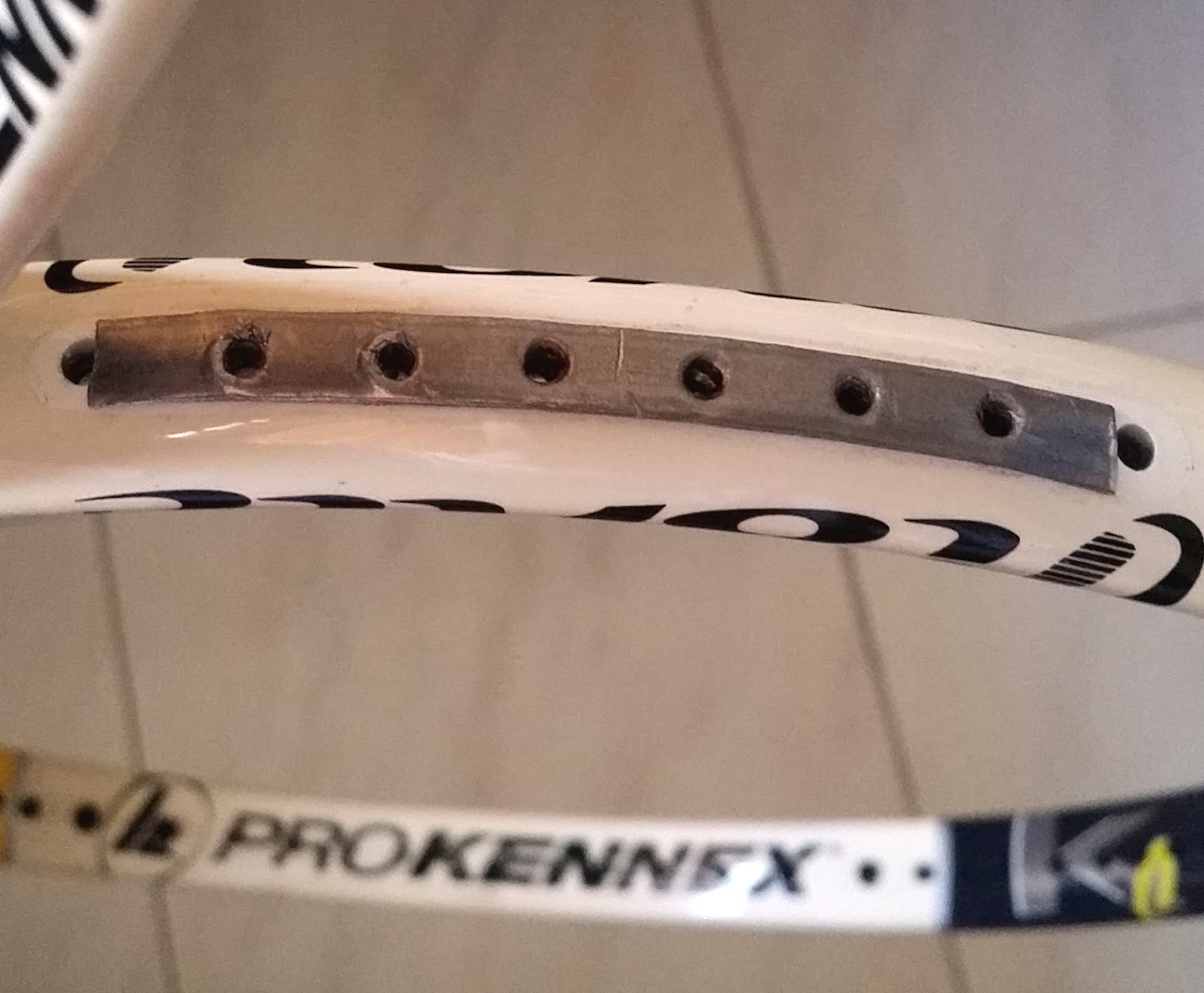
A sponsored player was struggling with arm pain. He asked if I could replicate his preferred specs in an arm friendly frame instead, then black it out.
His requirements were unique. It was not based on the usual mass, balance nor swingweight. I had to do some "reverse calculations" to determine how to proceed.
Since it was a first for me, I suggested trying the paint and mod on my personal frames to ascertain if I could pull it off. Then let him conduct a playtest before starting work on his actual sticks.
Took the opportunity to spray paint my trusty rusty wedge as well...
He agreed to the costs. And was happy with the comfort, playability, feel and control after testing it.
But by then, we only had about half a day left before his flight. And he wanted me to modify, match, paint and string SIX rackets. I only agreed to try my best.
There was not enough time to do a proper paint job - stripping out old paint, prime, two coats before a final top coat. Add to that, drying time between coats and final layer.
The black out was to meet his sponsorship obligations. Not for aesthetic purposes. I told him I would spray-paint right over the grommets. And with minimal sanding. He gave the thumbs up.
Within seven hours, I managed to complete four. And when I strung them, the paint was not even completely dry!
The most time consuming part was the pre/post paint measurements, calculations and adjustments. Depending on how much paint was removed or added, the weight impact was very significant to its end state playability.
If anyone wishes to try a similar DIY, do not under-estimate the weight implications of the paintjob.
Conversely, if you have a thorough understanding of the implications and effects of mass at different areas of the racket, you could make use of this sanding/painting to re-distribute weight to your desired end state, which would otherwise be unachievable.
Even with minimal sanding, which took me probably 15 minutes per racket, initially using 400 grit followed by 800 grit sandpaper, I removed an average of 10 grams per racket!
Final weight adjustments could only be done after the paint completely cured. In the earlier experiment on my own frames, I noticed that the solvent based paint lost weight gradually as it cured. I had to add that back to restore proper specs.
As I did not have time for the paint to cure fully, I added an extra 3 grams per racket to make up for the evaporating solvent. If my calculations were correct, it would end up 1 gram below his target specs when fully cured.
I gave him enough lead tape to cover any potential shortfall, should he need any.
Needless to say, my stringing machine mounts, hands, arms and shirt were all paint-stained during stringing.
Even though this was a paid project, I have no wish to repeat this mad rush. More time would have been helpful. And I would be more selective on the type of modifications.
But I must admit any rackets look nicer all black. They seem to play better too...
Showing posts with label arm injuries. Show all posts
Saturday, 10 March 2018
Tuesday, 6 December 2016
Replicating an ATP Top Ten Professional Racket Specs
Through an introduction from someone I have worked with, I met a chap who claimed to be a ntrp 4.5-5.0 player and needed some help.
Everytime I hear about someone's self-rated ntrp rating, it was always inflated. So I took it with a pinch of salt.
We met for coffee.
He requested for anonymity so I cannot post too much details. I'll call him "RX".
In a nutshell, RX was a college player who dabbled in several futures tournaments. He trained and played through pain, and is now paying the price with recurring tennis elbow.
Surprisingly, he has never heard of ProKennex rackets. And the racket manufacturer's claim that it helps with tennis elbow!
If you missed the test report by the professor from Massachusetts Institute of Technology, it was quite impressive! (link)
The question RX kept asking was whether this comfort-oriented racket could perform for a high level player. Other than Andreas Seppi, he could not google anyone else using a ProKennex on tour.
RX was not the first, nor the only high-level player asking me that question. So I had expected it.
Ultimately, there was only one way to find out. RX gave me his racket specs and asked if I would be willing to modify one of my ProKennex to his exact specs. Then let him test. He offered to bear all materials cost plus labour.
I accepted.
What intrigued me was that his specs was similar to a current ATP top ten male player. I have always wondered how would such a stick wield. How could I turn away this chance to kill two birds with one stone? And I still get to keep my racket after!!!
If you are a hardcore follower of tour pro's racket specs, you will know there are only three variables that determine every other aspect of the racket.
RX allowed me to share only one digit from each of the three variables. See if you can make any sense out of it:
x6x
x5x
x2x
Here's some pics of the process...
Added three layers of lead tape under the bumper in above pic.
Added three layers of lead tape inside throat grommets.
Can still see the thick layers of lead tape after replacing the throat grommet.
This was the peek inside the butt before some silicone and lead was inserted. If you are attempting this, please remove the rusty staples first.
These were just a part of the changes made. There were others that I agreed to keep confidential.
When all was completed, I went to RX's apartment for a playtest with his hitting partner. I observed.
As RX was here on holiday and recuperating from his tennis elbow, he was a little rusty. His timing was off for some difficult shots. But during co-operative hitting, I was amazed at his consistency, depth, direction and spin. It looked so effortless!
It rained last night so I could see the ball marks where his shots landed. For that co-operative hitting, I could fit 90% of his shots within a 4 ft by 4 ft square! And they were not pushing, blocking nor dinking the ball!
Search youtube for tour pro practice videos. That's how it looked like. Very humbling for a hacker like me. With their kind of pace and spin, I would not have lasted more than 3-4 shots in their usual 15-20 shots rallies.
And the sound of their ball impacts were loud and crisp. The ball crushing came with loud distinct pops.
Then they played a match while I sat miserably staring at my phone.
Almost two hours and very little pain or discomfort. I could see RX was back to swinging the racket freely. He was no longer held back by pain, nor fear of pain.
When I had my chance later, the racket was quite maneuverable. Heavy but not completely unwieldy. Not as difficult to use as I had imagined it to be. I liked the plowthrough and stability!
Thanks RX, I enjoyed working with you and have learnt much too!
Everytime I hear about someone's self-rated ntrp rating, it was always inflated. So I took it with a pinch of salt.
We met for coffee.
He requested for anonymity so I cannot post too much details. I'll call him "RX".
In a nutshell, RX was a college player who dabbled in several futures tournaments. He trained and played through pain, and is now paying the price with recurring tennis elbow.
Surprisingly, he has never heard of ProKennex rackets. And the racket manufacturer's claim that it helps with tennis elbow!
If you missed the test report by the professor from Massachusetts Institute of Technology, it was quite impressive! (link)
The question RX kept asking was whether this comfort-oriented racket could perform for a high level player. Other than Andreas Seppi, he could not google anyone else using a ProKennex on tour.
RX was not the first, nor the only high-level player asking me that question. So I had expected it.
Ultimately, there was only one way to find out. RX gave me his racket specs and asked if I would be willing to modify one of my ProKennex to his exact specs. Then let him test. He offered to bear all materials cost plus labour.
I accepted.
What intrigued me was that his specs was similar to a current ATP top ten male player. I have always wondered how would such a stick wield. How could I turn away this chance to kill two birds with one stone? And I still get to keep my racket after!!!
If you are a hardcore follower of tour pro's racket specs, you will know there are only three variables that determine every other aspect of the racket.
RX allowed me to share only one digit from each of the three variables. See if you can make any sense out of it:
x6x
x5x
x2x
Here's some pics of the process...
Added three layers of lead tape under the bumper in above pic.
Added three layers of lead tape inside throat grommets.
Can still see the thick layers of lead tape after replacing the throat grommet.
This was the peek inside the butt before some silicone and lead was inserted. If you are attempting this, please remove the rusty staples first.
These were just a part of the changes made. There were others that I agreed to keep confidential.
When all was completed, I went to RX's apartment for a playtest with his hitting partner. I observed.
As RX was here on holiday and recuperating from his tennis elbow, he was a little rusty. His timing was off for some difficult shots. But during co-operative hitting, I was amazed at his consistency, depth, direction and spin. It looked so effortless!
It rained last night so I could see the ball marks where his shots landed. For that co-operative hitting, I could fit 90% of his shots within a 4 ft by 4 ft square! And they were not pushing, blocking nor dinking the ball!
Search youtube for tour pro practice videos. That's how it looked like. Very humbling for a hacker like me. With their kind of pace and spin, I would not have lasted more than 3-4 shots in their usual 15-20 shots rallies.
And the sound of their ball impacts were loud and crisp. The ball crushing came with loud distinct pops.
Then they played a match while I sat miserably staring at my phone.
Almost two hours and very little pain or discomfort. I could see RX was back to swinging the racket freely. He was no longer held back by pain, nor fear of pain.
When I had my chance later, the racket was quite maneuverable. Heavy but not completely unwieldy. Not as difficult to use as I had imagined it to be. I liked the plowthrough and stability!
Thanks RX, I enjoyed working with you and have learnt much too!
Thursday, 10 November 2016
It's the Racket & Strings!!!!
During my game, I noticed a group of teenagers playing a doubles match next court under the watchful eyes of their coach.
School team players I suppose. After my session, I sat outside to chill and see if I could learn a thing or two from them.
Between sips, I observed their footwork, movement, anticipation, strategy, serves, strokes, style of play, etc.
As the coach barked instructions, it appeared clear to me that all four players were struggling not because of technique, but due to "inferior" equipment.
Among them were two Babolats, one Wilson and one Head racket. From the impact sound, all were strung with poly strings. New tournament balls were used.
Those are all good rackets. By "inferior", I meant ill-fitting. It seemed like they were selecting based on marketing hype rather than proper fit. (link1)(link2)
Physically, all four of them were about 1.6+ metres tall, and probably only low-60s kg. All were tanned and skinny.
The table below summed up my observations, assuming their rackets were unmodified:
Other than Player "C", the rest were all late on contact for serves and return of serves. It was evident the swingweights of 335, 327 and 332 were too much for Players "A", "B" and "D" respectively. Second serves were all suicide serves.
Neither could they control their serve returns accurately. Other than "C", most of their serve returns were either mere blocks or mis-hits. "C" hit some beautiful down-the-lines and passed the net guy, and some lob returns as well.
Groundstrokes were the only part of the game they did well in. But ironically, players "B" and "C" who were using the spinnest rackets were hitting the flattest groundstrokes!
From my estimate, about two-thirds to three-quarters of "B" and "C" topspin shots were sitters which their opponents slammed down on. That could be why they hit flat to keep the bounce low.
For volleys, only "A" managed some consistency in imparting backspin and placing the shots into blank spaces. Even "C", who used the lowest swingweight, struggled. Could be pain in his elbow.
A soft spoken lady, I presume to be the mother of one of the boys, saw me shaking my head incessantly, and came over to ask why.
I asked which kid was hers and shared the same information I posted above. Being a long-time tennis player herself, she agreed. However, the kid was insistent not to lose his strongest part of the game - groundstrokes.
From the impact sounds, the bite, dwell time and the way the ball comes off the strings, I felt the poly strings were all past their prime or tensioned way too high. In my opinion, none needed poly strings.
If they would heed advice, this would be one group where a racket and string change would yield almost immediate improvements to their game. I have made it happen many times.
But well..... like the mother said, they are entitled to their own choices.
School team players I suppose. After my session, I sat outside to chill and see if I could learn a thing or two from them.
Between sips, I observed their footwork, movement, anticipation, strategy, serves, strokes, style of play, etc.
As the coach barked instructions, it appeared clear to me that all four players were struggling not because of technique, but due to "inferior" equipment.
Among them were two Babolats, one Wilson and one Head racket. From the impact sound, all were strung with poly strings. New tournament balls were used.
Those are all good rackets. By "inferior", I meant ill-fitting. It seemed like they were selecting based on marketing hype rather than proper fit. (link1)(link2)
Physically, all four of them were about 1.6+ metres tall, and probably only low-60s kg. All were tanned and skinny.
The table below summed up my observations, assuming their rackets were unmodified:
Other than Player "C", the rest were all late on contact for serves and return of serves. It was evident the swingweights of 335, 327 and 332 were too much for Players "A", "B" and "D" respectively. Second serves were all suicide serves.
Neither could they control their serve returns accurately. Other than "C", most of their serve returns were either mere blocks or mis-hits. "C" hit some beautiful down-the-lines and passed the net guy, and some lob returns as well.
Groundstrokes were the only part of the game they did well in. But ironically, players "B" and "C" who were using the spinnest rackets were hitting the flattest groundstrokes!
From my estimate, about two-thirds to three-quarters of "B" and "C" topspin shots were sitters which their opponents slammed down on. That could be why they hit flat to keep the bounce low.
For volleys, only "A" managed some consistency in imparting backspin and placing the shots into blank spaces. Even "C", who used the lowest swingweight, struggled. Could be pain in his elbow.
A soft spoken lady, I presume to be the mother of one of the boys, saw me shaking my head incessantly, and came over to ask why.
I asked which kid was hers and shared the same information I posted above. Being a long-time tennis player herself, she agreed. However, the kid was insistent not to lose his strongest part of the game - groundstrokes.
From the impact sounds, the bite, dwell time and the way the ball comes off the strings, I felt the poly strings were all past their prime or tensioned way too high. In my opinion, none needed poly strings.
If they would heed advice, this would be one group where a racket and string change would yield almost immediate improvements to their game. I have made it happen many times.
But well..... like the mother said, they are entitled to their own choices.
Monday, 7 November 2016
Which Racket Characteristic Comes First?
All who have played with me know I use ProKennex rackets.
Many made the "mistake" of trying them, and ended up getting hooked to the impeccable comfort. Even those with no arm injuries.
Before you place an order for ProKennex, note that all my rackets are heavily modified. And it's not just lead tape or silicone added. If you have missed them, here's some of the mods I've tried:
http://unorthodoxstringing.blogspot.sg/2015/02/custom-drilling-10x19-spin-pattern.html
http://unorthodoxstringing.blogspot.sg/2013/04/overhaul-wilson-hammer-58-syn-gut-3228.html
http://unorthodoxstringing.blogspot.sg/2013/06/overhaul-pro-kennex-black-ace-98.html
http://unorthodoxstringing.blogspot.sg/2014/07/extending-racket-by-inch.html
http://unorthodoxstringing.blogspot.sg/2014/01/tri-brid-stringing-vs-varied-tension.html
With the spin and power craze, marketing has been focusing on what consumers want, just to generate sales.
But has anyone considered what is the most important factor in a tennis racket? Is it spin? Or power? Or control?
For me, and a lot of people who thought otherwise, it is comfort.
Think of the folks who play the most amount of tennis - professionals. Do you notice most prefer a flex in the high-50s to mid-60s? And many have silicone to both add weight and dampening.
Once comfort is established, we can enhance other variables. If we want more spin, use full poly with proportional stringing (link). For power and spin, gut/poly. For control and spin and durability, kevlar/poly or kevlar/zyex.
Almost all aspects, like power, spin or control can be added. But if comfort is absent, then all the other variables become limited.
Think about it, how much spin or power do you want to add if every impact was already jarringly painful?
Please keep this in mind before your next racket purchase.
Play safe!
PS: Please do not take this as my endorsement for ProKennex rackets. There are many other comfortable playing sticks from other brands.
Friday, 4 November 2016
Update to No More Tennis Elbow!!!
Here is "F's" stiff RA 70s flex, over-sized, head-heavy, light-weight racket restrung with full poly! (link)
And a very thin gauge to add plenty of feel and ball bite.
Quite unheard of for someone with tennis elbow!
And a very thin gauge to add plenty of feel and ball bite.
Tuesday, 25 October 2016
No More Tennis Elbow!!!
About 18 months after modifying the racket for a tennis elbow sufferer (link), this friend "F", handed me another racket to try to make it "similarly comfortable".
With the initial modified stick, "F" enjoyed 18 months of pain free tennis. Hard hitting singles, doubles, volleys, serves and swing volleys could again be executed without pain, nor fear of pain.
It seems "F" was playing so much that a backup stick is now necessary.
My point is, some may experience pain or discomfort due to their technique. Some due to equipment. But if you really enjoy the game so much, why live with the pain?
Usually a technique change, or re-hab, or equipment change can mitigate the problem. Talk to your stringer to find a solution.
Here's the newly matched specs for "F".
Apparently, two weeks after matching up the rackets and handing it back to "F", "F" is now requesting for a full poly setup in the rackets!
To me, that was a sure sign that the equipment was the culprit in her case of tennis elbow!
With the initial modified stick, "F" enjoyed 18 months of pain free tennis. Hard hitting singles, doubles, volleys, serves and swing volleys could again be executed without pain, nor fear of pain.
It seems "F" was playing so much that a backup stick is now necessary.
My point is, some may experience pain or discomfort due to their technique. Some due to equipment. But if you really enjoy the game so much, why live with the pain?
Usually a technique change, or re-hab, or equipment change can mitigate the problem. Talk to your stringer to find a solution.
Here's the newly matched specs for "F".
To me, that was a sure sign that the equipment was the culprit in her case of tennis elbow!
Monday, 4 July 2016
"Breaking Into" Rackets
Some months back, a junior competitive player asked for advice on how to continue playing with an arm injury.
Then, he was using a Babolat strung very tightly with full poly. Switching to a hybrid or even full multi did not help.
I felt a more flexy racket was necessary. After testing different sticks, he made his choice and stuck with the new racket since. According to published specs, the RA was around the low-60s.
During a recent restring, he started lamenting how the accuracy was still poor compared to his previous stiff Babolat.
I was perplexed.
He has been happily using the four new stick for about four months. Even managed to beat some team-mates he regularly lost to. Why the sudden nostalgia about his old Babolats?
He rang up his coach, passed me the phone and we spoke.
Top on my mind was whether he was "arming or swinging" (link) the new stick. This technique has huge implications on accuracy, especially when one is switching from a stiff flex to something softer. I also asked about his timing.
All seemed well.
To ascertain, I even dropped in on one of his training sessions to see for myself how he was hitting. And there he was, leaking some forehand shots just a tad right. First serve consistency was not as good as what I recalled.
I borrowed and played a tie-break each with all four of his sticks. Then realised that the flex has changed! The rackets has all broken-in and the graphite has softened!
The pieces started falling into place. Like when he mentioned that he felt he was not able to "load" the strings and "pocket" the ball as much as before. And the reduced spin. And the "not enough time" to shape the ball.
It was finally confirmed after we put the rackets into a Babolat RDC machine. The RA stiffness for all four of them now measured 59, 60, 60 and 61 compared to 63, 64, 63, 65 when new.
To address this, I proposed to:
(1) add some lead tape to increase mass, which would "stiffen" the dynamic flex, &/or
(2) lower the tension of his existing strings, &/or
(3) change to a thinner gauge or softer string.
As it was near an important competition, he selected option (2). It was a quick-fix that addressed most of his problems. His accuracy returned while the arm pain stayed away.
Perfect!
Then, he was using a Babolat strung very tightly with full poly. Switching to a hybrid or even full multi did not help.
I felt a more flexy racket was necessary. After testing different sticks, he made his choice and stuck with the new racket since. According to published specs, the RA was around the low-60s.
During a recent restring, he started lamenting how the accuracy was still poor compared to his previous stiff Babolat.
I was perplexed.
He has been happily using the four new stick for about four months. Even managed to beat some team-mates he regularly lost to. Why the sudden nostalgia about his old Babolats?
He rang up his coach, passed me the phone and we spoke.
Top on my mind was whether he was "arming or swinging" (link) the new stick. This technique has huge implications on accuracy, especially when one is switching from a stiff flex to something softer. I also asked about his timing.
All seemed well.
To ascertain, I even dropped in on one of his training sessions to see for myself how he was hitting. And there he was, leaking some forehand shots just a tad right. First serve consistency was not as good as what I recalled.
I borrowed and played a tie-break each with all four of his sticks. Then realised that the flex has changed! The rackets has all broken-in and the graphite has softened!
The pieces started falling into place. Like when he mentioned that he felt he was not able to "load" the strings and "pocket" the ball as much as before. And the reduced spin. And the "not enough time" to shape the ball.
It was finally confirmed after we put the rackets into a Babolat RDC machine. The RA stiffness for all four of them now measured 59, 60, 60 and 61 compared to 63, 64, 63, 65 when new.
To address this, I proposed to:
(1) add some lead tape to increase mass, which would "stiffen" the dynamic flex, &/or
(2) lower the tension of his existing strings, &/or
(3) change to a thinner gauge or softer string.
As it was near an important competition, he selected option (2). It was a quick-fix that addressed most of his problems. His accuracy returned while the arm pain stayed away.
Perfect!
Tuesday, 26 April 2016
Babolat AeroPro Drive (2007)
I'm late to the Babolat party...
On many occasions, I tried different versions of the APD on court. It is such a popular racket that someone would surely show up with it.
However, this time I set aside my own and hit exclusively with the 2007 APD for about 20+ hours. Both to test the racket and some exotic strings which would remain unknown.
While the specs (link) may claim a total weight of about 320 grams with 324 swingweight, the one I tested was 330 grams strung and gripped. Swingweight was very close to 330.
Not a big deal to me since I am no stranger to heavy sticks. (link)
Strangely, this APD felt slow and unwieldy. My timing was late. Everything including serves, serve returns and forehands. I could not understand it. It felt like I just finished the ironman triathlon minutes before playing tennis.
Naturally, I ended up arming/muscling the racket through. But I was still late. And the power threw my control haywire. I could not control the ball depth nor direction!
After struggling like a clown, my NTRP 4.5+ friend, a decade-long APD user, chuckled and pointed out the "secret tip" to me...
"It's a swinger's stick... try standing further back..." he said. (link)
Ahhh....! Then I got it! My forehand and backhand started falling in place. The loud "thwack" of the ball impact on the full poly stringbed sounded and the spin started kicking.
Serves took a little longer to get in tune as I had to adjust my toss and timing so I could "throw" the racket at the ball.
Once attuned, I aced a few second serves. The spin turned the ball down when all four of us thought it was flying long. Then kicked forward to catch the receiver totally off-guard. Certainly not something I normally delivered.
I became very impressed by the APD. Just loosen up, grip down, start the foreward swing a tad earlier, and enjoy letting the release of the wrist-hinge slap through the ball. So effortless!
As long as I was early with both footwork and racket prep, sweetspot and near-sweetspot ball impacts felt plush and comfy. There was no hint of any frame stiffness at all. (Of course, the secret string played a part!!!)
Conversely, when I was late, like under attack or read the ball wrongly, the APD was very demanding to move.
Like I had stacked too many plates on the barbell. Attempts to direct the racket at this stage meant a stiffening of the grip pressure. This engages the forearm and biceps while locking up the wrist.
Instinctive, but very wrong and deadly move!
The punishment for this was the full, jarring impact of the ball landing on the hand, wrist, elbow or shoulder. Especially with the lack of racket momentum to buffer the incoming "punch" from the heavy ball.
It was nasty!
Another issue was power.
When I was in full balance and contacted out front, I could unleash the full swing, load the stringbed well, and let the topspin keep the ball in the court. When late, the power was too much.
To curb that power, many tightened up the tension. Or selected a much stiffer low-powered string. Then they ended up "arming" the ball even more.
Disastrously, that was how the APD destroyed several of my former playing partners' elbows.
The polarization of weight in the APD is so deceptive. It fooled me and many into thinking it was fast and easy to maneuver. But it is not.
Don't be deceived. In my opinion, the APD is a player's frame. Beginners like it for it's easy power so learning tennis becomes faster.
However, it is a very demanding frame that expects good read of the ball, fast footwork and very early swing prep. Without which, it could cause some serious havoc with the player's arm.
Now I understand why many deemed this the indisputable "arm killer".
Play safe!
Monday, 30 November 2015
Bad Batch of Strings?
It's the school holidays and I was busy with a lot of stringing and customizations. One after another. Almost non stop.
With the Black Friday sales and Christmas mood, many were testing new string setups. Almost all wanted more spin.
Strangely, there was one poly string that kept snapping during tensioning. After the initial string snap, every single grommet hole was scrutinized thoroughly. All was in order.
The string gripper and clamps were stripped apart, cleaned and checked before re-assembling.
The poly string was also examined for kinks, nicks or other damages. None were found.
But when I applied tension on the mains, it just snapped. Not very tight, just 50 lbs on a 1.23 mm shaped poly.
Sustained a small cut on my left arm from the string lashing. Guess this is all part of stringing. Another reason why I just cannot like poly...
Should be a bad batch since I cut it out from the reel. At least it was not as bad as my previous lashing (link).
Wednesday, 23 September 2015
A Very Close Shave...
A competitive player asked if I could help him fine tune his strings setup.
Both his coach and himself claimed he was hitting well. They attributed the control issues he faced to the strings.
However, he liked his current 1.10mm thin poly strings. Better bite, more feel and more spin, he said. Well, common sense dictates - thicker string, more control right?
But instead, they wanted to increase the string tension on the 16x19 frame. By 10 pounds! To 72 lbs! I felt dizzy just listening to him mentioned THAT number!
As usual, my way of dealing with this pesky behaviour was to quote an insanely ridiculous price (link), hoping to turn him away diplomatically.
But he accepted! And paid upfront! Oh my goodness!!!
Before stringing, I put on a long sleeve shirt to protect my arms. While tensioning, I kept my face away from the racket as far as possible. But it was still not enough...
While pulling the outer mains, the string snapped! The flying clamps flew!
And the string that was under tension, whipped around and lashed me across my neck, chest and left hand. If NASA recorded some earthquake-like shock waves from Asia, it was my scream!
OUCH...!!!
My first knuckle on my left hand and ring finger turned numb.
It felt like my skin has split open. Took off my shirt to check, and saw my neck received a lashing as well.
Super lucky it missed my face!
Next time anyone wants high tension with thin strings, it would be US$2,000,000.00. Per racket! Upfront! In cash!
Both his coach and himself claimed he was hitting well. They attributed the control issues he faced to the strings.
However, he liked his current 1.10mm thin poly strings. Better bite, more feel and more spin, he said. Well, common sense dictates - thicker string, more control right?
But instead, they wanted to increase the string tension on the 16x19 frame. By 10 pounds! To 72 lbs! I felt dizzy just listening to him mentioned THAT number!
As usual, my way of dealing with this pesky behaviour was to quote an insanely ridiculous price (link), hoping to turn him away diplomatically.
But he accepted! And paid upfront! Oh my goodness!!!
Before stringing, I put on a long sleeve shirt to protect my arms. While tensioning, I kept my face away from the racket as far as possible. But it was still not enough...
While pulling the outer mains, the string snapped! The flying clamps flew!
And the string that was under tension, whipped around and lashed me across my neck, chest and left hand. If NASA recorded some earthquake-like shock waves from Asia, it was my scream!
OUCH...!!!
My first knuckle on my left hand and ring finger turned numb.
It felt like my skin has split open. Took off my shirt to check, and saw my neck received a lashing as well.
Super lucky it missed my face!
Next time anyone wants high tension with thin strings, it would be US$2,000,000.00. Per racket! Upfront! In cash!
Monday, 24 August 2015
Shoulder Pain
A friend of a playing partner, EC, has been suffering from shoulder pain, especially during serves.
EC is in his late-30s, been enjoying tennis for a few years and has received some coaching before. My initial impressions of him from the first few rally hits was that he is very well-built and a big, strong hitter.
When he showed me his bruises from his TCM massage therapy (link) for his upper right arm and shoulder pain, I was surprised.
Then I noticed he was using the Wilson BLX Tour Limited (link). The specs (reproduced from link):
As usual, most pay attention only to total weight when buying rackets and 315 grams strung sounds really comfortable.
Until one looks at the very stiff flex of RA73, extended length of 27.5", high balance point of 34 cm and a very high swingweight of 345!
The extended length would add about another 10+ SW points to make it play closer to 355-360! That is close to, or more than what is speculated online to be Federer's and Djokovic's racket swingweights!
Really reminds me of:
Swingweight Addiction
Mysterious Arm Pain
To make matters worse, it was strung tight with thick 16 gauge full poly! Now that would be amazing if his arm didn't hurt!
Even his backup racket, a Blade 98 (18x20)(link) was not very forgiving with 16 gauge full poly tightly strung too. Although much more arm "friendlier" at 27 inches, RA 64 and SW of 335, but how many recreational players can load 16 gauge full poly in a dense 18x20 stringbed? Not to mention it was dead poly.
So I suggested good old synthetic gut...
EC added a few layers of overgrips and inadvertently added some comfort by moving the balance a little lower. That also beefed up the weight to absorb some nasty vibes. His chief gripe, was still the dead, powerless, lifeless strings.
The full poly strings weighed 18 grams.
A full bed of synthetic gut weighs only 14 grams. That 4 grams difference reduced the swingweight by approximately 8 SW points. That is significant!
Another major difference is the greater elasticity of syn gut would allow EC to load the strings better, have greater dampening and a lot more power than full poly. EC could swing the racket easier now rather than forcing every shot.
Hopefully, with some rotator cuff exercises (link) I got him to do, and the much softer synthetic gut stringbed, his shoulder and arm would get better.
In case you missed this great article written by Toby, I think it is worth a read:
http://unorthodoxstringing.blogspot.sg/2015/01/why-i-dont-like-poly.html
Play safe to enjoy tennis longer!
EC is in his late-30s, been enjoying tennis for a few years and has received some coaching before. My initial impressions of him from the first few rally hits was that he is very well-built and a big, strong hitter.
When he showed me his bruises from his TCM massage therapy (link) for his upper right arm and shoulder pain, I was surprised.
Then I noticed he was using the Wilson BLX Tour Limited (link). The specs (reproduced from link):
As usual, most pay attention only to total weight when buying rackets and 315 grams strung sounds really comfortable.
Until one looks at the very stiff flex of RA73, extended length of 27.5", high balance point of 34 cm and a very high swingweight of 345!
The extended length would add about another 10+ SW points to make it play closer to 355-360! That is close to, or more than what is speculated online to be Federer's and Djokovic's racket swingweights!
Really reminds me of:
Swingweight Addiction
Mysterious Arm Pain
To make matters worse, it was strung tight with thick 16 gauge full poly! Now that would be amazing if his arm didn't hurt!
Even his backup racket, a Blade 98 (18x20)(link) was not very forgiving with 16 gauge full poly tightly strung too. Although much more arm "friendlier" at 27 inches, RA 64 and SW of 335, but how many recreational players can load 16 gauge full poly in a dense 18x20 stringbed? Not to mention it was dead poly.
So I suggested good old synthetic gut...
EC added a few layers of overgrips and inadvertently added some comfort by moving the balance a little lower. That also beefed up the weight to absorb some nasty vibes. His chief gripe, was still the dead, powerless, lifeless strings.
The full poly strings weighed 18 grams.
A full bed of synthetic gut weighs only 14 grams. That 4 grams difference reduced the swingweight by approximately 8 SW points. That is significant!
Another major difference is the greater elasticity of syn gut would allow EC to load the strings better, have greater dampening and a lot more power than full poly. EC could swing the racket easier now rather than forcing every shot.
Hopefully, with some rotator cuff exercises (link) I got him to do, and the much softer synthetic gut stringbed, his shoulder and arm would get better.
In case you missed this great article written by Toby, I think it is worth a read:
http://unorthodoxstringing.blogspot.sg/2015/01/why-i-dont-like-poly.html
Play safe to enjoy tennis longer!
Monday, 11 May 2015
Mysterious Arm Pain and Hyper Hammer 4.0 Overhaul
A playing partner asked if there could be any explanations why only a particular racket caused elbow pain when playing.
Both were strung with full synthetic gut around 55 lbs. Both specs were very close, but only the Wilson always resulted in pain after play, whereas the Head TiS6 never caused any discomfort.
Looking at the string wear in the sweetspot of the Wilson (above left picture), there was absolutely no doubt on the consistency of sweetspot impacts. So I ruled out pain due to framed shots.
Then I compared their specs:
Both were strung with full synthetic gut around 55 lbs. Both specs were very close, but only the Wilson always resulted in pain after play, whereas the Head TiS6 never caused any discomfort.
Looking at the string wear in the sweetspot of the Wilson (above left picture), there was absolutely no doubt on the consistency of sweetspot impacts. So I ruled out pain due to framed shots.
Then I compared their specs:
| Wilson HyperHammer 4.0 OS | Head TiS6 OS | |
|---|---|---|
| Weight | 249 grams | 252 grams |
| Balance | 9 pts head heavy | 8 pts head heavy |
| Swingweight | 308 | 318 |
| Length | 27.75" | 27.75" |
| Flex | RA 70 | RA 75 |
| Headsize | 110 sq inch | 115 sq inch |
| String Pattern | 16 x 20 | 16 x 19 |
Ironically, the TiS6 was 5 points stiffer on the RA scale compared to the Hammer. So it ought to have been the more damaging stick instead!
After much probing, dry-fitting and testing, similar to what I attempted here two years ago, the culprit pointed towards two things:
(1) the very low swingweight of this Hammer, and
(2) the very extreme weight polarization (9 points head heavy)
(1) the very low swingweight of this Hammer, and
(2) the very extreme weight polarization (9 points head heavy)
When there was sufficient time to prepare and swing, every shot felt good for both frames, for forehands and backhands, groundstrokes and volleys.
But when I was late, or on the run to retrieve a well-placed corner shot, the abbreviated compact swing made the racket feel very inadequate. It was powerless.
The extended length allowed me to reach the ball, but the feeble swingweight worked against me, and allowed only a very miserable pathetic tap against the full velocity of the ball.
As a result, instead of me swinging the racket to hit the ball, it became the reverse - the ball pounding hard on the racket, which in turn twisted or deflected my wrist/arm backwards.
With the racket weighing only a mere 250 grams to bear the impact, my arm became the shock absorber! I played with it, in stock form, for only about 10 minutes before I had to set it aside.
Literally, I had to beef up the racket by adding weight to improve its swingweight, vibration dampening and simultaneously reduce the extreme weight polarization.
The original handle was entirely hollow all the way up to the hoop.
Most of the racket's weight was concentrated on the tip of the head, near 12 o'clock. This encouraged vibrations to travel down the hollow frame towards the handle, which was the lightest part of the racket. And then up our hand, wrist and elbow.
After stuffing one side of it, I tapped around the frame and measured the vibrations via frequency. I stopped when about 70% of the "bad vibes" were removed or reduced.
Then the old strings were cut and restrung.
A little lead was added around the grip pallet as well. And about 4 grams were added to the hoop at 4 & 8 o'clock to add about 7 swingweight points. Placing the lead any higher would worsen the weight polarization so lower was better.
Here's how it looked completed.
While some aspects, like vibrations, total weight, balance and swingweight were easily quantifiable, the most important variable - player feel/preference, remained entirely subjective.
The only way to take this further, is for my friend to make minor adjustments and fine-tune after each session of play.
Whatever the outcome, the general consensus about "light and stiff" rackets stand - that they are hazardous to our arm health.
11May2015 update:
- For those with tennis elbow or wrist injuries, just a few hits with an unfriendly frame usually flares up the pain very quickly.
- After I handed the modified Wilson to the owner, she gave it a few air swings and proceeded to rally. I watched intently the ball impact locations on the stringbed, the amount of prep time and the magnitude of back swing.
- Added weight usually visibly slows down a player. Ironically, it enhanced this partner's swing timing. Immediately, I knew the racket had been too light earlier.
- Coupled with the extreme weight polarisation, it actually hindered her from taking a free swing as the heavy head's momentum ended up "pulling" her arm instead.
- The average pace of her shots increased. Directional control improved.
- What she admitted readily, was the absence of any pain or discomfort. The frame felt cushioned and friendly. But she did not believe that her ball speed increased and felt heavier to me.
- So I told her to keep this modification to herself. Then play with her usual doubles group and see what those three regular partners would say after their two hours session.
- I was updated later, that just during their warm-up rally prior to the game, her partners already remarked about her improved hitting depth, power and control. Even asking if she had been working out in the gym to achieve all that!
- Needless to say, she sent me a message, saying:
"Thanks again for resuscitating my racket... It keeps me grinning the whole day..."
With the racket weighing only a mere 250 grams to bear the impact, my arm became the shock absorber! I played with it, in stock form, for only about 10 minutes before I had to set it aside.
Literally, I had to beef up the racket by adding weight to improve its swingweight, vibration dampening and simultaneously reduce the extreme weight polarization.
The original handle was entirely hollow all the way up to the hoop.
Most of the racket's weight was concentrated on the tip of the head, near 12 o'clock. This encouraged vibrations to travel down the hollow frame towards the handle, which was the lightest part of the racket. And then up our hand, wrist and elbow.
After stuffing one side of it, I tapped around the frame and measured the vibrations via frequency. I stopped when about 70% of the "bad vibes" were removed or reduced.
A little lead was added around the grip pallet as well. And about 4 grams were added to the hoop at 4 & 8 o'clock to add about 7 swingweight points. Placing the lead any higher would worsen the weight polarization so lower was better.
Here's how it looked completed.
While some aspects, like vibrations, total weight, balance and swingweight were easily quantifiable, the most important variable - player feel/preference, remained entirely subjective.
The only way to take this further, is for my friend to make minor adjustments and fine-tune after each session of play.
Whatever the outcome, the general consensus about "light and stiff" rackets stand - that they are hazardous to our arm health.
11May2015 update:
- For those with tennis elbow or wrist injuries, just a few hits with an unfriendly frame usually flares up the pain very quickly.
- After I handed the modified Wilson to the owner, she gave it a few air swings and proceeded to rally. I watched intently the ball impact locations on the stringbed, the amount of prep time and the magnitude of back swing.
- Added weight usually visibly slows down a player. Ironically, it enhanced this partner's swing timing. Immediately, I knew the racket had been too light earlier.
- Coupled with the extreme weight polarisation, it actually hindered her from taking a free swing as the heavy head's momentum ended up "pulling" her arm instead.
- The average pace of her shots increased. Directional control improved.
- What she admitted readily, was the absence of any pain or discomfort. The frame felt cushioned and friendly. But she did not believe that her ball speed increased and felt heavier to me.
- So I told her to keep this modification to herself. Then play with her usual doubles group and see what those three regular partners would say after their two hours session.
- I was updated later, that just during their warm-up rally prior to the game, her partners already remarked about her improved hitting depth, power and control. Even asking if she had been working out in the gym to achieve all that!
- Needless to say, she sent me a message, saying:
"Thanks again for resuscitating my racket... It keeps me grinning the whole day..."
Thursday, 9 April 2015
Kevlar Crosses!?!?
Through M's introduction, T asked if I could take a look and see if I could recommend something for his existing strings setup.
The first glance at his racket strings shocked me!
Not only was the kevlar and syn gut hybrid set in the wrong order - with kevlar in the crosses, there was also a double string knot tied at the bottom 6th main.
My first question was, if there has been any pain or discomfort in his wrist or elbow from playing with that setup. Luckily, the racket was very flexible. Else it would have been disastrous!
Since T hits flat, I advised him to cut this out and re-string it with plain old synthetic gut.
The weight printed on the racket throat stated 275 grams but did not specify if that was strung or unstrung. So a quick check on the scale was done. 302 grams strung and with dampener.
Then I measured the inside hoop length and width with the syn gut/kevlar setup. Length was 322mm and width 255mm.
Then I cut out the strings and checked the unstrung inside hoop dimensions. About 326mm by 256mm. So the syn gut/kevlar caused a distortion of 4mm and 1mm respectively.
The racket was then strung with a full bed of synthetic gut. Strung inside hoop was 326mm and 254mm. Distortion from unstrung was 0mm and 2mm respectively.
T also mentioned the butt cap was shaky. So I removed the staples and checked if the pallet or foam was intact.
A common mistake is to use super glue to hold the butt cap stable. It will work for a while, but then the entire foam would disintegrate as super glue melts foam.
So I used thick double-sided adhesive tape to tighten the fit, then sprayed a squirt of rubbing alcohol to activate the tape before pushing the butt cap in firmly. Then stapled it down. That took care of the wobble.
T's grip was a little too big for him. To reduce it by half a size (1/16"), I stretched out the replacement grip a little before wrapping it back. That brought the grip size down from 4 3/8" to 4 5/16".
Hopefully the grip stays and he has a more enjoyable game with this.
This post was meant to document the changes made for T, and perhaps a reminder to fellow tennis players that kevlar should never be used in the crosses. Unless one wants his wrist or elbow destroyed.
The first glance at his racket strings shocked me!
My first question was, if there has been any pain or discomfort in his wrist or elbow from playing with that setup. Luckily, the racket was very flexible. Else it would have been disastrous!
Since T hits flat, I advised him to cut this out and re-string it with plain old synthetic gut.
The weight printed on the racket throat stated 275 grams but did not specify if that was strung or unstrung. So a quick check on the scale was done. 302 grams strung and with dampener.
Then I measured the inside hoop length and width with the syn gut/kevlar setup. Length was 322mm and width 255mm.
Then I cut out the strings and checked the unstrung inside hoop dimensions. About 326mm by 256mm. So the syn gut/kevlar caused a distortion of 4mm and 1mm respectively.
The racket was then strung with a full bed of synthetic gut. Strung inside hoop was 326mm and 254mm. Distortion from unstrung was 0mm and 2mm respectively.
T also mentioned the butt cap was shaky. So I removed the staples and checked if the pallet or foam was intact.
A common mistake is to use super glue to hold the butt cap stable. It will work for a while, but then the entire foam would disintegrate as super glue melts foam.
So I used thick double-sided adhesive tape to tighten the fit, then sprayed a squirt of rubbing alcohol to activate the tape before pushing the butt cap in firmly. Then stapled it down. That took care of the wobble.
T's grip was a little too big for him. To reduce it by half a size (1/16"), I stretched out the replacement grip a little before wrapping it back. That brought the grip size down from 4 3/8" to 4 5/16".
Hopefully the grip stays and he has a more enjoyable game with this.
This post was meant to document the changes made for T, and perhaps a reminder to fellow tennis players that kevlar should never be used in the crosses. Unless one wants his wrist or elbow destroyed.
Subscribe to:
Comments (Atom)