Showing posts with label used strings. Show all posts

Sunday, 3 May 2015

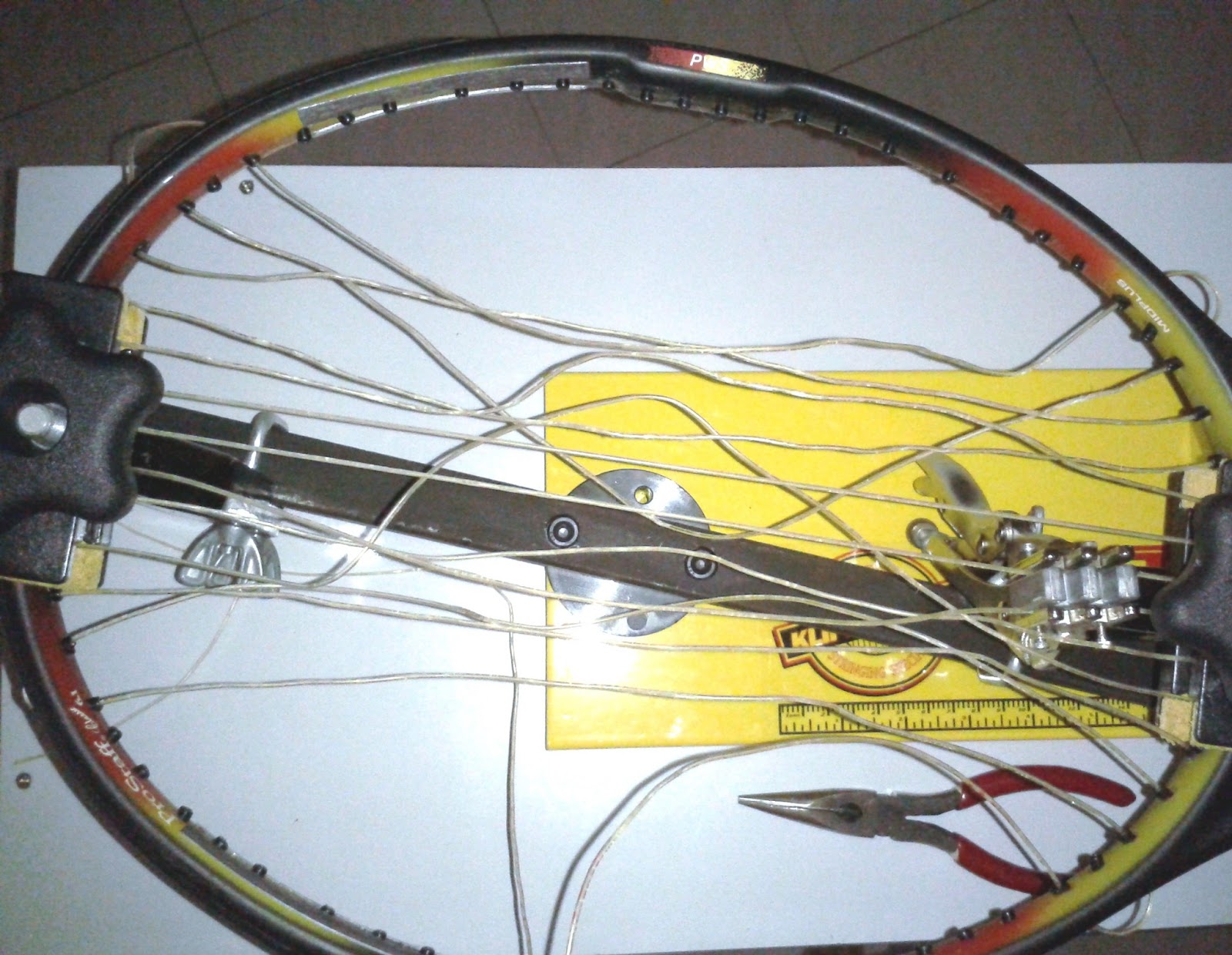
Tying Together Used Strings for Re-use?

Inspired by Ricardo from this post, I thought I should give it a try too.

The most recently snapped string I had was kevlar (link), and since kevlar have absolutely no life nor stretch, I thought it would be a good test to see if the knots would hold up.

Ricardo recommended the triple fisherman's knot but I could not wrap the stiff kevlar around. So I tied them together using two parnell knots on each string, totalling four parnell knots.


The knot joint was placed at the throat during stringing.


Despite tensioning the used kevlar at 75 lbs, I managed to complete the all the 10 mains strings smoothly without incident.

However, it was mid-way through the syn gut crosses that the kevlar snapped cleanly from the knotted area. The increased tension from the weaving must have stressed the kevlar.


To be fair, I did not use the recommended fishing knot. Secondly, the snapped kevlar was already fraying at some spots, so it was obviously weakened.

I think I would try this again next time with some other strings. Maybe natural gut?


Friday, 1 August 2014

DIY Textured Strings?

Many of the newer polys are shaped or textured, claiming it would increase bite and spin.

Despite many polys I've tested, "The One" remains elusive. But the idea of a rough texture increasing spin through higher friction appeals to me. (link)

Since I no longer break strings like I used to, I cut them out after about 8-10 hours, or when they've lost their mojo.

Instead of cutting out one that's due, I thought I'll rough it up as an experiment.

Even with a 60 grit, sandpaper was too smooth. I wanted it REALLY rough! So the bastard file was deployed.


It was so rough it was impossible to draw the stringbed against the back of my hand. Perhaps a really sadistic person could do that, but I couldn't. Neither my partner.

How rough? Just think of a grating tool...


To preserve some durability, only one side of the stringbed was filed. The other was left untouched as a comparison.


Playtest:
- Before and after roughing the strings, I measured the stringbed frequency. It was the same. So tension was a non-factor, even after play.
- Within the first few hits, it was obvious that ball feel was A LOT better on the rough side. The difference was something like hitting with a 18g string versus a 16g.
- Another surprising find was an improvement in directional control.
- Even when hitting totally flat, it felt so much easier to aim and direct the ball. 
- Comparing both sides, the smooth side felt slippery and that the ball was skidding a little across the strings during impact! Without a high speed camera, there was no way for me to verify that, it just felt that way to me.
- To ensure the greater accuracy was not mere psychology, I got my partner to feed me balls while I aimed at targets I usually found challenging. Five shots each were attempted with each side of the stringbed, alternating at every shot. The result was telling!
- I got my partner to try while I fed him easy balls, and he shared exactly the same sentiments.
- With the extra ball-to-string friction, all kinds of spin improved across all strokes, including serves.
- This extra bite on the ball was easily seen after less than ten strokes! The tennis ball fluffed up like a pom pom ball!
- The stringbed pic is below.


- Keep in mind, this stringbed was already used for about 9 hours before this. It was dead enough for me to want to cut it out.
- If you wish to test it, go easy on the roughing process. I snapped the earlier two attempts, this was the third.
- Even this snapped overnight after about an hour of play.


Friday, 9 August 2013

Residual Elasticity (Part 2): Hammer5.8 (16x10 Proportional)

(Link to Part 1 is here)

Among all the strings I've tried, poly has the highest deformation factor. That's why tension loss for poly is always so high. Especially immediately after stringing!


To further test my theory on stringing based on residual elasticity, I will be stringing with used poly this time.


The used poly string will come from my Wilson Hammer 5.8 (link). It was strung a few months ago and should have seen at least 10 hours of play, maybe more.


My plan is to string 2-piece with poly in mains. The previous stringing pattern would give me plenty of extra string to play with. A new set of synthetic gut will be used for crosses. That would help me isolate any problems, if any, with the stringbed later.


Before re-use, the used poly was tested for its elasticity, resilience and deformation properties. The test results would determine the tension and stringing method to use.


To prevent unnecessary stress or damage to the used poly, I am using only both ends for testing since they will be trimmed after stringing. Each segment of string would be tested a maximum of three times with the lightest tension first and heaviest last. 


After I have arrived at my preferred tension, I will test the centre of the used poly string once to confirm consistency of results. This is because the centre of the stringbed suffers more ball impacts than the side strings.


Here's a pic of how a segment of string was marked, measured, clamped and tested. Two black dots (circled in red) marks the test length before, during and after tension was applied.


Here's two results (from the same string segment) which I felt were insightful:

Test1

Starting length: 20.1cm 
Length @ 45lbs: 20.8cm (after 1min)
Length @ 45lbs: 20.9cm (after 30min)
Ending length: 20.3cm
Elasticity @ 45lbs: (20.9 - 20.3)/20.3 = 2.95%

Test2
Starting length: 20.3cm 
Length @ 50lbs: 20.9cm (after 1min)
Length @ 50lbs: 21.0cm (after 5min)
Length @ 50lbs: 21.1cm (after 30min)
Ending length: 20.3cm
Elasticity @ 50lbs: (21.1 - 20.3)/20.3 = 3.94%

If you refer back to my chart on "Poly Stretch Test" posted in March 2013 (link), you can see that this poly starts stretching from about 45 lbs. The above test findings again confirms that.


One very important observation is the absence of additional string deformation at 50lbs after the 45lbs test was completed. Despite being re-used, this poly string stays resilient!


Thus, 50lbs was selected as the starting tension and proportional stringing was used, just like the PK Black Ace 98 (link). That's how much I like that setup!


Stringing pics below...


From the last pic, it is clear how the slick round poly mains "snap back" automatically whereas the synthetic gut strings lay crooked.


Playtest:

- It played very very close to the PK BA98 (link).
- From the first hit, it is very comfortable. There is absolutely zero trace that the poly was re-used! From my previous recollection of how the poly played when new, it felt exactly the same to me. Exactly.
- Directional control is good. But there is this same feeling of the ball "penetrating the cross strings gap" whenever I crank it up. It is not a serious mis-direction and happens only occasionally. Maybe it will go away in the second session like previously?
- Spin shines! Between this and the BA98 full syn gut, the spin levels appear very similar.
- Power level for this is slightly lower than the BA98 full syn gut. So it is very good for people who like to swing all out. The low-power and heavy spin would easily keep the ball in the court.
- I'll test it again in the next session and update later.

12Aug2013 update:
- Surprisingly, the ball "penetrating the cross strings gap" problem disappeared.
- Spin levels improved over the first session. Both serves and groundstrokes kicked up hard and fast. Slices skidded off the ground wickedly and forced my partner to scrap the racket against the floor just to return that shot.
- The used poly performed as well as, if not better, than a fresh set of similar poly string. I am thoroughly satisfied that it is possible to re-use strings as long as it is strung based on residual elasticity.
- The new synthetic gut cross string lost quite a bit of tension during play today. It started getting softer and softer. As crazy as it sounds, I prefer re-using used strings as tension holding is so much more stable.
- Similar to the PK BA98 (link), light notching can be seen only on the mains poly string. The crosses have absolutely zero notching so far. I find this strange as poly is so much stiffer than syn gut. It seems like tightly-strung syn gut could be stiffer than poly!


Monday, 22 July 2013

Residual Elasticity (Part 1)

This is an update from my previous post on "Pocketing" (link).

Whenever I use new strings, the three most important properties I would investigate are the string's:
1. Elasticity
2. Resiliency
3. Deformation

The first two have been discussed in a previous post. (link


To recap, elasticity is how much the string can stretch, like a rubber band. Resiliency is how much of that stretch can be recovered when tension is removed.


Deformation occurs when the string has been stretched beyond its capabilities and is no longer able to recover to its initial length or shape. 


For example, a string with initial length of 30cm may stretch to 31cm at 50lbs. When tension is removed, it may recover to only 30.2cm. 


For that string, elasticity is about 3.33% at 50lbs 

((31-30)/30 x 100%).

Deformation would be that 0.2cm that cannot be recovered.


So far, every tennis player or stringer I speak to are only concerned with what tension to string. That's what I was accustomed to as well.


But after studying the three properties mentioned earlier, my thoughts are, what if we string rackets based on managing these three properties?


I thought that would be a very revolutionary way to string!


In fact, I've already done a few stringing experiments based on managing these three important variables. So far, the results are promising.


Let me recount one which I thought can be considered as an acid test of this "theory".


I re-used natural gut and synthetic gut!


When both strings were new, I recorded detailed measurements to understand how their elasticity and resiliency would change with use.


The numbers were then compared after the strings were used. 

Depending on how much elasticity and resilience has deteriorated, I would lower the tension accordingly so that the "residual elasticity" after stringing would match or be close to when the string was new.

Here's some pics of the re-used gut and syn gut as a hybrid at 25/23.5 lbs. It's a straight-forward 2 piece job. Nothing fanciful.


Playtest:

- The racket was tested less than 24 hours after stringing so the stringbed was still fresh and tight.
- Initial hits are very promising. The strong rebound of the natural gut was unmistakable. No trampoline!
- Surprisingly, control was still intact and did not differ very much compared to new strings.
- Comfort and feel was surprisingly still very good despite the re-used syn gut. There was no trace nor any hints of the gut or syn gut playing dead or lifeless at all. 
- All of my playing partners who tried this racket commented on how "fresh" and lively this setup played. None suspected re-used strings nor the super low tension of 20+ lbs!
- After about 45 minutes of rally, I can feel tension loss creeping in. Pocketing from the natural gut became deeper and I felt more and more of the gut doing the "work" alone. The syn gut has lost too much tension.
- Another problem was the huge difference in speed of resilience between gut and syn gut.
- The tension after play was measured by frequency. Tension loss was estimated to be about 2.5lbs. I cut it out as the differential between mains and crosses became too large. (Tension loss from gut is about 5% and syn gut about 15%, so the initial 25/23.5 lbs could have become 23.75 and 19.98 respectively. The differential widened to almost 4 lbs from 1.5 initially!)

And what did I do after I cut the natural gut out?

Here's some pics of the natural gut re-used again in the same racket. This time, a set of fresh syn gut was installed using the box method. Tension was 33/35 lbs.


After completing the mains, I rubbed some coconut oil on the natural gut to lubricate it as it was quite dry. You can see the gloss on the strings.


Boxing...


Playtest:

- To me, the ultimate test is to play a game with an equally strong partner. I did just that today with M.
- When warming up, I could already feel the potential of this setup. It is like a sports car, where the harder you hit, the better the control.
- The stringbed was nice and tight but delivered very good spin and power. 
- With gut, it is almost always comfortable, so I will not delve into that.
- Both first and second serves were very good. Flats were accurate and powerful while spin seconds were curving well already in mid-air. A few were so spinny they kicked off M's stringbed upon contact and flew out. I had a few aces too.
- Even after about an hour, the tension held. I arrived at 33/35lbs based on residual elasticity and also projected tension loss of 5% and 15% for gut and syn gut respectively. If correct, then it should stabilise around 31.35/29.75 lbs with a 1.6lbs differential, which is what I wanted.
- I won the set 6-0 with this setup, and it is a 80 sq inch head size!
- This setup is good and I like it! Ball fur pic below.


29Jul2013 update:

- Played a set with this racket today.
- Control is remarkably good. Both serves and groundstrokes that I hit well were delivered very accurately.
- Even spin serves had a little more pace due to the fast rebound and power of natural gut.

- I could not feel any difference in tension from my last game and it was confirmed by my frequency meter the tension change since the last game was less than 0.5lb!
- Perhaps due to the heavy spin I was attempting, I noticed more fraying that could have occurred today.
- I estimate this gut has been in play for 40-50 hours.


Sunday, 31 March 2013

Wilson PSC 6.1 + Natural Gut/Syn Gut @ 35/33 lbs

I just cannot understand why there is so much vibrations in the fullbed natural gut stringbed (link). 

Thinking back, I recalled the Klip Legend did not even stretch much when I strung it at 32 lbs. It seems like natural gut needs to be stretched a little more before its true playing potential surfaces.


Having spent so much on this one set of strings, I am reluctant to cut it out. But neither am I enjoying it at all. 


So I thought I'll re-use the natural gut in the mains and convert this to a hybrid! Since gut does not lose its resiliency at all, even up to the point of breakage, this should work very well, isn't it?


As usual, I mounted the racket and carefully cut out only the cross strings. Then I loosened the mains and removed the power pads as well. The gut still feels very crispy to the touch.


I checked the mains for any serious notching or fraying. All seems fine despite more than 6 hours of play. So I started tensioning the mains.


I just cannot resist pinging the mains after it is done. The sound is just so melodious and pleasant!


Weaving the synthetic gut cross is very easy. It is lubricated with silicon and pulling it across the mains is almost effortless.


Playtest:

- Despite the re-used gut, the feel and pocketing is still plush, deep and nice! Plus, ALL the vibrations disappeared!
- Power levels have toned down significantly from the previous fullbed, but the stringbed is not dead. It still has the unmistakable feel and comfort of natural gut.
- Despite the drop in power, power levels are still higher than fullbed ELT syn gut or multi.
- Spin is good. Definitely more so than normal tensions but maybe slightly less or same as ELT syn gut. My bald balls may not provide sufficient fur for the strings to grab.
- Directional control is among the best ELT I've tried. No surprise considering I'm using very "pre-stretched" nat gut.
- Overall, this is a very pleasant surprise for me as I expected the gut to be much less lively and playable.
- Even my lady partner preferred this gut/syn gut feel compared to the previous fullbed. So I think this hybrid will be a very good cost-saving alternative for one to enjoy natural gut.
- The next question on my mind is durability. I'll continue to play with this and monitor. 

03Apr2013 update:

- Weather is finally dry enough to use this racket again.
- Tension holding is superb! It felt as stable as when I first used it.
- Comfort, power and pocketing are probably the best aspects of using natural gut and all three are still in abundance!
- Spin is good. To get more, I'll have to hit harder. When I feel the pocketing go deeper, I know that's also when the "bite" is stronger. A slightly steeper brush upwards and spin goes up.
- This gut would have clocked 8+ hours of use after today and there isn't any significant increase in fraying nor notching!

08Apr2013 update:

- The feel of natural gut is highly addictive! I just keep coming back to this racket because of the gut strings!
- While pocketing are both deep for ELT syn gut and ELT natural gut, I am beginning to understand the differences.
- With ELT natural gut, the stringbed feels tighter as the pocketing deepens. I can feel the strings "wrap around" the ball and then rebounds very powerfully and directed accurately at where I was aiming the ball to go.
- For ELT syn gut, I get a slight "hollow" and loose feeling as the pocketing deepens. It almost feels like a butterfly net. And when the ball departs the stringbed, I have a little less confidence whether the ball trajectory is going to match where I was aiming.
- Keep in mind I used the exact same racket for both stringjobs so the racket properties and flex are not in question.
- This session marks about 10 hours of use.


10Apr2013 update:
- No matter what racket I bring, I keep coming back to this stick when the going gets tough.
- Natural gut is just so comfortable, powerful and predictable. Nothing comes close.
- Huge chunks of ball fur keeps getting ripped off by the strings.
- Added another hour of hard hits to make 11.


15Apr2013 update:

- Just to add another 3 hours of play with the gut to total about 14 hours now.
- String movement remains less than ELT syn gut.
- There's a little extra fraying on the mains.


16Apr2013 update:
- The gut just completed its 15th hour of use.
- I can feel the stringbed start to get less powerful with less rebound.
- Since this is a hybrid, I cannot determine whether it is the gut or the syn gut "losing" its elasticity. But given natural gut's reputation for tension stability and playability till the it breaks, the more likely culprit could be the synthetic. 
- Let me ponder if I should re-do only the cross.
- Another ball's felt cover was ripped open with the amount of spin we are hitting using ELT.


Strings:
Klip Legend Natural Gut 1.30mm mains @ 35 lbs
Pro Supex Synthetic Gut Titan 1.25mm crosses @ 33 lbs


Tuesday, 20 November 2012

Yonex Super RD Tour 95 + Full Poly @ 43/41 lbs (14x17)

The earlier setup of full poly did not play too well (link). Not that it's bad, it's just that the strings doesn't seem to come "alive" yet. It's like driving a Ferrari at 50 km/h and wondering why the car feels so sluggish and draggy...

With full permission (...and full damage waiver) from the Yonex racket's owner, we decided to re-use the set of strings and up the tension!!!


At only 30+ lbs, I did not bother to mount the racket. I just cut off the knots and slowly removed the poly strings. I did not hear the usual racket crackling sounds when strings are cut. This again confirms the previous tension was too loose. 


I re-installed the centre 14 mains @ 43 lbs and skipped both outer mains to soften the stringbed. This racket's sweet spot is almost near the top one-third of the stringbed. And my friend likes it that way.

So, after some measurements, I decided to skip two consecutive crosses at the bottom instead of two outer crosses to preserve the stability of that sweet spot. It will surely look odd later...


The completed 14 by 17 open pattern with my friend's favourite hitting spot right smack in the middle of the centre stringbed!


Playtest:
- despite the skipped outer strings, the stringbed still feels very harsh
- the previous strings buzzing is gone
- power level has dropped significantly from the previous  38/36 lbs
- the usually insane spin from the textured poly strings did not happen
- not an ideal setup at all

Monday, 12 November 2012

Wilson PSC 6.1 + Kevlar/Poly @ 45/45 lbs (14x16)

Since I felt 35lbs was too low tensioned, I thought of increasing it to 45lbs for both mains and crosses.

However, there are two things I wish to address with this "re-string".

First, I could not shake off that nagging feeling of being potentially hurt by tennis elbow should it be harsh. After all, tennis elbow is NOT a minor injury.

Second, I only have one pack of Kevlar strings to experiment and I've already used half of it for this hybrid.

After much thought, without any solution in sight, I decided to "cross over to the dark side" and ventured into unorthodox stringing...


I mounted the racket onto my stringing machine and carefully removed the strings to re-use them! After all, both kevlar and poly are extremely durable. And I don't think they have even started stretching yet @ 35 lbs!

With the shorter length of strings, it is no longer possible to complete the original 16 by 18. I have to change my stringing method. 

I "opened up" the racket to 14 by 16. By skipping both the outer mains and outer crosses, I am able to "soften" the outer stringbed stiffness and yet maintain the stiffness in the centre to preserve control and spin. Best of both worlds!

Note the double tie-off I had to do on the same string (5Top) on the top-left in the picture. This is a no-no in conventional stringing...

While pulling tension, I also noticed that both strings stretched more @ 45 lbs than when I previously strung @ 35 lbs. The amount of string slack I had to provide and the amount the dropweight drops while the strings stretches is evident!

Playtest:
- 45lbs feels significantly tighter than 35lbs
- yet, it does not feel harsh at all, but it feels soft
- it is incredibly low-powered
- control and spin remains excellent only on good hits
- the sweet spot seems to have either disappeared or been reduced to nanometers! (I think Woody is more forgiving!!!)