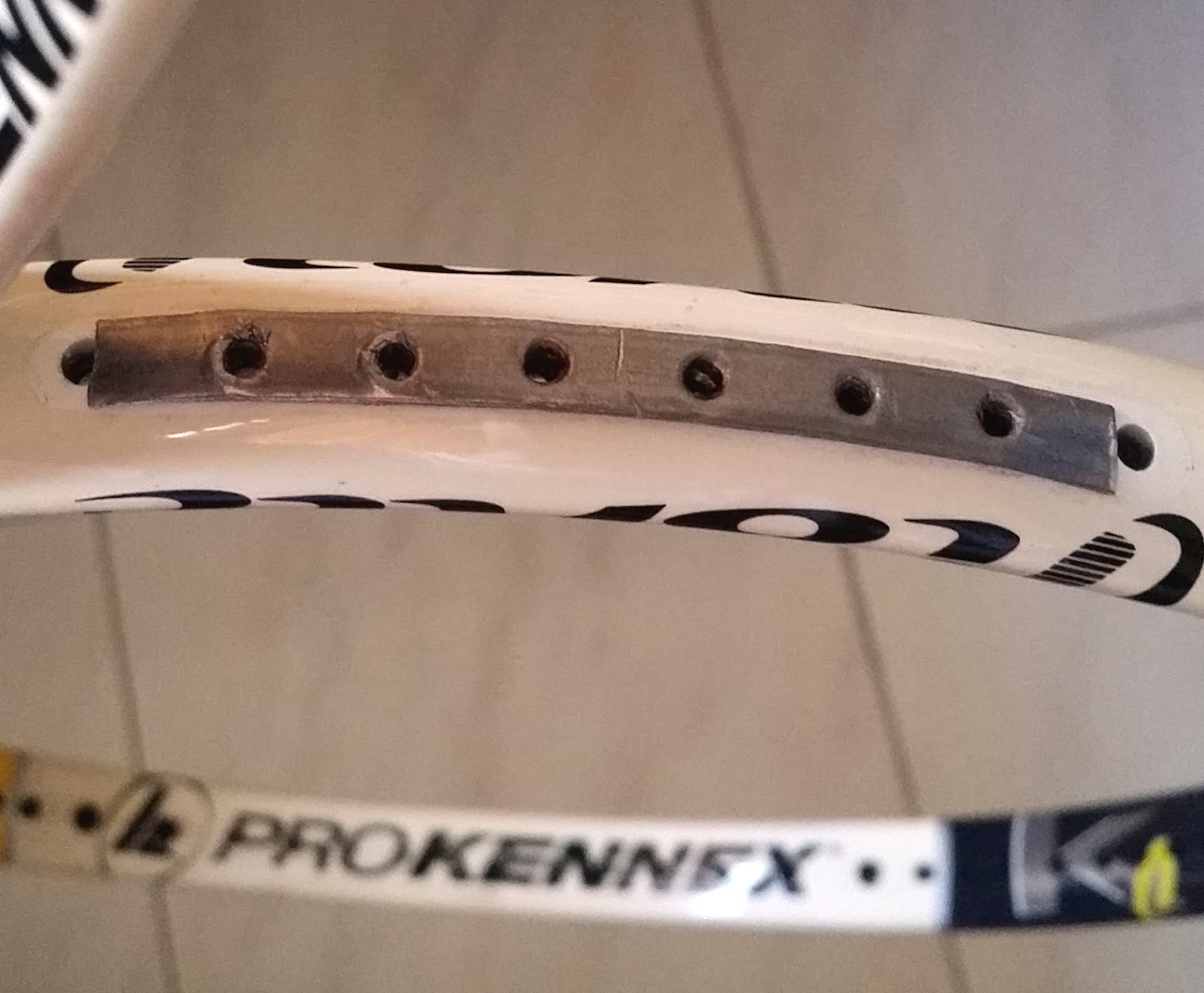
After decades of hearing from his old man on how well the old aluminium stick played, a young chap finally dusted off his dad's old racket and asked if I could restring it.
"With full poly", he asked.
I always have a thing for oldies, such as:
My 30+ Years Old Slazenger Woody
Another 30+ Years Old Racket By Head
Oldie: Yonex R-10
Yonex Couguss II
Exploding Woody - 1980s Slazenger Vilas
So I accepted after the usual disclaimers and upfront payment.
I'll let the pics do the talking...
I had a session with the chap. The racket was very flexible and comfy. Despite it's strung and gripped total weight of about 380 grams, it was not that difficult to whip this around.
Even serves were good! I managed an out-wide ace!
Strangely, with a head size of probably 60+ sq inches, coupled with a dense 18x18 string pattern, the string gaps were still large enough to generate more than enough spin to match today's spin effect sticks! I attribute that to the soft flex and heavy swingweight. (link)
The young chap did not fancy this racket, so he traded it with me for something else he liked.
Glad to add another nice find to my collection!
Through an introduction from someone I have worked with, I met a chap who claimed to be a ntrp 4.5-5.0 player and needed some help.
Everytime I hear about someone's self-rated ntrp rating, it was always inflated. So I took it with a pinch of salt.
We met for coffee.
He requested for anonymity so I cannot post too much details. I'll call him "RX".
In a nutshell, RX was a college player who dabbled in several futures tournaments. He trained and played through pain, and is now paying the price with recurring tennis elbow.
Surprisingly, he has never heard of ProKennex rackets. And the racket manufacturer's claim that it helps with tennis elbow!
If you missed the test report by the professor from Massachusetts Institute of Technology, it was quite impressive! (link)
The question RX kept asking was whether this comfort-oriented racket could perform for a high level player. Other than Andreas Seppi, he could not google anyone else using a ProKennex on tour.
RX was not the first, nor the only high-level player asking me that question. So I had expected it.
Ultimately, there was only one way to find out. RX gave me his racket specs and asked if I would be willing to modify one of my ProKennex to his exact specs. Then let him test. He offered to bear all materials cost plus labour.
I accepted.
What intrigued me was that his specs was similar to a current ATP top ten male player. I have always wondered how would such a stick wield. How could I turn away this chance to kill two birds with one stone? And I still get to keep my racket after!!!
If you are a hardcore follower of tour pro's racket specs, you will know there are only three variables that determine every other aspect of the racket.
RX allowed me to share only one digit from each of the three variables. See if you can make any sense out of it:
x6x
x5x
x2x
Here's some pics of the process...
Added three layers of lead tape under the bumper in above pic.
Added three layers of lead tape inside throat grommets.
Can still see the thick layers of lead tape after replacing the throat grommet.
This was the peek inside the butt before some silicone and lead was inserted. If you are attempting this, please remove the rusty staples first.
These were just a part of the changes made. There were others that I agreed to keep confidential.
When all was completed, I went to RX's apartment for a playtest with his hitting partner. I observed.
As RX was here on holiday and recuperating from his tennis elbow, he was a little rusty. His timing was off for some difficult shots. But during co-operative hitting, I was amazed at his consistency, depth, direction and spin. It looked so effortless!
It rained last night so I could see the ball marks where his shots landed. For that co-operative hitting, I could fit 90% of his shots within a 4 ft by 4 ft square! And they were not pushing, blocking nor dinking the ball!
Search youtube for tour pro practice videos. That's how it looked like. Very humbling for a hacker like me. With their kind of pace and spin, I would not have lasted more than 3-4 shots in their usual 15-20 shots rallies.
And the sound of their ball impacts were loud and crisp. The ball crushing came with loud distinct pops.
Then they played a match while I sat miserably staring at my phone.
Almost two hours and very little pain or discomfort. I could see RX was back to swinging the racket freely. He was no longer held back by pain, nor fear of pain.
When I had my chance later, the racket was quite maneuverable. Heavy but not completely unwieldy. Not as difficult to use as I had imagined it to be. I liked the plowthrough and stability!
Thanks RX, I enjoyed working with you and have learnt much too!
During my game, I noticed a group of teenagers playing a doubles match next court under the watchful eyes of their coach.
School team players I suppose. After my session, I sat outside to chill and see if I could learn a thing or two from them.
Between sips, I observed their footwork, movement, anticipation, strategy, serves, strokes, style of play, etc.
As the coach barked instructions, it appeared clear to me that all four players were struggling not because of technique, but due to "inferior" equipment.
Among them were two Babolats, one Wilson and one Head racket. From the impact sound, all were strung with poly strings. New tournament balls were used.
Those are all good rackets. By "inferior", I meant ill-fitting. It seemed like they were selecting based on marketing hype rather than proper fit. (link1)(link2)
Physically, all four of them were about 1.6+ metres tall, and probably only low-60s kg. All were tanned and skinny.
The table below summed up my observations, assuming their rackets were unmodified:
Other than Player "C", the rest were all late on contact for serves and return of serves. It was evident the swingweights of 335, 327 and 332 were too much for Players "A", "B" and "D" respectively. Second serves were all suicide serves.
Neither could they control their serve returns accurately. Other than "C", most of their serve returns were either mere blocks or mis-hits. "C" hit some beautiful down-the-lines and passed the net guy, and some lob returns as well.
Groundstrokes were the only part of the game they did well in. But ironically, players "B" and "C" who were using the spinnest rackets were hitting the flattest groundstrokes!
From my estimate, about two-thirds to three-quarters of "B" and "C" topspin shots were sitters which their opponents slammed down on. That could be why they hit flat to keep the bounce low.
For volleys, only "A" managed some consistency in imparting backspin and placing the shots into blank spaces. Even "C", who used the lowest swingweight, struggled. Could be pain in his elbow.
A soft spoken lady, I presume to be the mother of one of the boys, saw me shaking my head incessantly, and came over to ask why.
I asked which kid was hers and shared the same information I posted above. Being a long-time tennis player herself, she agreed. However, the kid was insistent not to lose his strongest part of the game - groundstrokes.
From the impact sounds, the bite, dwell time and the way the ball comes off the strings, I felt the poly strings were all past their prime or tensioned way too high. In my opinion, none needed poly strings.
If they would heed advice, this would be one group where a racket and string change would yield almost immediate improvements to their game. I have made it happen many times.
But well..... like the mother said, they are entitled to their own choices.
All who have played with me know I use ProKennex rackets.
Many made the "mistake" of trying them, and ended up getting hooked to the impeccable comfort. Even those with no arm injuries.
Before you place an order for ProKennex, note that all my rackets are heavily modified. And it's not just lead tape or silicone added. If you have missed them, here's some of the mods I've tried:
http://unorthodoxstringing.blogspot.sg/2015/02/custom-drilling-10x19-spin-pattern.html
http://unorthodoxstringing.blogspot.sg/2013/04/overhaul-wilson-hammer-58-syn-gut-3228.html
http://unorthodoxstringing.blogspot.sg/2013/06/overhaul-pro-kennex-black-ace-98.html
http://unorthodoxstringing.blogspot.sg/2014/07/extending-racket-by-inch.html
http://unorthodoxstringing.blogspot.sg/2014/01/tri-brid-stringing-vs-varied-tension.html
With the spin and power craze, marketing has been focusing on what consumers want, just to generate sales.
But has anyone considered what is the most important factor in a tennis racket? Is it spin? Or power? Or control?
For me, and a lot of people who thought otherwise, it is comfort.
Think of the folks who play the most amount of tennis - professionals. Do you notice most prefer a flex in the high-50s to mid-60s? And many have silicone to both add weight and dampening.
Once comfort is established, we can enhance other variables. If we want more spin, use full poly with proportional stringing (link). For power and spin, gut/poly. For control and spin and durability, kevlar/poly or kevlar/zyex.
Almost all aspects, like power, spin or control can be added. But if comfort is absent, then all the other variables become limited.
Think about it, how much spin or power do you want to add if every impact was already jarringly painful?
Please keep this in mind before your next racket purchase.
Play safe!
PS: Please do not take this as my endorsement for ProKennex rackets. There are many other comfortable playing sticks from other brands.