If I had to use only one word to condense the group wisdom I had benefited from working with competitive players (link), I think it would be "efficiency".
All the players I asked mentioned that tennis is not a 100 metres sprint. There are multiple rounds just to reach the finals. Often, the last two players would be taped up with muscle strains or injuries.
I have never seen in any tournament where the conditions of the last two players in the finals were as fresh as when they were in the first round.
This makes conservation of energy paramount. (Much like how critical pacing is in a marathon) Along with this, there would be less wear and tear and less injuries and strains too.
But I asked, what exactly is the key to this conservation? Most of the answers I received pointed to game tactics and style of play.
For tactics, it meant understanding opponents' preferences, strengths and weaknesses, and always playing to maximize their discomfort. Whatever that might be.
Making them do something unnatural, or outside of their preferences would meant increasing the opponents' effort needed in the match.
However, whatever we could do to them, could also be used against us. So I ruled out tactics. Unless one had superior abilities in execution of those tactics.
Only style of play remained. After rounds of debates on various styles of play, ultimately, all agreed that whichever player that was more energy efficient or productive than their opponents has the edge, assuming comparable skills/techniques/experience.
Again I probed, so how do we achieve this superior state of efficiency?
Two things were raised under style of play:
- Player style
- Equipment
Player Style
All beginners arm the racket. Few step into their shots and activate their legs to power their shots. Their reliance on ground reaction force is negligible.
As their game mature, they learn to loosen their grip, step in and swing through the ball. With earlier prep, they use more momentum and kinetic transfer. Less arming and less muscle.
This sounds simple. But to execute it well demands good anticipation, footwork and timing.
There is no player that can achieve 100% swinging all the time. It is always a combination of both swinging and arming. In our opinion, about 70% swinging would be as best as one could achieve, with 30% of the shots hit via "arming". Probably less in a closely-match competition.
Several coaches told me that they could almost always gauge any players' standard by how much the players arm the racket versus stepping in and swinging.
Likewise, they believed very few players who relies on "brute force" could go far or last long before injuries set in.
So the more footwork they relied on, the better the players, the longer they last.
Equipment
Unlike wood rackets, most modern rackets and strings have certain "inclinations". Some are baseliner sticks, some are spin setups while others may favour flat hitting more.
Not only that, the various combinations of string patterns, weight and balance, and lengths meant that modern equipment has a much wider latitude to cater to different players' anatomy, height, movement, timing and style of play. It is no longer a one-size-fit-all like woodies.
Conversely, this also means that ill-fitting rackets/strings could also be much worse off than before.
And if your opponents' equipment is more efficient and a much better fit for him than yours, then the odds would be against you even before the first serve.
All the competitive players whom I have worked with admitted overlooking the importance of fitting equipment. They were unaware so much physics was involved in a seemingly simple tennis racket and strings.
To all who believe that technique alone suffices, I can produce a racket that would totally breakdown your game. And those who keep blaming your tool, I am certain even if you had Federer's or Nadal's actual match rackets, you would not be able to serve nor spin it like them.
Both technique and equipment are equally important. They are not mutually exclusive.
To hone your techniques, get a honest coach. To tweak your equipment, find a trustworthy stringer who knows his stuff.
More importantly, make sure BOTH technique and equipment are efficient.
Tuesday, 27 February 2018

Wednesday, 6 September 2017
Apologies for my absence...
Sometime late last year, I visited a tennis string factory.
During the visit, a series of introductions acquainted me with some folks from the industry. That includes other manufacturers, suppliers, and also some professional players and their coaches.
What happened was, in his group chat for sponsored players, the factory manager touted I had some fancy stringing (proportional stringing) that could make the stringbed play vastly superior.
That brought some to drop by the factory very very quickly! At their repeated request, I ended up agreeing to string three rackets for three different players so they could try it themselves.
I was unprepared for this. I had to work the calculations off my tiny phone screen, struggle with an unfamiliar stringing machine, and weaved with stiff frozen fingers due to the cold and dry weather.
I was so relieved when the rackets were completed.
That relief turned into joy when I started seeing these players grin, followed by shock and amazement after they had hit some balls with those three rackets.
Over the last few months, I have met and worked with almost the entire squad. Coaches and some parents included.
That explains why I was unable to write. After I settle the remaining players, hopefully, I can post more about my experiences and learnings.
As usual, no names would be revealed as these are still actively competing players. And whatever I can share would first be subject to their approval.
During the visit, a series of introductions acquainted me with some folks from the industry. That includes other manufacturers, suppliers, and also some professional players and their coaches.
What happened was, in his group chat for sponsored players, the factory manager touted I had some fancy stringing (proportional stringing) that could make the stringbed play vastly superior.
That brought some to drop by the factory very very quickly! At their repeated request, I ended up agreeing to string three rackets for three different players so they could try it themselves.
I was unprepared for this. I had to work the calculations off my tiny phone screen, struggle with an unfamiliar stringing machine, and weaved with stiff frozen fingers due to the cold and dry weather.
I was so relieved when the rackets were completed.
That relief turned into joy when I started seeing these players grin, followed by shock and amazement after they had hit some balls with those three rackets.
Over the last few months, I have met and worked with almost the entire squad. Coaches and some parents included.
That explains why I was unable to write. After I settle the remaining players, hopefully, I can post more about my experiences and learnings.
As usual, no names would be revealed as these are still actively competing players. And whatever I can share would first be subject to their approval.
Wednesday, 26 April 2017
Oldie: Wilson Profile Tour 95

A player I was working with gave this oldie to me. It belonged to his dad who has long stopped using this racquet.
I changed the grips, restrung it and re-balanced it to my preference. Ended up almost 370 grams with swingweight about mid-350s.

Very rare for a stick from the 80s or 90s to have a trap door in the butt cap. Made adjustments very easy!

It played very well. The flex recovery was very fast. All my playing partners felt there was no flex at all. But it was there! All in the hoop, nothing at the throat at all.
Really a beast of a racket to play with. Enormous power, with surprisingly, fantastic built-in dampening.

Only problem was it was not really a 95 square inch. Probably much closer to 90. I aligned the Wilson Profile Tour with the ProStaff 90 and it was only marginally larger.
No wonder I struggled finding the sweetspot sometimes.
Nevertheless, an absolute delight to play with!
Monday, 3 April 2017
Some Random Modifications
Questions I'm most commonly asked regarding modifications:
Before modifications
- I am not a pro player, does it make a difference?
- Would the racket become too heavy and unwieldy for me?
- Would it really make any difference to my game?
After modifications
- The racket played so well now, why didn't you suggest this earlier?
- Can you replicate the same mod on my other sticks?
- Why didn't you tell me earlier it was not a stroke/technique issue but racket problem?
- What did you do to my racket to make it play so well?
Here's a few I did recently...
Player #1
- 30+ years old lady using Wilson K Factor K Surge
- needed greater racket stability to hit through shots
- silicone in the handle for dampening and balance
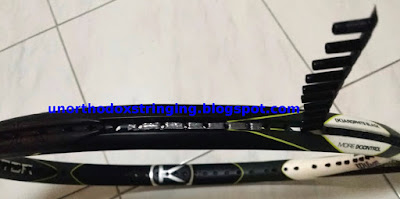

Player #2
- regular racket scraper
- worn top grommets and badly worn-off graphite at hoop
- new grommets replaced
- lead inserted to restore swingweight to former specs


Player #3
- competitive player with Blade 98
- wanted to beef up power and add dampening
- likes to use heavy spin hence polarized racket weights


Player #4
- recreational and occasional player using Head TiS6
- needed some extra mass for stability (added 50 grams!)
- added dampening to protect old tennis elbow & wrist pain


I like the fan-shaped string pattern in the Head TiS6. Natural "built-in" proportional stringing.

Applying lead tape and silicone is not difficult. The real work is in assessing the player accurately, then determining/calculating the correct specs, while ensuring the ratios are maintained for that players' tempo, strength and style of play.
Before modifications
- I am not a pro player, does it make a difference?
- Would the racket become too heavy and unwieldy for me?
- Would it really make any difference to my game?
After modifications
- The racket played so well now, why didn't you suggest this earlier?
- Can you replicate the same mod on my other sticks?
- Why didn't you tell me earlier it was not a stroke/technique issue but racket problem?
- What did you do to my racket to make it play so well?
Here's a few I did recently...
Player #1
- 30+ years old lady using Wilson K Factor K Surge
- needed greater racket stability to hit through shots
- silicone in the handle for dampening and balance


Player #2
- regular racket scraper
- worn top grommets and badly worn-off graphite at hoop
- new grommets replaced
- lead inserted to restore swingweight to former specs


Player #3
- competitive player with Blade 98
- wanted to beef up power and add dampening
- likes to use heavy spin hence polarized racket weights


Player #4
- recreational and occasional player using Head TiS6
- needed some extra mass for stability (added 50 grams!)
- added dampening to protect old tennis elbow & wrist pain


I like the fan-shaped string pattern in the Head TiS6. Natural "built-in" proportional stringing.

Applying lead tape and silicone is not difficult. The real work is in assessing the player accurately, then determining/calculating the correct specs, while ensuring the ratios are maintained for that players' tempo, strength and style of play.
Subscribe to:
Comments (Atom)