Saturday, 13 February 2016

Fishing Line...again...

Over coffee with a friend who reads this blog, he asked when would I be using fishing line again. 

He added lots of very persuasive talk. I knew, of course, that he just wanted to enjoy the incredible feel, bite and spin of fishing line again.

However, some things he said resonated. 

Like, would there have been any improvements in fishing line technology to make it more durable and less likely to snap? 

And, have I tried applying some of my newer stringing techniques to deal with the frequently snapping fishing line?

These questions started me thinking... 

...then my hands and feet just followed...


One major problem I had previously was knot slippage. The fishing line was SO THIN, tying knots became incredibly difficult. 

Pull too tight and it'll snap. Pull with my bare hands and it cut straight into my flesh. Double knots snapped the string too. And those knots that I succeeded, often slipped into the grommet hole and the string lost tension!


So I tried a double knot over the "Dead Man's Knot". It worked beautifully! No slippage. No need to pull too tight. No tension loss. No grommet damage. Perfect!

For prestretch, I used a friend's fishing line reel line winder which he built himself using an electric drill! Something like this. I told him what I was after, left the fishing line with him for a few days and "Voila" it's done! So simple!


I think this was my smoothest and most peaceful fishing line stringjob ever! Success in one attempt! If you do not understand the challenges, just read my past posts on fishing line. To me, this is a big deal!

And the other good news was the thin fishing line did not even notch after the initial 90 minutes!

Yes! It was blissful hitting with it. My partner that day commented not only on the extra spin but accurate placements as well. And I could pull him extra wide on those sidelines serves!

Hmmm... why did I forsake fishing line?!?!


Tuesday, 2 February 2016

Wet Tennis Balls

Someone I string for commented that he could not control the ball in slightly wet weather.

My reply was tennis was meant to be played in dry conditions.

Nevertheless, here's my thoughts on how wet balls affect the strings...


All of the above six balls weighed 59 grams when dry. 

The top three balls were soaked in water for ten minutes before weighing. The bottom three were rolled around on a wet floor.

The average weight of the top three and bottom three was about 73 grams and 68 grams, respectively, with a difference of about 5 grams.

Compared with dry balls, the top and bottom weighed an extra 14 grams and 9 grams respectively.

All these were static measures on a stationary ball. The difference is perceptible but insignificant.

However, once the ball starts moving at high speeds, the additional weight increases its momentum very significantly.

Momentum = Mass x Velocity

Without getting too much into detailed calculations, a simplified version looks like:

Dry Ball Momentum = 59 grams x 50 mph

versus

Wet Ball Momentum = 73 grams x 50 mph

And that's only for the average rally speed in tennis. For serves, the speed often increases to 100 mph, or more. Even for many recreational players.

When tensioning, I often take into account the players' footwork, tempo, racket head speed, string pattern, string gauge, choice of string, etc. And all these are based on DRY conditions.

Can you imagine what would happen, after all the weight measurements were taken, and the appropriate bungee cord attached for that single person, then three jumpers just decided to strap together to jump?

Of course there are other factors, like the wet felt on the ball reducing ball-to-string friction, the wet court affecting bounce, and the fluffed up fur changing trajectory. 

But to me, the huge increase in momentum delivers the biggest impact to the stringbed. Which was why I liked using damp balls to train myself before playing with a heavy hitter last time.

In addition, after the extra stress from playing with wet balls, the stringbed would usually lose too much tension thereafter.


Thursday, 21 January 2016

Divorced Mains and Crosses

Despite suffering a serious bout of tennis elbow from dead poly, M still could not give up the spin. So he wanted gut/poly to see if the comfort would increase.

To isolate variables, we tried different setups on similar matched racket. Among them, there were two gut/poly hybrids that caught my attention.

Strangely, one played dead from the start while the other played perfectly.

The dead one felt too tight, like it was over-tensioned. We could not load the strings. There was no pocketing, no dwell time. The ball just "touched and flew off". 

M felt he did not have enough time to spin nor shape the shot. This was done only in the the low 50s lbs. I figured it may need some time to break-in.

The good one performed perfectly from the first hit. As expected from gut/poly, it was comfortable, powerful, fast, spinny and had great control. However, it did not last long. Maybe 2 sessions?

Since gut was not cheap, M continued playing with both.

After several sessions with others, we met up and played again. When hitting with both setups, the pocketing had grown so deep it felt like a fishing net!

But yet, after it reached it's maximum stretch, we could feel the strings deflecting the ball back out. The dwell time was long and extended. Both were still playable but rebound angle was high.

Then it dawned on us, that it could be because one string of the hybrid had completely lost tension. Most likely the poly. The other string was actually doing most of the work during ball impact!

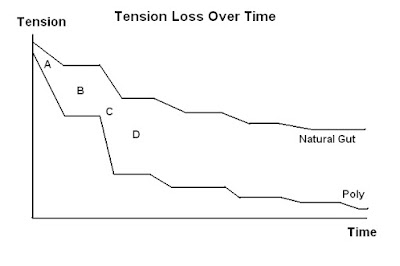
Probably something like this chart below?


At point "A", both strings start to lose tension right off the stringing machine. Poly's loss is higher than natural gut.

"B", "D" and the other horizontal lines indicate rest periods where the racket was left unused in a room.

The second big tension drop occurs during "C", which was the first session of play after stringing.

Regardless who strings the rackets, both "A" and "C" would always register the biggest tension loss. Subsequent drops would be slow and gradual.

So, it seems that the poly in M's setup could not hold tension. And the tension gap between the gut and poly had grown too huge. So huge, that their actions during ball impact became divorced, with one string doing almost all the work and the other idling.

And how did I know this feeling? 

I once strung up only the mains on an old test racket and hit some balls with it...


Wednesday, 13 January 2016

What I have been up to...

What started as a hobby has now gathered so much momentum, that I spend more time working with serious players than on my own sticks.

That is the reason for the silence the past month or so.

Correspondingly, the lack of time to explore/experiment, coupled with the confidentiality requests from those I worked with, meant a double whammy to what I now can post in the blog.

I am evaluating options. But with my work and other obligations, I still have no wish to move into full time stringing or customization yet.

For now, this blog will remain. Updates would be less frequent. Thanks to those who asked - I am well.