Thursday, 2 July 2015

Pay Attention to Your String Notching Areas

A little after this post (link), several asked if I could help them spot their ball impact areas and then to optimize their racket sweetspots.

If you cannot find anyone, nor capture the impact on video, one very simple way is to study your string notches. The deeper the notch, the more regular the impact. 
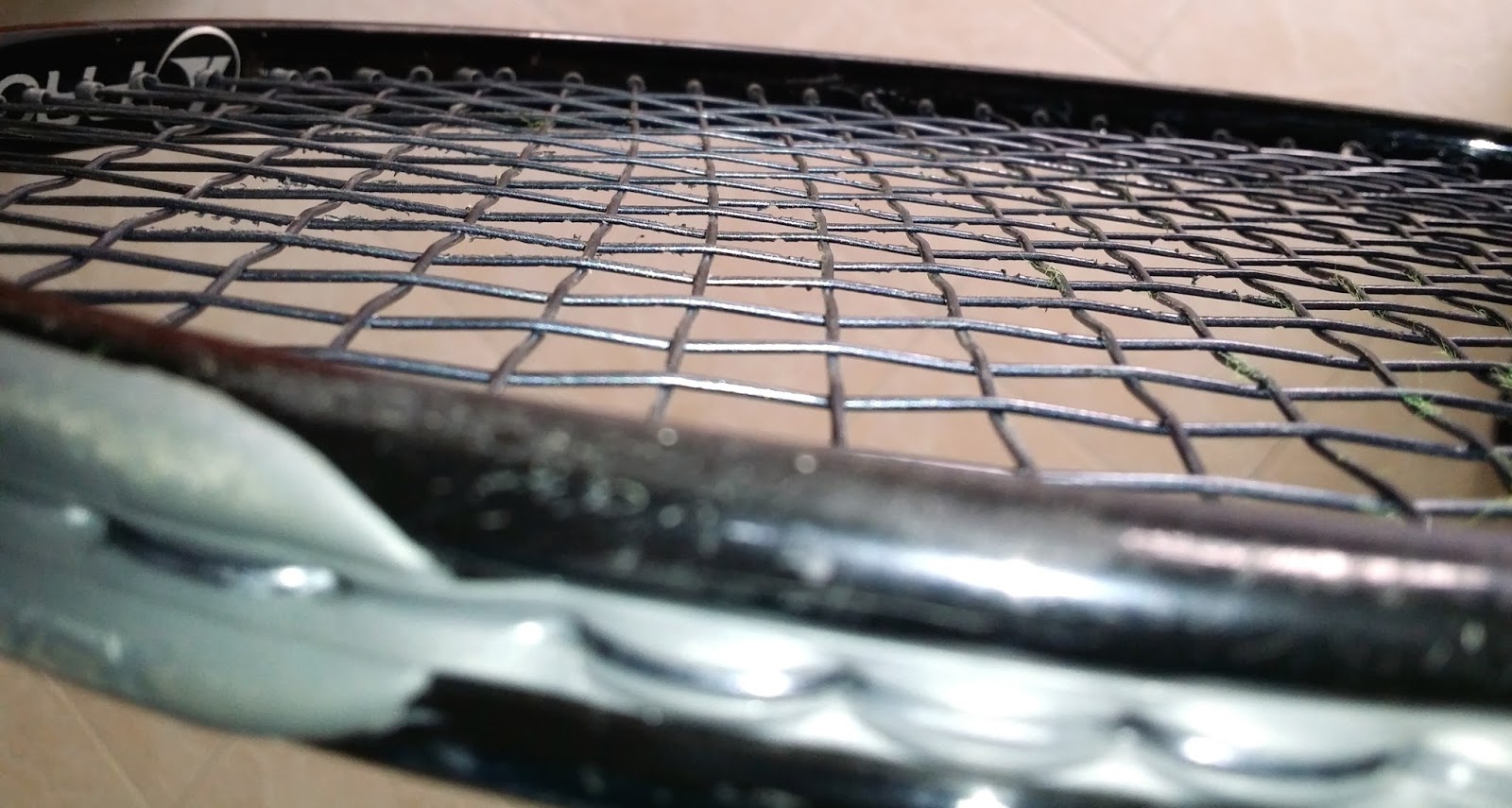


The above picture was shot from the side of the racket, somewhere around 10 o'clock.

The strings have been played with for about 8 hours. All the cross strings were pulled apart to reveal the notches. Regardless of string type, the deepest notches always occur in the main strings between the 7th, 8th and 9th cross for me.

So I know, for this racket with 20 cross strings, my natural bias is to hit the ball a little higher than the middle. This would be one basis for my stringing adjustment later on.

Another way would be to apply some stencil ink all over both sides of the stringbed. Note the ink would stain your tennis balls.

If you could hold the racket the same side up, such that your forehand and backhand are always hitting on different sides of the string bed, you could even study your impact patterns for both wings!


Friday, 26 June 2015

Kevlar / Natural Gut Hybrid

Some deem this wasteful. To them, it makes no sense to pair the deadest string with the liveliest (and most expensive) one.

The most famous user of this setup was Andre Agassi in the 1990s.


This has been on my to-do list for very long, so I strung one up to experience first hand what's so special about it...(secretly hoping that I could return serves like Agassi!)


Compared to kevlar/syn gut, natural gut added a lot more comfort, power and spin.

No break-in was needed. It was comfortable from the first hit. The most impressionable item was the extra amounts of dampening.

With syn gut crosses, kevlar felt a little harsh with a soft "pingy" vibration at impact even with a dampener. Natural gut crosses almost eliminated this ping. Sweetspot hits felt as comfortable as a full syn gut stringjob. But much more powerful.

What I did not expect from natural gut crosses was more spin. Compared to syn gut, natural gut was dry and "gummy". However, the kevlar glided smoothly, adding easy spin to serves and rallies without sacrificing power nor control. That is a huge plus.

The two major disadvantages were rapid fraying and that I could not use it in wet weather.


First pic below was after 3 sessions of about 2 hours each. Visible fraying commenced.


Pic below was after 7 sessions. Spin seemed to decrease gradually with each session but comfort and power was consistent.


Given the marginal improvement over syn gut crosses, I am unlikely to try this combination again. However, I am glad to have this item completed from my to-do checklist!


Monday, 15 June 2015

Natural Ball Impact Location

Perhaps influenced by watching professionals change their rackets at every ball change, many became fastidious about their string tensions too.

When probed, I was surprised by the theories they presented, and how some of these myths were believed to affect string tension and their play.

However, when asked about their natural ball impact location on the stringbed, everyone threw a blank face at me!

Davydenko was known to reduce the top 4 or 5 crosses by a few pounds of tension. (link) However, it was not mentioned why he preferred it that way.

According to the Babolat Play statistics, even Nadal (link1)(link2) posted only about 55% dead centre hits for forehands, and about 45% for backhands during competitive play.

Knowing is the first step. The next is to communicate with your stringer (or coach) to find out what he can do for you. The "sweetspot" location can be adjusted slightly to suit your style of play.

The most common impact location I noticed seems to be the top one-third of the stringbed.

Take a video or get a non-playing partner to stand directly behind and record the impact locations. This has huge implications on the types of shots you can or cannot execute, the placements locations, spin and power.

In my opinion, this takes precedence over string tension. 


Tuesday, 2 June 2015

Racket-holics Anonymous

"We admitted we were powerless over alcohol new tennis rackets - that our lives had become unmanageable." 
(adapted from "The Twelve Steps of Alcoholics Anonymous")

Not only am I a struggling racket-holic, my addictions include:

- strings-holic,
- tension-holic,
- hybrid-holic.

With greater affluence, many are actively trying new frames and strings. To some, this gives as much pleasure as playing the game itself. 


What puzzled me was the furious pace at which these players change equipment and setups. On local online forums, it is commonplace to see ads like:


"Latest model racket for sale, used for only one session, condition 9.9/10 totally unscratched, plastic wrapper still on handle, selling cos unsuitable for my play"


Despite seriously meddling with my "new" ProKennex Black Ace 98 for almost two years, I am still discovering new things about the racket!


Here's just a portion of what has been attempted in the Black Ace 98 from June 2013 to June 2014. My racket discovery process, so to speak:


Low Tension with Syn Gut @ 35/34 Boxed


Black Ace 98 Overhauled


Low Tension with Syn Gut @ 28 lbs


Skipping Crosses for 16x10


Grass Trimmer Line


0.90mm Fishing Line/Syn Gut Hybrid

Fishing Line/Poly Hybrid

Fishing Line/Poly/Multifilament Tri-brid

1.0mm Fishing Line/Syn Gut Hybrid

Another Fishing Line/Poly Hybrid

Monitoring Racket Distortion Levels After Stringing

0.6mm Dyneema Fishing Line/Syn Gut Hybrid


Kevlar/Syn Gut Hybrid

Re-stringing Mains Only

A few whom I help to re-string has sent in different acquisitions each time. Offhand, some would have changed rackets about seven to eight times in less than a year.

How did these chaps come to their realizations so fast?

Whenever I handle a new stick, the first thing I look out for are the weights - swing weight, total weight and weight distribution.


These weights determine our timings, power, spin and control. They carry huge implications on every aspect of our games, primarily, serve, return of serve, ground strokes and net play. And each aspect takes a lot of time to be tested thoroughly.


Some frames are better for serve and volley, while others excel in spin. Some frames are extremely string or tension sensitive, while others perform the same strung with syn gut or poly.


After the preferred frame has been selected, the next major component would be strings and tension. Perhaps a little lead tape somewhere too.

Ultimately, all these testings mean money need to be spent. Purchasing the racket merely started the process. 


If you are not prepared - physically, financially, mentally and emotionally, to go through the adjustment period, changing only one variable each time, and getting an astute partner to spot the differences in your play, then it's just a senseless waste of time and money.

And the cycle keeps repeating...

Personally, whenever I test a new racket, I always start with a familiar strings setup at middle of the recommended tension. Over the next few sessions, I would explore as wide a variety of strokes as possible. 


Only after I've dialed in about 70-80% of the weight and power adjustments, would I then start playing with strings. It takes at least a few weeks to decide whether it's a keeper, or to revert back to old faithful, or to search for another.

Before you spend your hard-earned money to purchase a new stick, budget a little more for lead tape, court bookings and balls to test it out. Plus a few stringjobs.