Sunday, 16 March 2014

Wilson Pro Staff 95s with Syn Gut + Spin Challenge

Online forums reported on how quickly strings break in the PS95s. While the very open 16x15 stringing pattern is excellent for spin, it is terrible for string durability.

As a result, everyone strings with either full poly, kevlar or 15g syn gut. Even then, most enjoyed only a few hours of play before it snapped.

After trying Z's PS95s (link), I was exceedingly curious: 
(1) how long would 17g syn gut last in that racket, and
(2) between racket, type of strings and stringing method, which factor would influence the amount of spin more?

Since Z also felt that his PS95s was due for a restring, he gave me a free hand on how it was to be done. 

I chose full syn gut modified proportional stringing with base tension of 50lbs. A lot of the strings would end much MUCH LOWER than the recommended range of 54-64 lbs!


Then we took it out for a playtest cum spin challenge with some of my previously strung spin setups.


Rackets in above pic, from top to bottom:
Wilson Hammer 5.8 + syn gut varied tension (link)
Wilson ProStaff 95s + syn gut proportional stringing
Head Prestige Mid + full poly
Dunlop AG200 + fullbed fishing line (0.9mm mains)(link)
Yamaha EOS + 17g syn gut (link)

Our ranking was unanimous. From best spin to worst, it was:
1. Dunlop AG200
2. Yamaha EOS
3. Wilson PS95s
4. Wilson Hammer 5.8
5. Head Prestige Mid

What we gathered there was:

Stringing Pattern
Even dense string patterns (18x20) can generate heaps of spin. Although the Dunlop was strung as 16x19, the gaps between the strings remain small and tight. The fishing line bites extremely well compared to the full poly in the Head Prestige, which ranked last.

String Wear
The Yamaha ranked 2nd while Hammer was 4th. Reason being different hours of use - Yamaha had about 6 hours versus 10 hours (or more) for the Hammer.

Stringing Method & Swingweight
The Yamaha, PS95s & Hammer were all strung with a modified form of proportional stringing that varies tension among the strings. The same 17g syn gut was used for all. 

Despite that, spin in the Yamaha trumps PS95s. Why?


I believe it's the low total and low swingweight of the PS95s. Both the Yamaha and Hammer have modified swingweights of about 330-340 kg/cmwhereas the PS95s was only about 300 kg/cm2. That is a huge difference!

String Type and Tension
It is indisputable that poly is excellent for spin. But with so many different types of polys & co-polys, many stringers get confused about what tension to use. 

All polys have a very narrow useful plastic range before it fails. Once exceeded, poly plays totally dead (link). The 18x20 Head Prestige was strung at 60lbs.

Here's some pics of the stringbed after play... look at the amount of ball fur...


So what next?

I believe there is a lot of modification potential in the PS95s. Forums are rife with comments to add weight under the buttcap. That's one avenue to explore.

Another would be to add swingweight. (link) I cannot help but wonder, did the PS95s designers intentionally kept swingweight low to prevent the strings from snapping too fast, like in the Steam 99s? 

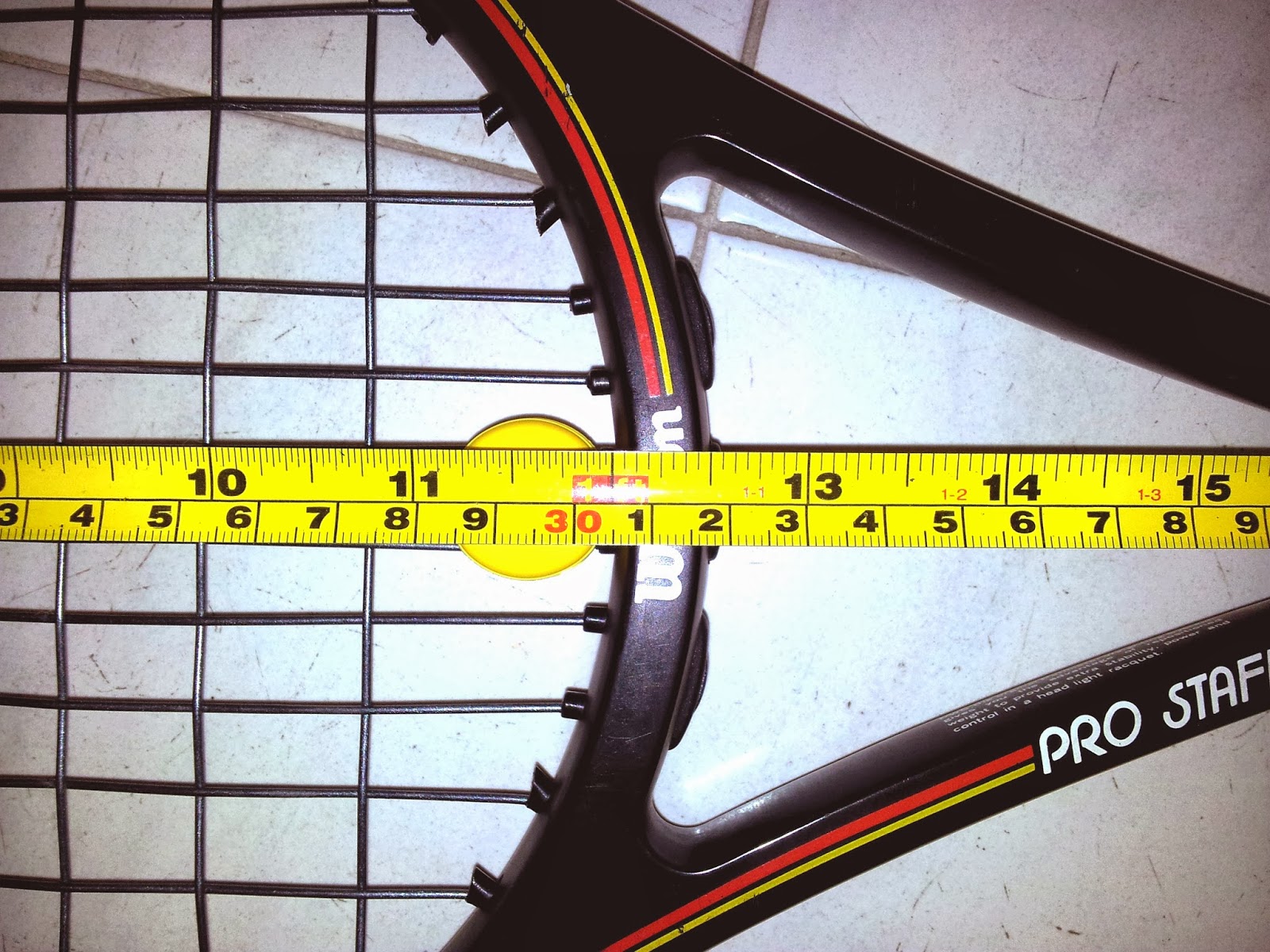
According to their spec sheets, both PS95s and 99s have 16x15 string patterns. Other specs like total weight and flex are very close. However, swingweight differs by 28 kg/cm2.

It is Z's racket after all, he'll call the shots how he wants it to be done after this syn gut wears or snaps. Or maybe, he'll just stick with the 18x20...


Friday, 14 March 2014

Spin Challenge: 16x18 Syn Gut vs 16x15 Full Poly

Haze or not, I guess the amount of PM2.5 in the air is not enough to deter me from tennis.

I met an interesting chap named Z. He claimed to be an NTRP 1.0 but runs me all over the court, front to back, left to right. He places the ball very well.

Claiming that he only started playing tennis from Nov 2013, his backhand slice is almost unreturnable! It skids extremely LOW, hard and fast after hitting the ground. How do I return these shots that are only 3 or 4 inches off the ground? He makes Steffi Graf's backhand look like child's play!

Then, I realised what his racket was! He was using the 16x15 Wilson Pro Staff 95s!!! (link) I think... See for yourself...


He did not like the colour, so he sanded off the paintjob. Initially, I thought it looked familiar, but dismissed it as another old racket looking at the amount of paint "wear" it had. I was fooled!

After the "Aha!" moment, everything started falling in place. His footwork gave him away as a beginner. However, his forehand topspin and backhand slice were pretty good, especially the backhand.

For someone who has played tennis for only 4 months, he could generate some serious spin. I'm reminded of another playing partner, M, whose topspin shots mostly kicks up to my head level.

So I changed my strokes. I hit flat or slice off both wings and kept the ball deep and very low. Now, it's my turn to run him around.

I was extremely curious just how much spin this 16x15 could perform. So I asked if we could swap rackets for a while. He kindly agreed.

Here's my observations:
- The full poly stringjob was old. It felt a little flat.
- He did not use any dampeners, so vibrations are present.
- The Amplifeel took away a lot of ball feel. It was muted.
- Since it was full poly, control was very good. It felt a little like syn gut in the 60s. There was no hints at all that this had only 15 cross strings.
- The flex felt just right, neither too stiff nor too flexy. It was a nice compromise that offered comfort and yet maintaining the level of accuracy I expected.
- Relaxed hits had ordinary spin. But when I stepped it up, the spin increased! It was a matter of watching the ball kick up to his hips level versus ear level, both with the same level of net clearance. And yes, my backhand slices could probably be on par with Steffi Graf's too!
- As a comparison, I repeated the same test after swapping back to my 16x18 Yamaha strung with syn gut at varied tension. (similar to the Hammer5.8 link)
- The Yamaha fared better for spin. Much better. Even with about 7-8 hours of use on the syn gut, the spin latitude is much wider. I could whip and the spin increases. But with the poly strung 95s, the range of spin is less. In other words, with relaxed hits, the Yamaha had more spin. When I hit hard, it was also the Yamaha that outshone the 95s.
- One significant difference I felt was the very low swingweight of the 95s. The specs stated 305 with balance at 32.08cm. It did feel very light and maneuverable, very fast. 
- However, the plowthrough and the feel of compressing the ball was absent. The poly did not give much pocketing as well, compared to the syn gut. Ball directional changes also needed more effort or accuracy would suffer.
- If I owned this racket, I would beef up the swingweight and stick with syn gut. I wonder how it will play with syn gut strung with varied tension?

Note:
As a recreational player, I hit with many different partners. I rarely meet players that generate more spin than me, but there are. So it is very different when I am on the receiving end of this amounts of spin instead of from the hitting perspective. That's why I had problems determining whether the 95s was indeed a spinny racket initially.


Tuesday, 11 March 2014

The Haze is Back...

Tennis will have to take a back seat till this clears up...

(AFP photo from sg.news.yahoo.com)


Sunday, 2 March 2014

Just ½" Wider & ¾" Longer...

That's the difference (inside hoop measurements) between my 95 sq inch ProStaff Classic versus the ProStaff 85.


Whenever I bring the PS85 out for some fun hits, friends and acquaintances would advise me to switch up to a larger sized frame.

"Keep the PS85... it's a collectors item... you cannot play with that..." they'll say. All well intentioned, of course.


But after they have had a few hits with it themselves, most started nodding their heads at how well it played compared to their regular sticks.


Instead of opting for a larger frame size, I believe appropriate stringing can optimize the sweetspot size much better. Improper tensioning not only reduces the sweetspot size, it also warps the frame.


Small headsizes also have the added advantage of a naturally higher sweetspot which many preferred. To some, that ½-¾" higher sweetspot means about 15g of weight need not be added at 12 o'clock. That is significant.


Other than the PS85, occasionally, I still hit around with my 65 sq in woody (link1)(link2). It's excellent for training how to find the sweetspot consistently.


For a while, I've been thinking about "God's racket" (link). That will probably be the only stick whose sweetspot cannot be optimized however it's strung.